India's Political Storm: Delimitation, Women's Reservation and Opposition Fireworks


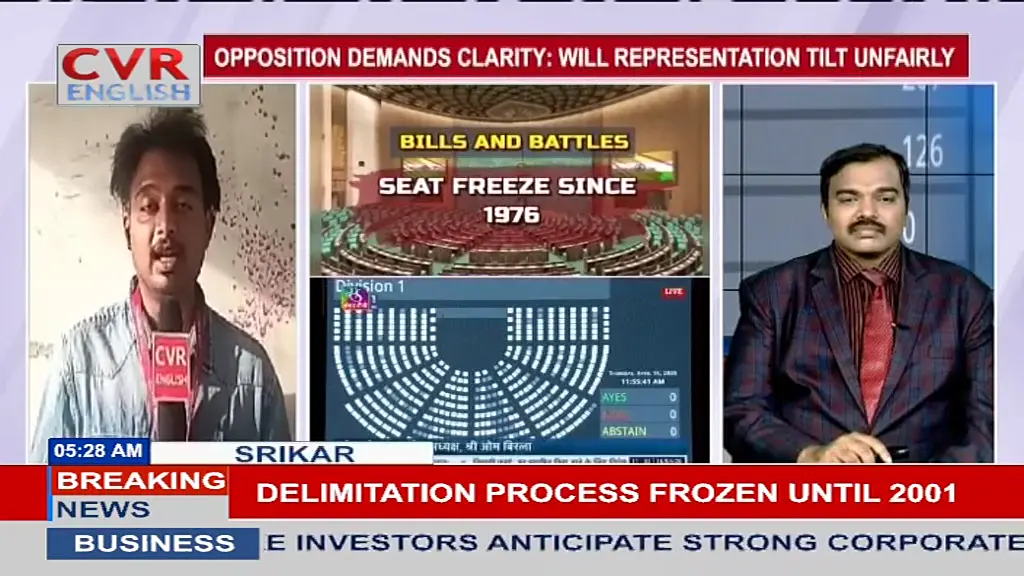
India's Parliament erupts as the government pushes through contentious bills linking delimitation to women's reservation, sparking nationwide protests, constitutional challenges and fierce political battles. The Lok Sabha has become a warzone of competing narratives, with Prime Minister Narendra Modi defending the reforms as democratic empowerment while opposition leaders decry them as political manipulation. Meanwhile, international tensions escalate as the US intensifies sanctions on Iran, threatening to redraw the geopolitical map. In business, India's economic partnerships with Austria and Australia take center stage, promising new trade corridors and investment flows. This comprehensive roundup dissects the day's most explosive political developments, market reactions and international flashpoints, with exclusive panel discussions and field reports from across India and beyond.
cvr-english's Best Political Coverage: Delimitation and Women's Reservation Bills Spark Constitutional Crisis
Parliament descends into chaos as the government's twin bills on delimitation and women's reservation dominate proceedings. The delimitation bill, which proposes redrawing parliamentary constituencies based on the 2011 census, has become a lightning rod for opposition fury. Critics argue it disproportionately affects southern states like Tamil Nadu and Telangana, where population control measures have kept growth rates artificially low. The women's reservation bill, promising 33% quota for women in legislatures, faces similar scrutiny over its implementation and intersectionality concerns.
Prime Minister Modi's high-stakes gamble has backfired spectacularly. His government's attempt to link delimitation with women's empowerment has triggered accusations of political opportunism. In a fiery Lok Sabha debate, Congress MP K.C. Gopal accused Modi of "dramatizing" the women's reservation bill, calling it a "political tool" rather than addressing genuine representation concerns. The opposition's strategy appears to be working: BJP MP Bansuri Swaraj was forced to defend the bills as "constitutional mechanisms" rather than political conspiracies.
Southern states in revolt as the delimitation controversy exposes deep regional divides. Telangana's Chief Minister Rayon has emerged as the opposition's standard-bearer, arguing that linking delimitation to Gross State Domestic Product (GSDP) violates the "one vote, one value" principle. The debate has reignited long-standing tensions between northern and southern states over political representation and economic disparities. In West Bengal, Mamata Banerjee has seized the moment to criticize BJP's "interference" in state affairs, setting the stage for a high-stakes electoral showdown.
Constitutional experts weigh in on the bills' validity. The opposition's legal team argues that the delimitation process, if based on outdated census data, could violate constitutional principles of fair representation. Constitutional law expert Fali Nariman has warned that the bills could face judicial scrutiny if they're perceived as politically motivated. Meanwhile, the government insists the reforms are necessary for "democratic empowerment" and "electoral fairness."
Women's representation under fire as the debate exposes deep flaws in the women's reservation bill. Panel discussions reveal that marginalized women—Dalits, SC/ST communities, and obese women—face systemic barriers to political participation. The bill's failure to address intersectionality has drawn sharp criticism from women's rights activists. "The bill is a step forward, but it's not enough," said Priyanka Gandhi-Wadkar. "We need 33% quota for backward class women and Muslims, not just a token gesture."
Political dynasties in the crosshairs as the controversy threatens to upend traditional power structures. The debate has exposed how women representatives often serve as proxies for male family members, with husbands and sons attending meetings on their behalf. "This is not empowerment," said Akhilesh Yadav. "This is perpetuating patriarchy under a different guise." The Congress leader's remarks have resonated with grassroots women activists, who argue that true empowerment requires systemic change, not just legislative quotas.
Press Monitor Clips: "Delimitation Bill and Women's Reservation Debate" (442s); "Critique of Women Reservation Bill Implementation" (189s); "Congress vs BJP on Women's Reservation and Delimitation" (142s)
cvr-english's Best Business Coverage: India's Global Economic Partnerships Take Center Stage
India's economic diplomacy is reaching new heights as the country strengthens ties with Austria and Australia. The India-Austria business forum has yielded promising results, with both sides committing to expanded trade and investment. Austrian Chancellor Kristine Stoker and India's MEA Secretary Gus CB George announced new initiatives in green energy, quantum research and cultural exchanges. "This partnership is about more than trade," said George. "It's about building a sustainable future together."
Trade corridors opening up as India positions itself as a global manufacturing hub. The India-Australia economic partnership, announced during a high-level business forum in Mumbai, promises to boost bilateral trade to $50 billion by 2030. Key sectors include pharmaceuticals, IT services and renewable energy. Australian companies are particularly interested in India's burgeoning electric vehicle market, while Indian firms see opportunities in Australia's critical minerals sector.
Investment flows accelerating as foreign direct investment into India hits record highs. The business forums have catalyzed deals worth billions, with Austrian and Australian companies committing to major investments in India's infrastructure, technology and manufacturing sectors. "India is no longer just an outsourcing destination," said Kristine Stoker. "It's a strategic partner in the global supply chain."
Green energy transition gains momentum as both countries commit to ambitious climate targets. The partnerships include joint ventures in solar power, wind energy and battery storage, positioning India as a leader in the global clean energy transition. Austrian companies are bringing cutting-edge technology in green hydrogen, while Australian firms are investing in India's offshore wind projects.
Press Monitor Clips: "India-Austria Business Forum Introduction" (26s); "India-Australia Economic Partnership" (37s); "Detailed Economic Partnership" (70s)
cvr-english's Best Sports Coverage: No Major Developments
No significant sports news was selected for today's roundup. The curated briefing package contained no sports-related stories meeting the selection criteria.
cvr-english's Best in Other Coverage: Geopolitical Tensions and Societal Shifts
US-Iran tensions escalate as the Trump administration intensifies sanctions against Iran's nuclear program. The US has frozen assets of Iranian leadership and imposed secondary sanctions on Iranian oil, threatening to derail ongoing diplomatic efforts. "This is not just about Iran," said a senior US official. "It's about regional stability and global energy security." The escalation comes as Iran's proxies in Lebanon and Yemen increase their activities, raising fears of a wider conflict.
Blockade crisis deepens in the Persian Gulf as the US Navy enforces a blockade on Iranian ships. General Dan Cain, US Joint Chiefs Chairman, warned that any vessel attempting to breach the blockade would face "escalated military measures." The crisis has drawn international condemnation, with Russia and China calling for restraint. "This is a dangerous escalation," said a UN spokesperson. "We urge all parties to exercise maximum restraint."
Societal mindset shifts take center stage as India grapples with deep-rooted gender inequalities. Panel discussions reveal that despite legislative progress, women continue to face systemic barriers in education, employment and political participation. "The challenge is not just about laws," said a women's rights activist. "It's about changing mindsets." The debate has sparked a national conversation about the role of women in Indian society, with calls for systemic change rather than token gestures.
Constitutional principles under scrutiny as the delimitation controversy exposes flaws in India's electoral system. Experts argue that linking delimitation to GSDP violates the "one vote, one value" principle, creating unequal voting power across states. "This is not just about politics," said a constitutional law expert. "It's about the very foundations of our democracy." The debate has reignited long-standing tensions between northern and southern states over political representation and economic disparities.
Press Monitor Clips: "Challenges in Changing Societal Mindsets" (131s); "Karnataka Lok Sabha seat redistribution analysis" (29s); "Akhilesh Yadav's remarks on women's reservation bill" (30s)