ndtv24x7 Power Monitor: Global Flashpoints, India’s Elections, and Market Shocks Dominate April 7 Coverage


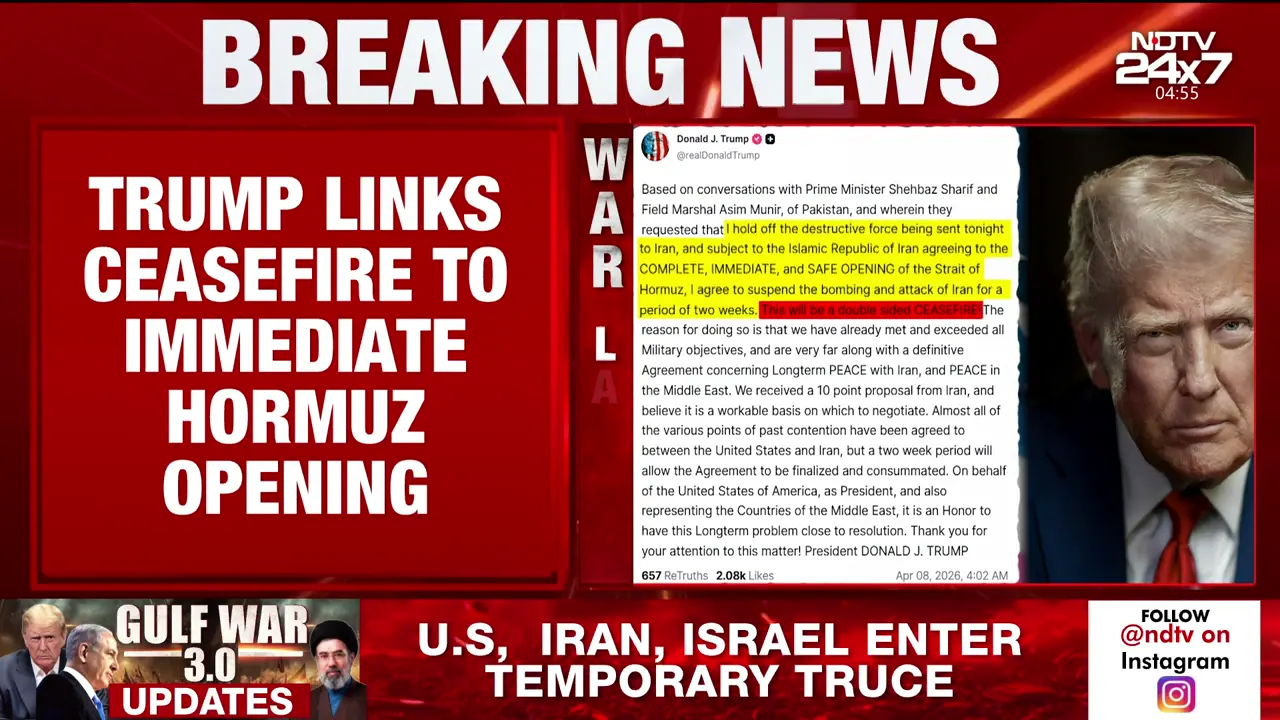
The world woke up to a geopolitical powder keg on April 7 as President Donald Trump’s administration and Iran stood on the brink of a military confrontation with global oil markets in the crosshairs. In India, the political temperature soared with elections in Tamil Nadu and a high-stakes scandal embroiling Assam’s Chief Minister. Markets, meanwhile, faced turbulence from corporate upheavals at Air India and geopolitical tremors in the Gulf.
The Iran-U.S. Showdown: A Two-Week Ceasefire and the Clock Ticking
President Donald Trump’s announcement of a two-week ceasefire with Iran, brokered by Pakistan, marked a dramatic de-escalation in one of the most dangerous standoffs of 2026. The ceasefire, announced just hours before a self-imposed U.S. deadline, was hailed as a temporary reprieve but came with strings attached. Iran’s Foreign Minister Abbas Arachi outlined a 10-point proposal that included the reopening of the Strait of Hormuz—a critical chokepoint for global oil supplies—and the lifting of U.S. sanctions. The proposal, described as a ‘double-sided’ approach, was met with cautious optimism in Gulf capitals, where nations like Saudi Arabia and the UAE have been caught in the crossfire of escalating tensions.
Trump’s rhetoric had earlier escalated to apocalyptic levels, with warnings that ‘the whole civilization will die’ if Iran crossed certain red lines. The U.S. President’s threats to target oil hubs in the Gulf, including Saudi Arabia’s Al-Jubail facility, sent shockwaves through energy markets. The fire at Al-Jubail, attributed to Iranian drone and missile attacks, underscored the fragility of global energy security. Analysts warned that even a limited conflict could trigger a supply shock, pushing oil prices beyond $120 per barrel and destabilizing economies already grappling with inflation.
The ceasefire’s terms remain fragile. Iran’s Supreme Leader Ayatollah Mujtaba Khomeini framed the proposal as a test of U.S. sincerity, while Israeli Prime Minister Benjamin Netanyahu reiterated Israel’s stance that Iran’s nuclear ambitions posed an ‘existential threat.’ The involvement of Gulf nations, including Saudi Arabia and the UAE, in brokering the deal highlighted their precarious position—balancing alliances with the U.S. while avoiding direct confrontation with Iran. The NDTV team’s live coverage, anchored by Nick Harper, captured the tension as negotiators scrambled to finalize the agreement before the deadline. [CLIP: U.S.-Iran Ceasefire Announcement and Negotiations - 2:08]
India’s Political Battleground: Tamil Nadu, Assam, and the Dravidian Script
India’s electoral landscape dominated domestic coverage, with Tamil Nadu emerging as the epicenter of a political earthquake. The state’s elections, described as ‘unprecedented’ in scale, saw parties leveraging the Dravidian script—a cultural and linguistic symbol—to mobilize voters. The NDTV panel dissected the strategies of the Dravida Munnetra Kazhagam (DMK) and the All India Anna Dravida Munnetra Kazhagam (AIADMK), with analysts noting how regional identity politics could reshape national alliances. [CLIP: Tamil Nadu Election Analysis - 8:56]
Meanwhile, Assam’s Chief Minister Himanta Biswas Sarma found himself at the center of a storm following allegations that his wife, Rinki Boyan, held multiple passports under different names. The scandal, which erupted just days before polling in the state, raised questions about the integrity of India’s electoral process. Biswas Sarma, a key ally of Prime Minister Narendra Modi, denied any wrongdoing, but the controversy threatened to overshadow the Bharatiya Janata Party’s (BJP) campaign in the region. NDTV’s investigative team dug into the passport records, revealing discrepancies that fueled public outrage. [CLIP: Assam Chief Minister controversy - 1:13]
Prime Minister Narendra Modi’s diplomatic engagements also drew attention. In a rare interview, Modi reaffirmed India’s ‘enormous friendship’ with Israel, emphasizing the two nations’ shared commitment to ‘truth’ in a world marred by disinformation. The interview, conducted against the backdrop of rising anti-Semitism and geopolitical realignments, positioned India as a stabilizing force in West Asia. Modi’s remarks came as Israel faced mounting pressure over its military operations in Gaza, with global calls for a ceasefire growing louder. [CLIP: Interview with Prime Minister Narendra Modi on India-Israel Relations - 0:31]
Corporate Upheavals and Market Turbulence: Air India, NDTV, and the Gulf Crisis
The corporate world was not spared the chaos. Air India’s board stunned markets by accepting the resignation of CEO Campbell Wilson, just months after the airline’s near-collapse following the Ahmedabad crash. Wilson’s departure, described as ‘unexpected’ by board members, raised questions about the airline’s succession plan and its ability to navigate the turbulent skies of India’s aviation sector. The crisis at Air India, once a flagship of India’s public sector, highlighted the challenges of reviving a brand tarnished by mismanagement and safety lapses. [CLIP: Air India CEO Resignation Update - 1:22]
NDTV, meanwhile, continued to expand its footprint with promotions across its channels—NDTV 24-7, NDTV India, NDTV Profit, and NDTV Yuva. The network’s ‘Breakfast Bulletin’ delivered a cross-category update, blending political analysis with economic insights and cultural commentary. The segment, anchored by Parmesh Parbava, underscored NDTV’s role as a one-stop shop for news consumers navigating a fragmented media landscape. [CLIP: NDTV Breakfast Bulletin and Cross-Category Updates - 8:34]
The Gulf crisis, however, remained the biggest wild card for markets. The fire at Saudi Arabia’s Al-Jubail oil facility, attributed to Iranian attacks, sent crude prices surging and triggered a sell-off in Asian equities. Analysts at the IMF warned that a prolonged disruption in oil supplies could derail global economic recovery, particularly in energy-importing nations like India and China. The incident also reignited debates about the vulnerability of critical infrastructure to cyber and kinetic attacks, with experts calling for greater investment in resilience. [CLIP: Saudi Arabia Oil Facility Fire: Escalating Crisis - 0:11]
The Youth Agenda: Entrepreneurship, Generational Divides, and Kashmir’s Ground Realities
Beyond politics and markets, April 7’s coverage also spotlighted the aspirations and challenges of India’s youth. NDTV Yuva hosted a panel discussion on entrepreneurship, with young voices challenging conventional wisdom about career paths and societal expectations. The segment, titled ‘Change the Game,’ featured entrepreneurs who had pivoted from traditional jobs to startups, highlighting the risks and rewards of innovation in a rapidly changing economy. [CLIP: Youth Entrepreneurship Discussion - 0:03]
A parallel debate explored the generational divide, with older voices urging caution and younger ones advocating for bold ideas. The discussion, described as ‘uncomfortable’ by moderator Gargi Rawat, delved into topics like work-life balance, financial independence, and the role of technology in shaping futures. Rawat, anchoring live from the NDTV newsroom, emphasized the need for intergenerational dialogue to bridge divides that threatened to fracture society. [CLIP: Generational Debate on Future - 0:09]
In Kashmir, ground reports painted a grim picture of life along the Line of Control. Shiv Aroor’s field report detailed the human toll of cross-border shelling, with children bearing the brunt of the violence. The report, which included harrowing accounts of injuries and displacement, underscored the urgent need for dialogue to prevent further escalation. Aroor’s segment also explored the rise of local crime syndicates in Kashmir, which analysts linked to the region’s prolonged conflict and economic stagnation. [CLIP: Kashmir ground report: Observations from the Line of Control - 0:03]
What’s Next: The Leadership Takeaway
As the day drew to a close, the big question on everyone’s mind was whether the Iran-U.S. ceasefire would hold. Analysts cautioned that the deal’s success hinged on Washington’s willingness to lift sanctions and Tehran’s commitment to de-escalation. In India, the focus shifted to the electoral outcomes in Tamil Nadu and Assam, with results expected to reshape the political map ahead of the 2024 general elections. For markets, the priority was stability—both in the Gulf and at Air India—as investors sought clarity amid uncertainty.
Prime Minister Modi’s diplomatic outreach, particularly his stance on Israel, suggested India’s intent to play a more assertive role in West Asia. Meanwhile, NDTV’s expanded coverage reflected the network’s ambition to dominate India’s news landscape, blending hard news with cultural commentary and youth engagement. The April 7 roundup was a microcosm of a world in flux—where geopolitical tensions, electoral battles, and corporate crises intersected to define the news cycle.
Press Monitor Clips: U.S.-Iran Ceasefire Announcement and Negotiations; Assam Chief Minister controversy; Interview with Prime Minister Narendra Modi on India-Israel Relations