11 Essential Insurance Stories for Industry Leaders


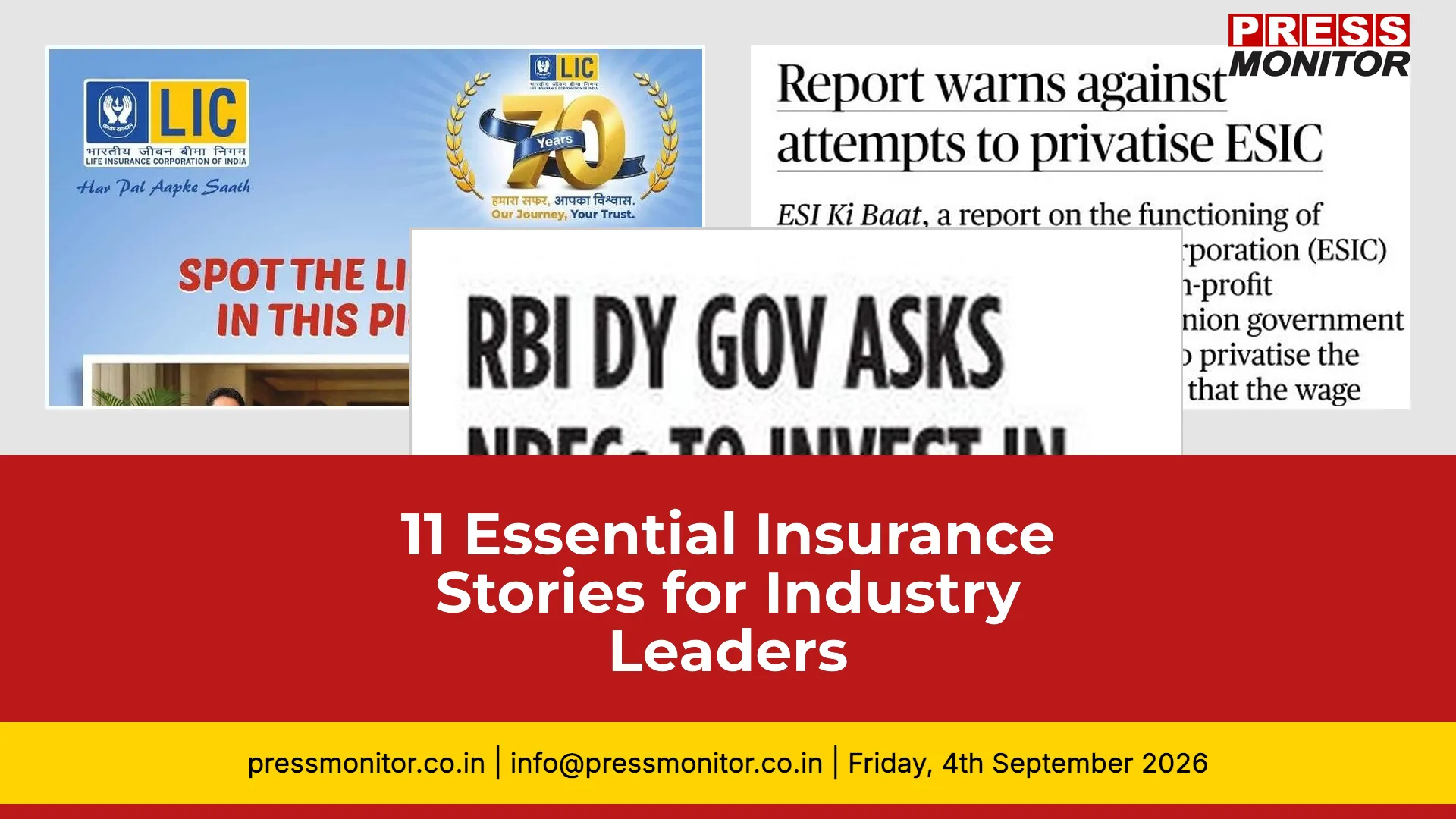
From life insurance campaigns to regulatory warnings, today's Indian print media offers a comprehensive look at the insurance sector's evolving landscape. This press review highlights the most consequential developments for professionals tracking news on insurance, drawing on media monitoring and print media monitoring from Press Monitor's tracking of Indian publications to deliver media intelligence on the sector.
1. LIC's Family Agent Campaign Dominates Front Pages
A front-page report in Times of India says an advertisement invites readers to spot a Life Insurance Corporation of India agent, presented as a family friend. On 18 July 2026, the ad encourages people in India to connect with the agent, scan the quick response code, download the My LIC App, and discuss how life insurance can help meet financial goals and retirement plans.
Life Insurance Corporation of India is running a family-oriented advertising campaign across national dailies, inviting families to connect with a trusted LIC agent through QR codes and the My LIC App.
Why it matters: LIC remains the dominant life insurer in India with roughly 60 per cent market share. Its emphasis on family trust and agent relationships signals a defensive strategy against growing competition from private insurers and digital-first insurtech platforms.
Key detail: The advertisement encourages readers to scan a QR code, download the My LIC App, and discuss financial goals and planned retirement with a familiar agent.
Source: Times of India, New Delhi
Next step: Industry observers should watch whether this campaign translates into measurable policy sales among younger demographics.
2. Safe In India Warns Against ESIC Privatisation
A front-page report in Business Line says that Safe In India, a non-profit organisation, has prepared a report on the functioning of the Employees' State Insurance Corporation warning the Union government against attempts to privatise the ESIC. The report recommends increasing the wage ceiling to avail ESIC coverage to Rs 33,000 from the present figure of Rs 72,000. Director General Ashok Kumar Singh released the report, stating that the Code on Social Security would help more workers avail ESIC benefits.
A report by the Safe In India non-profit has flagged concerns over reported Union government moves to privatise the Employees' State Insurance Corporation, recommending a higher wage ceiling for coverage.
Why it matters: ESIC covers over 180 million Indian workers. Any restructuring of this social security pillar affects employers, employees, and the broader insurance and health coverage ecosystem.
Key detail: Director General Ashok Kumar Singh released the report, stating that the Code on Social Security would help more workers avail ESIC benefits.
Source: Business Line, Delhi
Next step: Corporate HR and compliance teams should monitor legislative developments closely, as ESIC changes could alter employer contribution obligations.
3. RBI Urges NBFCs to Invest in Cyber-Security
A front-page report in Asian Age says Reserve Bank of India deputy governor Shirish Chandra Murmu on Thursday asked non-banking financial companies and housing finance companies to diversify funding sources, strengthen underwriting standards and invest in strong cyber-security to protect customer data and maintain trust at the seventh non-banking financial company and housing finance company summit in Mumbai. Murmu said sustainable growth requires better governance, liquidity management, asset quality, customer protection and digital transformation, warning that liquidity events show exposure to market sentiment and concentrated funding.
Reserve Bank of India deputy governor Shirish Chandra Murmu has called on non-banking financial companies and housing finance firms to strengthen underwriting standards and invest heavily in cyber-security.
Why it matters: As digital insurance distribution grows, cyber-security is no longer optional — it is a regulatory expectation. Insurers and InsurTech firms face rising scrutiny on data protection.
Key detail: Murmu stressed that sustainable growth requires better governance, liquidity management, asset quality, customer protection, and digital transformation.
Source: Asian Age, Delhi
Next step: Insurance CIOs and CISOs should align their technology roadmaps with RBI's guidance on cyber resilience.
4. Student Term Insurance Plans From Rs 477
A front-page report in Mint says student term insurance plans are now available for young adults aged 18 to 25, with monthly premiums starting from Rs 477 for a 50 lakh cover over a 40-year policy term. Major insurers including Axis Max Life, ICICI Prudential, HDFC Life, Tata AIA, and Bandhan Life offer these plans. While the early-buy argument cites lower premiums and building financial habits, experts say not every student needs such cover.
Major insurers including Axis Max Life, ICICI Prudential, HDFC Life, Tata AIA, and Bandhan Life are now offering student term insurance for young adults aged 18 to 25, with premiums starting at Rs 477 per month for a 50 lakh cover over 40 years.
Why it matters: Early financial planning is gaining traction among India's youth. These low-cost entry points could build a generation of insured adults, reshaping the life insurance distribution model.
Key detail: Experts caution that not every student needs such cover and advise disclosing all existing insurance before purchasing additional policies.
Source: Mint, New Delhi
Next step: Insurance marketers should evaluate whether student-term products can become a pipeline for lifelong customer relationships.
5. LIC MD Sets Sustainable Growth Agenda
A front-page report in Business Standard says Life Insurance Corporation of India turned 70 years old recently as managing director and chief executive officer R Doraiswamy outlined plans for sustainable growth and profitability. Doraiswamy stated the company aims to maintain a value of new business margin between 24 and 25 per cent while evaluating strategic investments in fintech and health insurance during an interview in Mumbai. The insurer also discussed addressing misselling at the point of sale and improving its agency distribution network as markets share fluctuates around 60 per cent.
Life Insurance Corporation of India marked its 70th anniversary as managing director R Doraiswamy outlined a vision for sustainable growth and profitability.
Why it matters: LIC's strategic direction influences the entire Indian insurance industry. Its focus on profitability and fintech partnerships signals a modernisation push.
Key detail: Doraiswamy aims to maintain a value of new business margin between 24 and 25 per cent while exploring strategic investments in fintech and health insurance.
Source: Business Standard, Mumbai
Next step: Stakeholders should track LIC's fintech partnerships for potential collaboration or competitive threats.
6. Travel Insurance Fine Print Exclusions Trip Up Travellers
A front-page report in Mint says that travel insurance policies contain restrictive fine print that left a traveller uncompensated for flight delays, a leg injury, and delayed luggage during a Europe trip. The article highlights how missed-connection clauses, medical exclusions, and baggage delay restrictions vary widely across insurers, with claim rejection rates ranging from twenty percent to seventy five percent. It advises travellers to carefully review policy exclusions and public disclosures before purchasing coverage.
A Mint investigation reveals how travel insurance fine print has left travellers uncompensated for flight delays, injuries, and lost luggage during European trips. Claim rejection rates range from twenty to seventy-five per cent across insurers.
Why it matters: As international travel rebounds, understanding policy exclusions is critical for both consumers and insurance brokers managing claims.
Key detail: Missed-connection clauses, medical exclusions, and baggage delay restrictions vary widely, with public disclosures often buried in dense legal text.
Source: Mint, Delhi
Next step: Travel insurance brokers should review their policy wordings for transparency and consider consumer education initiatives.
7. Student Term Insurance as a Financial Planning Building Block
A front-page report in Mint says student term insurance is being positioned as an early start to financial planning, with experts noting that protection is the next logical building block after saving and investing. The report highlights that term cover bought as a student may become inadequate as financial responsibilities grow, and advises disclosing all existing insurance before purchasing additional policies.
Mint reports that student term insurance is being positioned as the next logical step in financial planning after saving and investing. However, experts warn that term cover bought as a student may become inadequate as financial responsibilities grow.
Why it matters: This framing shifts the conversation from price to long-term financial architecture — a trend that could influence product design across the insurance sector.
Key detail: Financial planners advise disclosing all existing insurance before purchasing additional policies to avoid overlap and waste.
Source: Mint, New Delhi
Next step: Insurance educators and advisors should develop curricula around student financial literacy that includes insurance fundamentals.
8. Indusind General Insurance AGM Scheduled for September 25
A front-page report in Free Press Journal says Indusind General Insurance Company Limited will hold its 26th Annual General Meeting on September 25, 2026, through video conferencing. The company has engaged KFin Technologies Limited for remote e-voting, with the cut-off date set for September 18, 2026. Members can attend and vote electronically in compliance with MCA circulars.
Indusind General Insurance Company Limited will hold its 26th Annual General Meeting on September 25, 2026, through video conferencing. KFin Technologies Limited has been engaged for remote e-voting.
Why it matters: Corporate governance in general insurance is under increasing scrutiny. The shift to e-voting reflects broader digital transformation in the sector.
Key detail: Members can attend and vote electronically in compliance with MCA circulars, with the cut-off date set for September 18, 2026.
Source: Free Press Journal, Mumbai
Next step: Shareholders and industry analysts should review the AGM agenda for insights on Indusind's strategic priorities.
9. PFRDA Opens Recruitment for 30 Assistant Manager Posts
A front-page report in Times of India says ISRO has undergone extensive leadership reshuffles across at least seven major centres following a wave of superannuations. S R Biju has taken over as director of the Human Space Flight Centre coordinating the Gaganyaan programme, with the first uncrewed mission targeted within the next sixteen to twenty weeks. Multiple directors have been reassigned across facilities including Vikram Sarabhai Space Centre, UR Rao Satellite Centre, and Satish Dhawan Space Centre.
The Pension Fund Regulatory and Development Authority has invited applications for thirty Assistant Manager Grade A posts under the PFRDA Act of 2013. Applications are open from September 3 to September 24, 2026.
Why it matters: PFRDA's expansion signals growing institutional capacity in India's pension and retirement insurance ecosystem.
Key detail: The recruitment is for Indian citizens on a direct recruitment basis, with online applications accepted through the PFRDA portal.
Source: Times of India, New Delhi
Next step: Career-minded professionals in the pension and insurance sectors should prepare applications ahead of the deadline.
10. 96% of Gig Workers Affected by Heat, Limited Insurance Coverage
A front-page report in Business Standard says a nationwide survey by Janpahal and Gig Workers Association reveals platform workers in India face high workplace safety risks with limited insurance, training, or reporting mechanisms. Extreme heat affected 96.57 per cent of workers ability to work, while 62.2 per cent lacked health insurance and 50 per cent were not registered on the e-Shram portal.
A nationwide survey by Janpahal and the Gig Workers Association reveals that extreme heat affected 96.57 per cent of platform workers' ability to work, while 62.2 per cent lacked health insurance and 50 per cent were not registered on the e-Shram portal.
Why it matters: The gig economy's insurance gap is a pressing regulatory and social security concern. This data could drive policy interventions.
Key detail: Limited insurance, training, and reporting mechanisms leave gig workers vulnerable to occupational hazards.
Source: Business Standard, New Delhi
Next step: InsurTech firms should explore parametric or micro-insurance products tailored to gig workers' needs.
11. Kalyan Jewellers Offers Special Gold Rate with LIC Agent Listing
A front-page report in Tribune says Kalyan Jewellers is offering a special gold rate this season with stores across India including Delhi, Noida, and Ghaziabad. The promotional content also features a Life Insurance Corporation agent listing for insurance services alongside jewellery purchases.
Kalyan Jewellers is offering a special gold rate this season across stores in Delhi, Noida, and Ghaziabad. The promotional content also features a Life Insurance Corporation agent listing for insurance services alongside jewellery purchases.
Why it matters: The convergence of retail jewellery and insurance distribution highlights new cross-sell opportunities in the Indian insurance ecosystem.
Key detail: The LIC agent listing within a jewellery store represents an innovative point-of-sale insurance distribution strategy.
Source: Tribune, Delhi
Next step: Insurance distribution strategists should study retail cross-sell models as a growth avenue for life insurance penetration.
Closing: With LIC's family trust campaigns, RBI's cyber mandates, and the gig economy's insurance gap all making headlines, which development will most reshape India's insurance landscape in the next twelve months?