11 Essential Insurance Stories for Industry Leaders


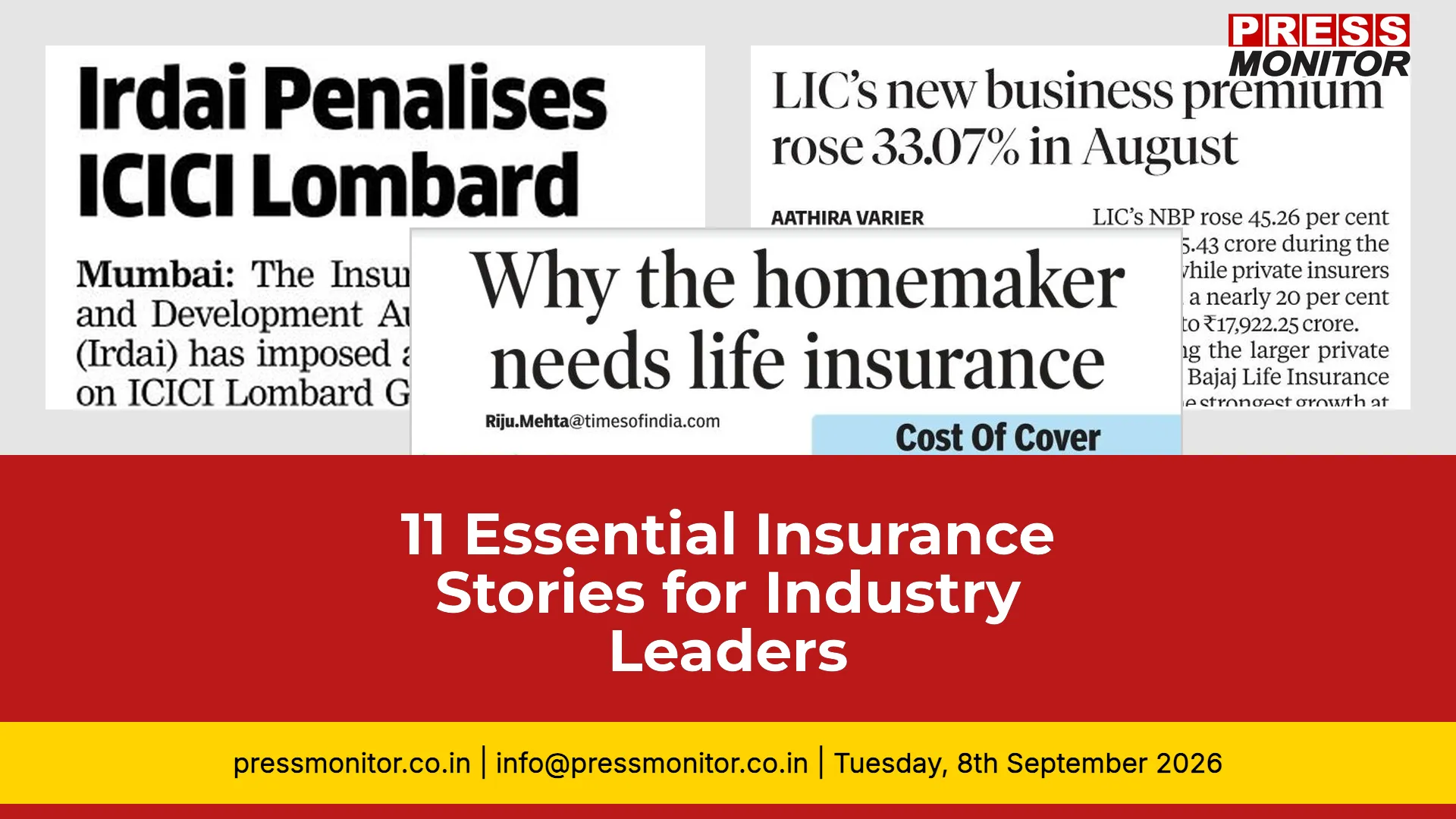
According to Press Monitor's tracking of Indian publications, today's print media landscape delivers eleven pivotal stories shaping the insurance sector—from regulatory penalties and life cover innovations to livestock schemes and insolvency rulings. This media monitoring report delivers the latest news on insurance, equipping leaders with the press review insights and media intelligence they need to act before markets open.
1. ICICI Lombard Fined Crore Over Outsourcing Lapses
A front-page report in Economic Times says IRDAI imposed a penalty on ICICI Lombard General Insurance for lapses in outsourcing practices, vendor management, and corporate governance during a 2019 inspection. The insurer incurred 2709.57 crore under sales marketing and business support, of which about 35 to 37 crore was paid to agents of other insurers. IRDAI said the insurer failed to classify event management services as outsourced activity, thereby avoiding regulatory scrutiny. IRDAI imposed a significant penalty on ICICI Lombard General Insurance for outsourcing and corporate governance violations traced to a 2019 inspection. The insurer incurred over Rs 2,700 crore in sales marketing and business support expenses, of which approximately 35 to 37 crore was routed to agents of competing insurers without proper classification of event management services as outsourced activity. Why it matters: Regulatory scrutiny of insurer outsourcing practices is intensifying, and governance lapses can trigger substantial financial penalties and reputational damage. Key detail: Rs 1 crore fine imposed; Rs 35–37 crore in questionable agent payments identified. Source: Economic Times, Mumbai, 7 September. Next step: Insurers should audit their vendor management frameworks and ensure event management costs are properly classified. What does this mean for your compliance timeline?
2. LIC NBP Jumps 33.7% in August
A front-page report in Business Standard says that LIC’s new business premium rose by forty‑five point two six percent to rupees twenty‑three crore and seventy‑five rupees during August, while total life insurers’ new business premium increased by thirty‑three point seven percent to rupees four lakh and twelve crore seventy‑eight rupees. The growth follows a robust mobilisation of premiums across state‑owned and private insurers, with Bajaj Life Insurance leading private insurers at a rate of nearly thirty‑one point six percent. LIC's new business premium rose by 45.26% to Rs 23 crore and seventy-five lakh during August, while total life insurers' new business premium increased by 33.7% to Rs 4 lakh and twelve crore seventy-eight lakh. Bajaj Life Insurance led private insurers with growth of nearly 31.6%. Why it matters: Strong premium growth signals robust consumer confidence in life insurance products and a competitive private sector. Key detail: Total industry NBP up 33.7%; Bajaj Life leading private insurers at approximately 31.6%. Source: Business Standard, Mumbai, 7 September. Next step: Track whether this momentum sustains into Q3 and assess competitive positioning. How will your growth strategy compare?
3. Homemaker Life Cover Tops Rs 1 Crore
A front-page report in Times of India says that traditional wisdom once deemed life insurance unnecessary for non-earning homemakers, but insurers now recognise the substantial economic value of their domestic responsibilities. Companies determine suitable cover sizes by evaluating the family’s financial status, the homemaker’s profile, and typically cap coverage at fifty to one hundred percent of the earning spouse’s sum assured, often reaching up to Rs 1 crore. Premiums are primarily driven by mortality risks, age, and health metrics rather than income potential. Insurers now recognise the substantial economic value of homemakers' domestic responsibilities, offering life cover up to Rs 1 crore—typically 50 to 100 percent of the earning spouse's sum assured. Premiums are driven by mortality risks, age, and health metrics rather than income potential. Why it matters: This shift reflects a broader industry trend toward inclusive product design and expanding addressable markets. Key detail: Coverage caps at Rs 1 crore; premiums based on mortality and health, not income. Source: Times of India, New Delhi, 8 September. Next step: Evaluate homemaker life products for your client portfolio or family planning. Have you considered adequate cover for your household?
4. Insurers Seek Equity Derivatives Flexibility
A front-page report in Economic Times says insurance companies are seeking greater flexibility on how equity derivatives are used, including allowing exposure to be aggregated across multiple funds. The Insurance Regulatory and Development Authority of India allowed insurers to use equity derivatives solely to hedge existing equity exposures in February 2025. Insurance companies are seeking greater flexibility on how equity derivatives are used, including allowing exposure to be aggregated across multiple funds. IRDAI permitted insurers to use equity derivatives solely to hedge existing equity exposures in February 2025. Why it matters: Expanded derivative flexibility could unlock new portfolio management strategies and improve risk-adjusted returns for insurers. Key detail: Current rule limits derivatives to hedging existing equity exposures; insurers seeking broader usage. Source: Economic Times, Delhi, 8 September. Next step: Monitor IRDAI's response to industry feedback and prepare for potential regulatory changes. Is your investment team ready for expanded derivative access?
5. UP Livestock Insurance Gets Major Boost
A front-page report in Free Press Journal says the Uttar Pradesh government will cover 85 percent of the insurance premium under the Mukhyamantri Risk Management and Livestock Insurance Scheme, reducing the financial burden on livestock owners. Livestock Minister Dharampal Singh directed officials to simplify the process from purchasing policies to settling claims, ensuring transparency and timely payments. The scheme will cover indigenous and crossbred milch animals, draught animals, goats, sheep, and pigs, with Rs 60 crore allocated for 2026-27 to target insurance coverage for 2,28,350 animals. The Uttar Pradesh government will cover 85 percent of the insurance premium under the Mukhyamantri Risk Management and Livestock Insurance Scheme, reducing the financial burden on livestock owners. Rs 60 crore allocated for 2026-27 to target insurance coverage for 2,28,350 animals including indigenous and crossbred milch animals, draught animals, goats, sheep, and pigs. Why it matters: Government-backed livestock insurance supports agricultural resilience and farmer income stability. Key detail: 85% premium subsidy; 2,28,350 animals targeted; Rs 60 crore allocated. Source: Free Press Journal, Lucknow, 18 July 2026. Next step: Assess opportunities for agro-insurance partnerships in UP and similar states. Could this scheme model work in your region?
6. New India Assurance: A Legacy That Inspires Innovation
A front-page report in Business Standard says New India Assurance Co. Ltd, founded by Sir Dorabji Tata in 1919, has served India through independence, nationalisation, liberalisation, natural catastrophes, a pandemic, and rapid technological change. The company views its legacy as a compass rather than a museum, balancing nonnegotiable values like integrity in underwriting, fairness in claims, and financial prudence with continuous process evolution. New India Assurance aims to prepare its workforce for the future by building capabilities in data literacy, customer experience, technology, risk management, and leadership, ensuring that innovation remains anchored in trust while preserving the promise of its founding in 1919. Founded by Sir Dorabji Tata in 1919, New India Assurance Co. Ltd has served India through independence, nationalisation, liberalisation, natural catastrophes, a pandemic, and rapid technological change. The company balances nonnegotiable values like integrity in underwriting, fairness in claims, and financial prudence with continuous process evolution. Why it matters: A century-old insurer demonstrating that legacy and innovation can coexist offers a blueprint for the sector. Key detail: Founded 1919; focus on data literacy, customer experience, technology, and leadership. Source: Business Standard, New Delhi, 8 September. Next step: Study New India Assurance's workforce development strategy as a benchmark. How is your organisation balancing tradition with transformation?
7. Punjab Government Tender For Livestock Insurance
A front-page report in Hindustan Times says the Punjab Government has issued a tender notice under the National Livestock Mission for insurance coverage and risk management of livestock. The approximate tender amount is Rs 2 lakh, with the opening scheduled for 28 September 2026. Director Bary has been designated as the nodal officer, and further information is available on the official website. The Punjab Government has issued a tender notice under the National Livestock Mission for insurance coverage and risk management of livestock. The approximate tender amount is Rs 2 lakh, with the opening scheduled for 28 September 2026. Director Bary has been designated as the nodal officer. Why it matters: Government tenders for livestock insurance create new market access points for insurers and brokers. Key detail: Rs 2 lakh tender; opening 28 September 2026; National Livestock Mission framework. Source: Hindustan Times, Delhi, 8 September. Next step: Insurers and brokers should prepare bids ahead of the September deadline. Is your team ready to participate?
8. ITAT Upholds IBC Clean Slate Principle
A front-page report in Business Line says the Mumbai bench of the Income Tax Appellate Tribunal dismissed tax disputes against IndusInd General Insurance Company Ltd, upholding the clean slate principle under the Insolvency and Bankruptcy Code. The decision, delivered on August 3, confirms that an approved corporate resolution plan permanently extinguishes pre-insolvency tax liabilities of both the bankrupt parent and its subsidiaries. The dispute stemmed from assessment years spanning 2011 to 2021, originating from disallowed expenditures related to motor vehicle dealer payments. The Mumbai bench of the Income Tax Appellate Tribunal dismissed tax disputes against IndusInd General Insurance Company Ltd, upholding the clean slate principle under the Insolvency and Bankruptcy Code. The decision confirms that an approved corporate resolution plan permanently extinguishes pre-insolvency tax liabilities of both the bankrupt parent and its subsidiaries. Why it matters: This ruling provides clarity on tax treatment post-insolvency, affecting insurers and other corporates navigating IBC proceedings. Key detail: Dispute from assessment years 2011–2021; disallowed expenditures related to motor vehicle dealer payments. Source: Business Line, Mumbai, 8 September. Next step: Insurers with IBC-exposed subsidiaries should review their tax positions. Does your organisation have pending IBC-related tax disputes?
9. PIB Insurance Brokers Offers Solutions
A front-page report in Business Line says PIB Insurance Brokers Pvt Ltd posted an advertisement offering complete insurance solutions for businesses. The ad covers corporate, SME, property, fire, marine, liability, and employee benefits with competitive premiums and fast claim support. PIB Insurance Brokers Pvt Ltd posted an advertisement offering complete insurance solutions for businesses, covering corporate, SME, property, fire, marine, liability, and employee benefits with competitive premiums and fast claim support. Why it matters: Brokerage firms expanding their service portfolios signal growing demand for comprehensive risk management. Key detail: Coverage spans corporate, SME, property, fire, marine, liability, and employee benefits. Source: Business Line, Delhi, 8 September. Next step: Evaluate PIB's offerings against your current broker arrangements. Are your insurance brokers delivering full-spectrum coverage?
10. PID Insurance Provides Comprehensive SME Solutions
A front-page report in Business Standard says PID Insurance offers comprehensive risk management and financial engineering solutions tailored for small and medium enterprises, large corporations, and commercial properties. The firm provides extensive coverage spanning liability, marine logistics, employee benefits, motor fleets, and group health plans, supported by dedicated premium structuring and expert claim assistance. Clients seeking customised policies can contact the provider directly through their official communication channels. PID Insurance offers comprehensive risk management and financial engineering solutions tailored for small and medium enterprises, large corporations, and commercial properties. Coverage spans liability, marine logistics, employee benefits, motor fleets, and group health plans with dedicated premium structuring and expert claim assistance. Why it matters: Specialised SME insurance solutions are in high demand as small businesses seek tailored risk protection. Key detail: Services include liability, marine logistics, employee benefits, motor fleets, and group health plans. Source: Business Standard, New Delhi, 8 September. Next step: Compare PID Insurance's offerings with your current SME coverage. Are your SME clients adequately protected?
11. RNFI Services Gets RBI Payment Aggregator Nod
A front-page report in Free Press Journal says RNFI Services Ltd has received in-principle authorisation from the Reserve Bank of India to operate as a payment aggregator for physical, offline, and in-store payments. The authorisation will help the last-mile financial infrastructure company expand its regulated financial services portfolio. RNFI already holds an Authorised Dealer Category Two licence, mutual fund distribution capabilities, insurance broking registration, and a prepaid payment instrument business. RNFI Services Ltd has received in-principle authorisation from the Reserve Bank of India to operate as a payment aggregator for physical, offline, and in-store payments. The authorisation will help the last-mile financial infrastructure company expand its regulated financial services portfolio, which already includes an Authorised Dealer Category Two licence, mutual fund distribution capabilities, insurance broking registration, and a prepaid payment instrument business. Why it matters: RBI's nod to RNFI signals growing convergence between payment infrastructure and insurance distribution channels. Key detail: In-principle authorisation for payment aggregation; existing AD Category Two licence and insurance broking registration. Source: Free Press Journal, Mumbai, 8 September. Next step: Monitor how payment aggregators integrate insurance broking into their service stacks. Could this open new distribution channels for your products?
These eleven stories, tracked through print media monitoring by Press Monitor, reflect the dynamic forces reshaping India's insurance landscape. Which development will have the greatest impact on your organisation? Share your thoughts in the comments.