11 Pivotal Legal & Regulatory Stories for Counsel


Stay ahead with today’s essential press review on legal & regulatory developments across India. Our print media monitoring tracks every court ruling, tribunal decision, and compliance shift so you never miss a beat. Here is your daily news on legal & regulatory shifts, distilled through rigorous editorial verification.
1. Supreme Court Sets Bar Council Poll Deadlines
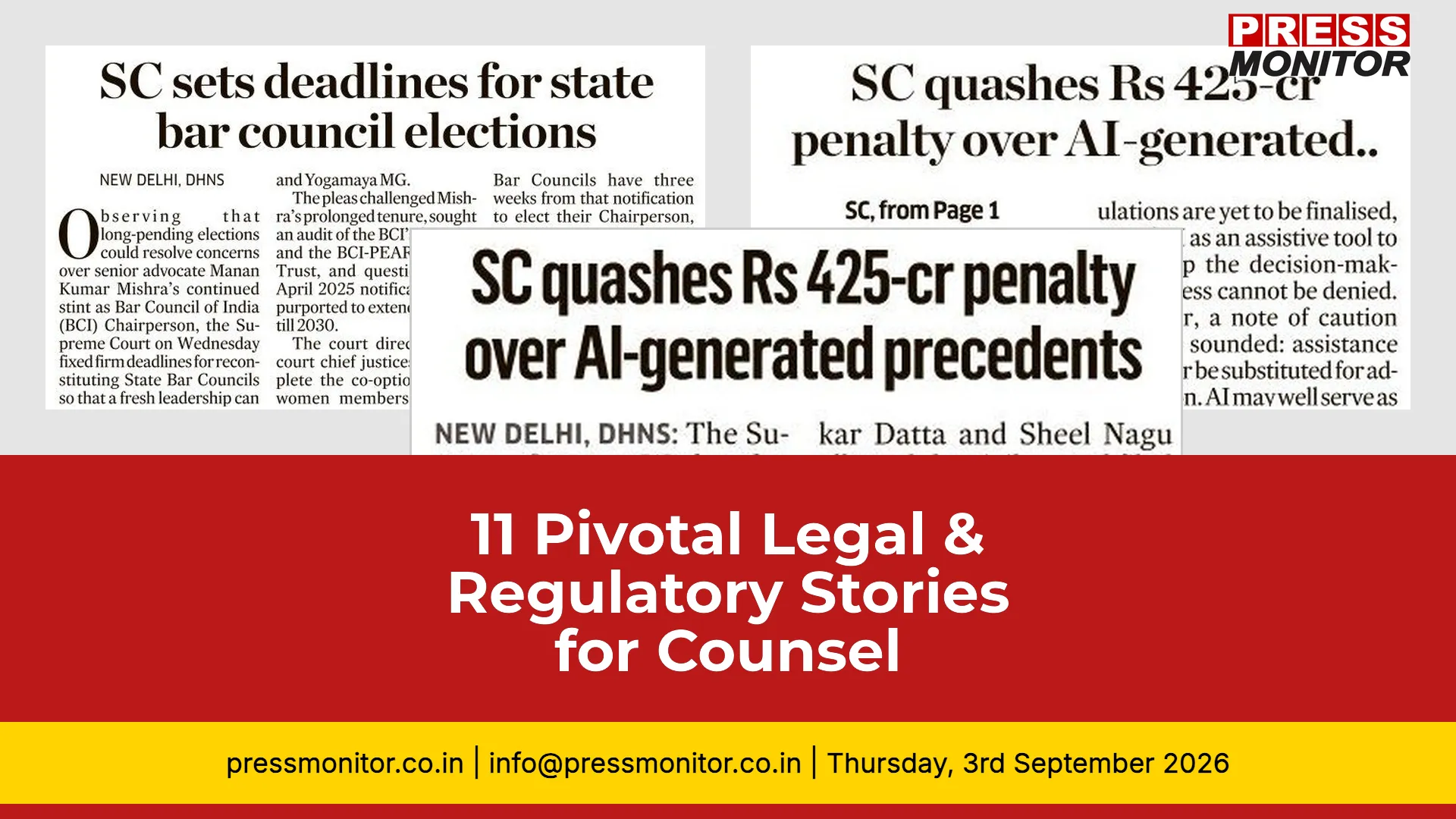
A front-page report in Deccan Herald says the Supreme Court has fixed firm deadlines for reconstituting State Bar Councils, amid concerns over senior advocate Manan Kumar Mishra's continued tenure as Chairperson of the Bar Council of India. A bench led by Chief Justice of India Surya Kant directed high court chief justices to complete the co-option of two women members to each State Bar Council within two weeks, with fresh office-bearer elections to follow within three weeks. The pleas, filed by advocates M Varadhan and Yogamaya MG, sought an audit of the Bar Council of India's finances and the BCI-PEARL FIRST Trust, and the matter will next be heard on September 17 to monitor compliance.
Why it matters: Institutional governance in the legal profession faces immediate restructuring, impacting how bar associations operate nationally.
Key detail: The apex court directed high court chief justices to co-opt two women members to each State Bar Council within two weeks, with fresh office-bearer elections within three weeks. It also mandated consultation with the Attorney-General and Solicitor-General for all major policy moves while senior advocate Manan Kumar Mishra serves pro tem.
Source: Deccan Herald
Next step: Monitor compliance reports ahead of the September 17 hearing.
2. Supreme Court Flags AI Hallucination in Case Citations
A front-page report in Deccan Herald says the Supreme Court set aside a High Court order and an October 2025 Order-in-Original after finding that some case citations were non-existent or fake, an apparent hallucination of AI. The bench warned that advocates relying on unverified AI-generated precedents could face misconduct proceedings, and cautioned that AI may serve as training wheels but must never be placed in the pilot's seat. The court directed that the proceedings be revived for fresh adjudication by an officer of the same rank, but not the officer who passed the original order.
Why it matters: Judicial integrity relies on accurate precedents; unchecked AI adoption threatens litigation outcomes and professional ethics.
Key detail: The bench set aside a High Court order after discovering fabricated citations generated by artificial intelligence. Advocates using unverified AI outputs now face potential misconduct proceedings, with the court emphasizing AI as training wheels, not a pilot.
Source: Deccan Herald
Next step: Update firm research protocols to mandate human verification of all digital precedents.
3. SC Quashes Rs 425-Crore Customs Penalty Over AI Precedents
A front-page report in Deccan Herald says the Supreme Court has quashed a Rs 425.27-crore customs penalty imposed on diamond trader Vijay Ghanshyam Gadiya, after finding the adjudicating authority relied on non-existent judicial precedents that appeared to have been generated by artificial intelligence. The penalty was imposed by the Additional Commissioner of Customs, Surat, under Section 114 of the Customs Act, 1962, over the alleged mis-declaration of a consignment of natural diamonds as lab-grown stones, and the Gujarat High Court had dismissed the challenge on 20 January 2026. The apex court said the judiciary must adopt a zero-tolerance policy towards producing, citing or using AI-generated precedents without verification.
Why it matters: Trade and customs authorities must overhaul reliance on automated legal research to avoid massive financial reversals.
Key detail: The apex court overturned a Rs 425.27-crore penalty against diamond trader Vijay Ghanshyam Gadiya, ruling that the adjudicating authority relied on non-existent judicial precedents. The judiciary adopted a zero-tolerance stance toward unverified AI-generated citations.
Source: Deccan Herald
Next step: Audit customs and tax advisory workflows for AI dependency.
4. Supreme Court Grants Divorce After Two-Decade Separation
A front-page report in Focus News says the Supreme Court has granted a divorce to a couple living separately since December 2005, ruling that the wife had deserted the marital relationship. A bench of Justice Prashant Kumar Mishra and Justice Chandrashekhar directed the husband to pay Rs 7 lakh as permanent alimony while partly allowing his appeal against a Madhya Pradesh High Court order that had rejected his divorce plea. The couple married in June 2003, have no children, and the husband had filed for divorce in June 2007 on grounds of desertion and mental cruelty.
Why it matters: Family law precedents continue to clarify desertion thresholds and alimony structures under the Hindu Marriage Act.
Key detail: A bench led by Justice Prashant Kumar Mishra granted the divorce, overturning the Madhya Pradesh High Court’s refusal. The husband was directed to pay Rs 7 lakh as permanent alimony after the court found the wife had deserted the marital relationship since December 2005.
Source: Focus News
Next step: Review matrimonial dispute strategies for long-term separations.
5. Supreme Court Quashes 20-Year-Old Juvenile Conviction
A front-page report in The Pioneer says the Supreme Court has set aside the 20-year-old conviction of Mahavir alias Avnish, who was a minor when an offence was registered in Morena, Madhya Pradesh, in 2004. A bench of Justices Prashant Kumar Mishra and Shree Chandrashekhar held that a child should not be treated as a criminal and that procedural finality cannot deny statutory benefits to a juvenile. The court reiterated that a claim of juvenility can be raised at any time under Section 7A of the Juvenile Justice Act.
Why it matters: Statutory protections for minors override procedural finality, reinforcing child rights jurisprudence.
Key detail: The court set aside the conviction of Mahavir alias Avnish, who was a minor during the 2004 offence. Justices Mishra and Chandrashekhar reiterated that juvenility claims remain valid indefinitely under Section 7A of the Juvenile Justice Act.
Source: The Pioneer
Next step: Reassess legacy criminal cases involving alleged juvenile offenders.
6. High Court Quashes Noida Police Detention of DU Student
A front-page report in Times of India says the Allahabad High Court has quashed Noida police’s detention of DU law student and labour activist Aakriti Choudhary under National Security Act. The court ordered compensation of Rs 5 lakh for Aakriti and directed her immediate release if arrest was not warranted in any other case.
Why it matters: Civil liberties and preventive detention laws face strict scrutiny when applied to students and activists.
Key detail: The Allahabad High Court ordered the immediate release of law student Aakriti Choudhary and awarded Rs 5 lakh in compensation, ruling that her detention under the National Security Act lacked justification.
Source: Times of India
Next step: Track subsequent habeas corpus filings and police compliance.
7. Google Ad Exchange Ruling Blocks Forced Sale to DOJ
A front-page report in Mint says that US Judge Leonie Brinkema declined to make Google sell AdX, where publishers pay Google a 20% fee to sell ads in auctions that happen instantly when users load websites. She accepted most of the parties’ proposed behavioral remedies.
Why it matters: Tech antitrust enforcement balances market competition with operational continuity, setting global digital advertising precedents.
Key detail: US Judge Leonie Brinkema declined to force Google to divest its AdX platform, accepting proposed behavioral remedies instead. Publishers will continue paying a 20% fee for instant auction placements.
Source: Mint
Next step: Evaluate impact on ad-tech partnerships and compliance frameworks.
8. Bombay High Court Orders CBI Probe Into Disha Salian Death
A front-page report in Deccan Chronicle says the Bombay High Court has ordered a CBI probe into the death of Disha Salian, former manager of late actor Sushant Singh Rajput. A division bench of Justices Sarang V. Kotwal and Ranjitsinha R. Bhonsale pulled up the Mumbai police for failing to register an FIR for six years, observing that their investigation raised more questions than it answered. In its 44-page judgment, the court criticised the police for treating the case only as an accidental death and noted glaring discrepancies in their probe.
Why it matters: High-profile investigations demand transparent law enforcement, especially when initial probes face credibility challenges.
Key detail: A division bench criticized Mumbai police for treating the 2020 case as accidental and failing to register an FIR for six years. The court directed the CBI joint director to record statements and formally investigate glaring discrepancies.
Source: Deccan Chronicle
Next step: Follow CBI registration timelines and witness recording schedules.
9. Subhash Chandra Opposes NCLT Insolvency Bench Expansion
A front-page report in Mint says Zee Group founder Subhash Chandra has opposed the National Company Law Tribunal's decision to constitute a five-member bench to hear his personal insolvency case afresh, arguing that Section 419(5) of the Companies Act gives the tribunal no such power. His counsel told the National Company Law Appellate Tribunal that the earlier order approving his repayment plan, passed by member Nilesh Sharma on 25 August, could not be set aside. The case concerns Chandra's personal guarantees for loans of about Rs 22,574 crore taken by Essel and Zee Group companies, with creditors including LIC Housing Finance, HDFC Bank and Union Bank of India challenging the plan.
Why it matters: Corporate insolvency proceedings hinge on tribunal composition and statutory interpretation of repayment plans.
Key detail: Zee Group founder challenged the five-member bench formation, citing Section 419(5) of the Companies Act. Creditors including LIC Housing Finance and HDFC Bank continue contesting his personal guarantee exposure of roughly Rs 22,574 crore.
Source: Mint
Next step: Monitor NCLAT appeals and creditor committee negotiations.
10. Delhi High Court Seeks Transgender Arrest SOP
A front-page report in The Hans India says the Delhi High Court has asked the Centre, Delhi Police and the Delhi government to frame a Standard Operating Procedure governing the arrest and detention of transgender persons. A Bench of Chief Justice D K Upadhyaya and Justice Tejas Karia issued notices on a PIL by law student Taaran Chandna, who argued that Delhi Police has standing orders for arresting women and senior citizens but none for transgender persons. The plea cited the alleged search of three transgender persons arrested in May 2025 by a male police officer without inquiry into their gender identity or consent.
Why it matters: Policing standards must align with constitutional dignity and gender identity recognition.
Key detail: Chief Justice D K Upadhyaya’s bench issued notices on a PIL by law student Taaran Chandna, directing the Centre and Delhi Police to draft arrest and detention guidelines specifically for transgender persons, following allegations of improper searches.
Source: The Hans India
Next step: Await government response and draft SOP publication.
11. Supreme Court Drops Bihar Killing Case Due to No Investigation
A front-page report in Times of India says that the Bihar police had proven its case before the trial court and Patna high court against six persons accused of firing indiscriminately to kill a man in broad daylight in 2OOl. However, the Supreme Court took more than a decade to acquit the accused by concluding that it was a case of “no investigation” having taken place.
Why it matters: Judicial patience has limits; prolonged cases without foundational investigation risk systemic miscarriage of justice.
Key detail: The apex court acquitted six accused serving life terms for a 2001 firing incident, concluding that no proper investigation ever occurred despite earlier trial and high court convictions.
Source: Times of India
Next step: Assess implications for legacy criminal backlogs and investigative accountability.
Closing: This press review synthesizes today’s most impactful rulings through rigorous print media monitoring. How will your organization adapt to these shifting legal and regulatory currents? Share your perspective below.