13 Essential Elderly Care Stories for Senior Stakeholders


India's print media landscape is tracking a defining shift in how the nation approaches its aging population — from pension reform and elderly care policy to cybersecurity threats targeting seniors and judicial retirement age changes. According to Press Monitor's tracking of Indian publications, these 13 stories reveal the urgency of building a comprehensive elderly care infrastructure. This press review draws on print media monitoring to deliver media intelligence that matters for policymakers, corporate leaders, and care professionals. Here is the news on elderly care you need to know today.
1. India Working on Policy to Support Ageing Population
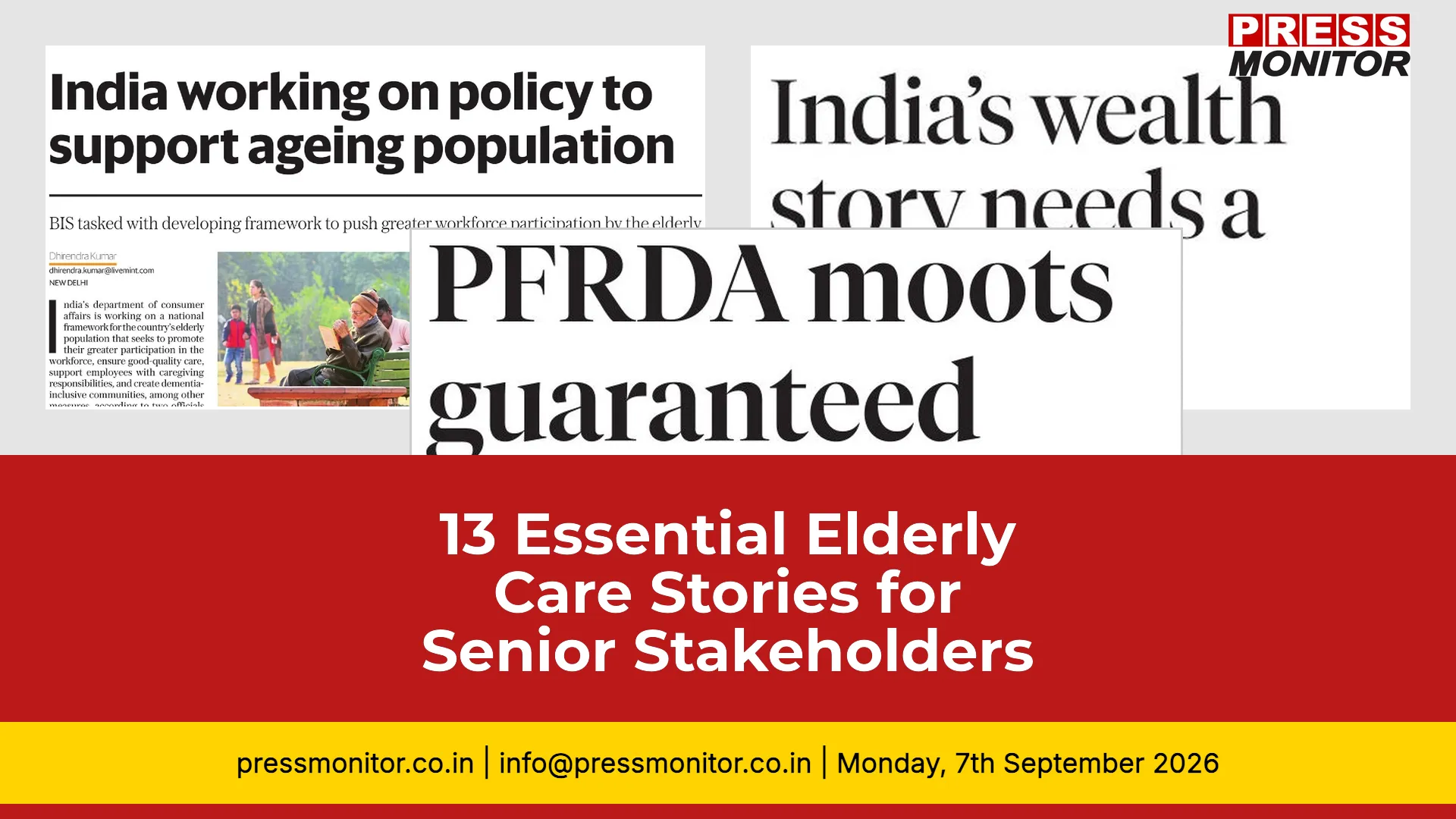
A front-page report in Mint says India's department of consumer affairs is working on a national framework for the elderly population that seeks to promote their greater participation in the workforce, ensure good-quality care, support employees with caregiving responsibilities, and create dementia-inclusive communities. The plan comes amid concerns over changing family structures and the growing prevalence of nuclear families, as India undergoes a rapid demographic transition with the number of people aged 60 years and above projected to rise from 100 million in 2011 to 230 million by 2036. The Bureau of Indian Standards has been tasked with developing the framework, which will have a set of protocols for the quality of care for older persons and their participation in the workforce.
Mint reports that India's Department of Consumer Affairs is developing a national framework for the elderly, promoting workforce participation, quality care, and dementia-inclusive communities. With the population aged 60+ projected to rise from 100 million in 2011 to 230 million by 2036, the Bureau of Indian Standards is creating protocols for care quality. Why it matters: this framework could reshape how employers and communities support older workers. Key detail: nuclear family structures are accelerating the need for institutional care solutions. Source: Mint, Delhi, by Dhirendra Kumar. Next step: watch for BIS draft protocols in the coming months.
2. NPS Reaches 22.9 Million Subscribers as India Ages Faster
A front-page report in Business Standard says the National Pension System has 22.9 million subscribers and assets under management of Rs 17.73 trillion as of August 2026, yet retirement preparedness remains a challenge as India's population ages faster than financial adaptation. The combined NPS and Atal Pension Yojana schemes served approximately 101.3 million subscribers with a combined AUM of around Rs 218.32 trillion. The article emphasises that retirement planning must extend beyond salaried employees to include gig workers, entrepreneurs, and the unorganised sector, while recent exit framework changes allow up to 80 per cent corpus withdrawal to build layered retirement income plans.
Business Standard reports the National Pension System has 22.9 million subscribers and AUM of Rs 17.73 trillion as of August 2026, with combined NPS and Atal Pension Yojana serving approximately 101.3 million subscribers. Why it matters: retirement preparedness lags behind India's rapidly aging demographics. Key detail: recent exit framework changes allow up to 80% corpus withdrawal for layered retirement income. Source: Business Standard, New Delhi. Next step: gig workers and the unorganised sector need targeted outreach.
3. PFRDA Talks With Finance Ministry On Guaranteed Returns
A front-page report in Business Standard says the Pension Fund Regulatory and Development Authority is in discussions with the Union Ministry of Finance to introduce a pension scheme offering guaranteed returns. The regulator is also considering assured-payout options for National Pension System subscribers while exploring conditional access to derivatives such as forward rate agreements to hedge market risk, though it remains committed to keeping costs low. In recent months, PFRDA has adjusted multiple NPS rules, including easing withdrawal norms for non-government subscribers, allowing investments in commodities, approving bank sponsorship for pension funds, and tightening audit requirements for Points of Presence.
Business Standard reports PFRDA is discussing guaranteed-return pension schemes with the Union Finance Ministry, including assured-payout options and conditional access to derivatives for hedging. Why it matters: retirees need stable income streams without taking on market risk. Key detail: PFRDA has also eased NPS withdrawal norms and approved bank sponsorship for pension funds. Source: Business Standard, Mumbai, by Anjali Kumari. Next step: monitor Finance Ministry response.
4. Karnataka Reintroduces Old Pension Scheme
A front-page report in Statesman says Karnataka Deputy Chief Minister G Parameshwara announced the State Government has decided to reintroduce the Old Pension Scheme and abolish the New Pension Scheme. The announcement was made at the State-level Teachers Day celebrations in Bengaluru, fulfilling the Congress party's pre-election promise. The government also decided to allow teachers to use the honorary prefix Tr before their names.
Statesman reports Karnataka Deputy Chief Minister G Parameshwara announced the state will reintroduce the Old Pension Scheme, fulfilling a Congress pre-election promise at Teachers Day celebrations in Bengaluru. Why it matters: this reversal of NPS for government employees sets a precedent other states may follow. Key detail: teachers will also be allowed the honorary prefix Tr before their names. Source: Statesman News Service, Bengaluru. Next step: watch for other state governments considering similar reversals.
5. Pension Fund Schemes New Classification Rules
A front-page report in Navbharat Times says the Pension Fund Regulatory and Development Authority issued new standardised framework on 28 August 2026 to classify pension schemes. Under the new rules, schemes will be divided into five categories based on equity exposure ranging from conservative to aggressive growth. This change aims to help investors easily compare risk, returns and charges before choosing a scheme.
Navbharat Times reports PFRDA issued a new standardised framework on 28 August 2026 to classify pension schemes into five categories based on equity exposure. Why it matters: investors can now easily compare risk, returns, and charges. Key detail: categories range from conservative to aggressive growth. Source: Navbharat Times, Delhi. Next step: financial advisors should update client guidance on the new classification.
6. NPS Offers More Flexibility to Manage Retirement Savings
A front-page report in Financial Express says the National Pension System now allows non-government subscribers to choose multiple schemes across one or more pension fund managers and investment strategies. The new default contribution allocation feature enables investors to specify percentage allocations across selected schemes, with subsequent contributions automatically distributed accordingly, making portfolio management more meaningful as goals and risk appetite change over time.
Financial Express reports NPS now allows non-government subscribers to choose multiple schemes across pension fund managers with a default contribution allocation feature. Why it matters: portfolio management becomes more meaningful as goals and risk appetite change. Key detail: subsequent contributions are automatically distributed according to specified percentage allocations. Source: Financial Express, Delhi. Next step: subscribers should review their NPS allocations.
7. Punjab Staff Protest AAP Over Pay Demands
A front-page report in Economic Times says the AAP government in Punjab is confronting intense agitation from its own employees and pensioners just five months ahead of state assembly elections. Staff members are protesting over unpaid dearness allowance arrears, the delayed implementation of the old pension scheme, and other employment-related demands. The unrest marks a significant political challenge for the ruling party as it prepares for the upcoming votes.
Economic Times reports AAP government employees and pensioners in Punjab are protesting unpaid dearness allowance arrears and delayed implementation of the old pension scheme, five months ahead of state assembly elections. Why it matters: pension policy is becoming a live political issue. Key detail: the unrest marks a significant challenge for the ruling party. Source: Economic Times, Delhi, by Nidhi Sharma. Next step: political observers should track how this impacts election promises.
8. WHO Reports Loneliness As Global Health Concern
A front-page report in Statesman says that loneliness is becoming one of the most serious yet least discussed problems confronting contemporary society. In 2025, the World Health Organization reported that roughly one in six people worldwide experiences loneliness, making it a global public-health concern affecting young and old alike. The article examines how urbanisation, migration, and digital technology contribute to isolation in India, while also referencing historical figures like Rabindranath Tagore and Jawaharlal Nehru who understood loneliness deeply.
Statesman reports the WHO found roughly one in six people worldwide experiences loneliness, making it a global public-health concern. The article examines how urbanisation, migration, and digital technology contribute to isolation in India. Why it matters: senior isolation is a growing crisis that demands community-level intervention. Key detail: historical figures like Rabindranath Tagore and Jawaharlal Nehru understood loneliness deeply. Source: Statesman, Delhi, by Abhik Roy. Next step: policymakers should integrate loneliness metrics into elderly care frameworks.
9. Justice delayed: Two years to rebuild capacity
A front-page report in Tribune says the Supreme Court has directed seven states to raise the retirement age of judicial officers from 60 to 62, citing 5.18 crore pending cases in the district judiciary. However, Punjab and Haryana have opposed the proposed increase over concerns about additional expenditure and impacts on opportunities for younger entrants, even though the Punjab and Haryana High Court favours it. The report emphasizes that the time gained must be used for structural reforms including filling vacancies, strengthening the district judiciary, rationalizing procedures, and expanding mediation and alternative dispute resolution.
Tribune reports the Supreme Court directed seven states to raise the retirement age of judicial officers from 60 to 62, citing 5.18 crore pending cases. Punjab and Haryana have opposed the increase. Why it matters: judicial retirement age directly impacts case resolution for elderly litigants. Key detail: the time gained must be used for structural reforms including filling vacancies and expanding mediation. Source: Tribune, Delhi. Next step: watch for state-level responses to the Supreme Court directive.
10. Two Swine Flu Cases in Dungarpur
A front-page report in First India says that on 18 July 2026, two elderly people tested positive for swine flu in Dungarpur. One patient is from Brahmasthali Colony and the other from Bokhla village, with treatment underway at a government hospital in Udaipur and Dungarpur District Hospital. Health officials are monitoring the cases as the Health Department remains on alert.
First India reports two elderly people tested positive for swine flu in Dungarpur on 18 July 2026, with treatment underway at government hospitals. Why it matters: elderly populations are disproportionately vulnerable to flu complications. Key detail: health officials are monitoring the cases as the Health Department remains on alert. Source: First India, Jaipur. Next step: elderly care facilities should review flu vaccination protocols.
11. Retired Banker Loses Rs 3.83 Crore
A front-page report in Free Press Journal says a 64-year-old retired HDFC Bank operations manager was allegedly duped of Rs 3.83 crore by cyber fraudsters posing as Anti-Terrorism Squad officers who threatened to arrest him and his family in a fabricated money-laundering and terror-funding case in Mumbai. The fraud began on August 7 when callers identifying themselves as ATS officers claimed illegal SIM cards were purchased using the complainant's Aadhaar details, prompting him to transfer Rs 3,83,49,250 in four transactions between August 12 and 17 after receiving a fake Supreme Court arrest warrant and a document bearing the Reserve Bank of India logo.
Free Press Journal reports a 64-year-old retired HDFC Bank operations manager was duped of Rs 3.83 crore by cyber fraudsters posing as Anti-Terrorism Squad officers in Mumbai. Why it matters: seniors are prime targets for financial fraud. Key detail: the fraud involved four transactions between August 12 and 17 after a fake Supreme Court arrest warrant. Source: Free Press Journal, Mumbai, by Poonam Apraj. Next step: banks should strengthen fraud alerts for senior customers.
12. RIAs Manage Rs 29,847 Crore Amid Dispute
A front-page report in Economic Times says that only 1,039 registered investment advisors currently hold valid licences compared to 3.41 lakh mutual fund distributors. These advisors serve just 7,754 clients, representing a 0.41 percent market share while managing assets worth Rs 29,847 crore. The sector faces an ongoing regulatory dispute centred on whether distributors discussing retirement or education goals crosses into comprehensive financial planning requiring RIA-level compliance.
Economic Times reports only 1,039 registered investment advisors hold valid licences compared to 3.41 lakh mutual fund distributors, serving just 7,754 clients with a 0.41% market share. Why it matters: fee-only advisers are critical for retirement planning but remain vastly outnumbered. Key detail: the regulatory dispute centres on whether distributors discussing retirement goals requires RIA-level compliance. Source: Economic Times, Delhi. Next step: seniors seeking financial advice should verify RIA credentials.
13. SIR electoral revision excludes senior citizen wife
A front-page report in Tribune says A retired IAS officer in Amritsar encountered problems during the Special Intensive Revision of electoral rolls in Punjab in 2025. His wife's voter ID could not be mapped to his despite forty-nine years of marriage because the system requires mapping to a parent's vote, prompting calls for senior-friendly procedures.
Tribune reports a retired IAS officer in Amritsar could not map his wife's voter ID to his during the Special Intensive Revision of electoral rolls in Punjab, despite 49 years of marriage. Why it matters: senior-friendly electoral procedures are long overdue. Key detail: the system requires mapping to a parent's vote, creating barriers for elderly couples. Source: Tribune, Delhi, by a retired IAS officer based in Amritsar. Next step: election authorities should introduce senior-friendly voter ID mapping.
These 13 stories, tracked through print media monitoring, underscore that India's aging population demands coordinated action across policy, finance, healthcare, and technology. Which of these developments will your organisation prioritise first?