13 Pivotal Jobs & Employment Stories for HR Leaders


In today’s press review, we track the fastest-moving shifts across hiring, skilling, and labor policy. This media intelligence briefing distills verified print reporting into actionable insights for executives managing talent pipelines. According to Press Monitor's tracking of Indian publications, the convergence of global restructuring and domestic skilling reforms is reshaping how organizations approach workforce planning.
1. United States Payrolls Rise by 162,000
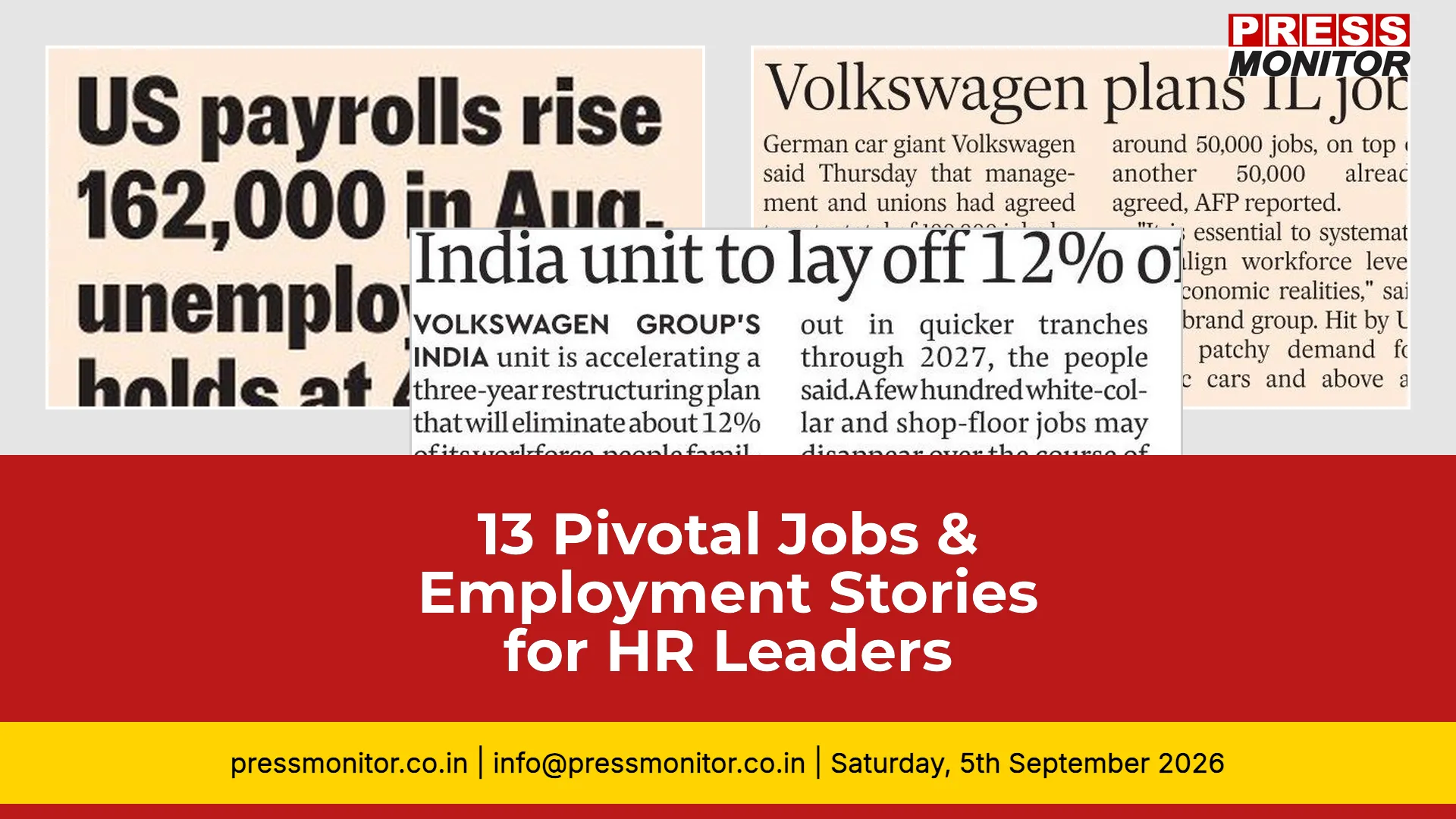
A front-page report in Free Press Journal says the United States nonfarm payroll employment increased by 162,000 in August, far above the average monthly gain of 31,000 over the previous 12 months, while the unemployment rate stayed at 4.1%, according to the United States Bureau of Labour Statistics. The August increase was led by food services and drinking places, which added 59,000 jobs, above their average monthly gain of 12,000 over the past year. Local government education added 42,000 jobs, largely offsetting a decline in the previous month, while manufacturing employment rose by 16,000 in August and was 58,000 above its recent low in December 2025.
Why it matters: Strong US hiring data signals continued economic resilience, influencing global capital flows and multinational expansion timelines.
Key detail/stat: Nonfarm payrolls jumped to 162,000 in August, far exceeding forecasts, while unemployment held steady at 4.1%.
Source: Free Press Journal
Next step: Review your Q4 hiring budgets against shifting interest rate expectations.
2. Volkswagen Plans 100,000 Job Cuts
A front-page report in Free Press Journal says Volkswagen has agreed with its unions to cut 100,000 jobs by the end of 2030, the largest restructuring in the global automotive industry. The German carmaker, headquartered in Wolfsburg, Germany, announced the plan amid US tariffs, weak electric‑car demand and fierce competition from China.
Why it matters: A historic automotive restructuring highlights supply chain volatility and the urgent need for agile talent redeployment strategies.
Key detail/stat: The German automaker agreed with unions to eliminate 100,000 roles by 2030 amid tariff pressures and EV demand shifts.
Source: Free Press Journal
Next step: Audit vendor and supplier contracts for workforce contingency clauses.
3. Volkswagen India Trims 12% Workforce
A front-page report in Financial Express says Volkswagen Group’s India division is accelerating a three-year restructuring plan to cut roughly twelve percent of its workforce by two thousand twenty-seven. The initiative aims to save tens of millions of US dollars ahead of launching next-generation vehicles after struggling to achieve sufficient market scale. While executives cite operational optimisation, employee representatives note that compulsory redundancies remain excluded under existing labour agreements through two thousand thirty.
Why it matters: Regional subsidiaries face immediate operational optimization mandates, impacting local manufacturing and service ecosystems.
Key detail/stat: VW India will reduce roughly 12% of its staff by 2027 to save tens of millions ahead of next-gen vehicle launches.
Source: Financial Express
Next step: Engage legal counsel on redundancy frameworks compliant with Indian labour agreements through 2030.
4. Rs 60,000 Crore PM-SETU Transforms Vocational Training
A front-page report in Free Press Journal says India is launching a Rs 60,000 crore vocational education transformation through the PM-SETU programme in 2026 to align workforce skills with industry needs. The initiative will modernise 1,000 Industrial Training Institutes across hubs like Bhubaneswar, Chennai, Hyderabad, Kanpur, and Ludhiana, granting employers a 51 percent controlling stake over cluster management and curriculum design. Skill Development Secretary Debashree Mukherjee emphasised that industry-backed funding will bridge the accelerating talent mismatch in sectors such as artificial intelligence, green hydrogen, and semiconductors.
Why it matters: Massive public-private skilling investments create new talent pools for AI, green hydrogen, and semiconductor sectors.
Key detail/stat: The programme modernises 1,000 ITIs and grants employers a 51% controlling stake over cluster curriculum design.
Source: Free Press Journal
Next step: Align corporate apprenticeship programs with PM-SETU industry clusters.
5. 7% Placement Rate In PMKVY Training
A front-page report in Business Standard says the government's PMKVY scheme has recorded placements of just 7 per cent of the 2.85 million candidates it has trained, with 200,224 placements as of August 28. The dashboard data reveals sharp sector-wise variation, with telecom recording the highest placement rate at 17.5 percent and management the lowest at 1.1 percent. The scheme, part of the Skill India Programme, has an approved outlay of 8,800 crore for 2022-23 to 2025-26, with 6,000 crore allocated to PMKVY 4.0.
Why it matters: Highlights a critical implementation gap between government skilling outlays and actual job market absorption.
Key detail/stat: Only 7% of 2.85 million trained candidates secured placements, with telecom leading at 17.5% and management lagging at 1.1%.
Source: Business Standard
Next step: Partner directly with high-placement sectors rather than relying solely on centralized schemes.
6. Gwalior Telecom Zone Land Allotment Opens
A front-page report in Times of India says M P Industrial Development Corporation Limited invites applications for land allotment in the Telecom Manufacturing Zone at Gwalior, Madhya Pradesh, starting 3 September 2026. The seventeen-acre facility offers plug-and-play infrastructure, a special policy package with capital subsidies up to Rs 200 crore, and fifty percent subsidy on export freight. Central support of Rs 243 crore from the Department of Telecommunications backs the project, which aims to create over ten thousand direct jobs.
Why it matters: New manufacturing corridors unlock localized job creation and reduce regional talent migration costs.
Key detail/stat: A 17-acre facility backed by Rs 243 crore central support aims to generate over 10,000 direct jobs.
Source: Times of India
Next step: Submit applications for plug-and-play infrastructure subsidies before the September window closes.
7. CG Power Starts Sehore Transformer Production
A front-page report in The Pioneer says CG Power and Industrial Solutions announced the rollout of the first power transformer from its new greenfield facility at Sehore, Madhya Pradesh, on Friday. Spread over 50 acres, the facility is India's largest single-location power transformer manufacturing facility with a capacity to roll out 35 power transformers every month, ranging from 220 kV to 1,200 kV class. Madhya Pradesh Chief Minister Mohan Yadav, who was the Chief Guest at the event, said the facility will create over 2,000 direct and indirect employment in Sehore.
Why it matters: Greenfield industrial expansions signal strong private sector confidence in power infrastructure and heavy engineering.
Key detail/stat: The 50-acre facility will produce 35 transformers monthly and create 2,000 direct and indirect roles.
Source: The Pioneer
Next step: Target recruitment campaigns toward Madhya Pradesh technical institutes.
8. Karnataka Launches Study Abroad 2026 Programme
A front-page report in Deccan Herald says the Government of Karnataka has launched the Study Abroad two thousand twenty-six initiative through the Karnataka Vocational Training and Skill Development Corporation. The programme aims to connect local students with more than ten global universities while providing comprehensive application and admission support. Officials including Minister for Medical Education D.K. Shivakumar and Chairperson Doctor G. Parameshwara attended a progress meeting ahead of the event scheduled for early September in Bengaluru.
Why it matters: State-led international education initiatives expand graduate mobility and cross-border skill acquisition pathways.
Key detail/stat: Connects local students with 10+ global universities, featuring ministerial oversight and application support.
Source: Deccan Herald
Next step: Evaluate partnership opportunities for sponsored executive education tracks.
9. 8.7 Percent Women Enter Indian Auto Jobs
A front-page report in Business Line says that women constitute just 8.7 percent of India’s automotive manufacturing workforce, facing substantial pay disparities and shift limitations. Major manufacturers including Tata Motors and Hero MotoCorp are expanding female recruitment and launching large-scale training initiatives, though smaller suppliers continue to struggle with infrastructure costs and hiring biases.
Why it matters: Gender diversity metrics remain a compliance and innovation priority as manufacturers scale production lines.
Key detail/stat: Women hold just 8.7% of automotive manufacturing roles, prompting Tata Motors and Hero MotoCorp to launch targeted training.
Source: Business Line
Next step: Benchmark your DEI hiring KPIs against sector averages and adjust shift infrastructure.
10. DA Hike For 85,000 Punjab Employees
A front-page report in Tribune says around 85,000 Punjab Government employees recruited after July 17, 2020, are set to benefit from a dearness allowance increase from 42 per cent to 60 per cent. AAP Punjab president and Industry Minister Aman Arora announced the decision as a Janamashtami gift, taken by a Cabinet sub-committee on employee grievances. The remaining 3.15 lakh employees have not received similar relief.
Why it matters: Public sector wage adjustments trigger ripple effects across state procurement budgets and contracted labor rates.
Key detail/stat: Dearness allowance rises from 42% to 60% for post-July 2020 recruits, announced as a Janamashtami policy move.
Source: Tribune
Next step: Update compensation forecasting models for state-linked project bids.
11. Employees Seek Pay Parity
A front-page report in Tribune says a government decision in India to offer specific pay relief to employees recruited after 2020, while excluding the pre-2020 workforce and 3.5 lakh pensioners, could reshape an ongoing confrontation with state employees. Sukhchain Khera, convenor of the Sanjha Mullazam Manch, an umbrella body of employee unions, said the decision taken on 17 July 2020 should be withdrawn and all employees placed under one pay structure based on the state pay commission. GS Johal, president of the Government College Retired Teachers Welfare Association, called for parity in dearness allowance for all, noting University Grants Commission pay scales are tied to the central pay framework.
Why it matters: Fragmented pay structures fuel union negotiations and impact retention across government and PSU networks.
Key detail/stat: Unions demand a unified pay commission framework, excluding pre-2020 hires and pensioners from recent relief.
Source: Tribune
Next step: Stress-test internal equity audits and prepare transparent communication playbooks.
12. India GDP Growth Faces Mistrust
A front-page report in Indian Express says the Union government released India's gross domestic product data for April to June on Monday, 18 July 2026, pegging growth at around 7.8 per cent amid growing public mistrust of official figures. The report attributes the distrust to weak employment, a shrinking labour force, falling wages, rising retail and food inflation, and poor consumer sentiment, citing Centre for Monitoring Indian Economy data and a Mahesh Vyas research note.
Why it matters: Macroeconomic data credibility directly influences investor sentiment and corporate expansion approvals.
Key detail/stat: Q1 growth pegged at 7.8%, yet consumer sentiment remains weak due to inflation and shrinking labor force participation.
Source: Indian Express
Next step: Diversify market entry strategies beyond headline GDP figures.
13. India Tops Global Unpaid Work Rankings
A front-page report in Tribune says India has the highest percentage of workers reporting sixteen or more unpaid working hours per week, according to a study by ADP's People at Work 2026. About twenty-four percent of Indian labourers work more than sixteen unpaid hours per week, and an additional forty percent put in six to fifteen hours of unpaid labour each week. The study notes that employees who put in more than sixteen unpaid hours are more likely to report being totally involved in their work, but this is accompanied by lower levels of thriving, perceived productivity, and intent to find another employment.
Why it matters: Excessive unpaid hours correlate with burnout, turnover risk, and declining perceived productivity.
Key detail/stat: 24% of Indian workers log 16+ unpaid hours weekly, with higher disengagement intent reported.
Source: Tribune
Next step: Implement strict overtime caps and wellness monitoring in high-volume operations.
This news on Jobs, Employment & Training reflects real-time editorial vetting across India’s print landscape. How is your organization adapting to these structural shifts?