15 Pivotal Media & Publishing Stories for Executives


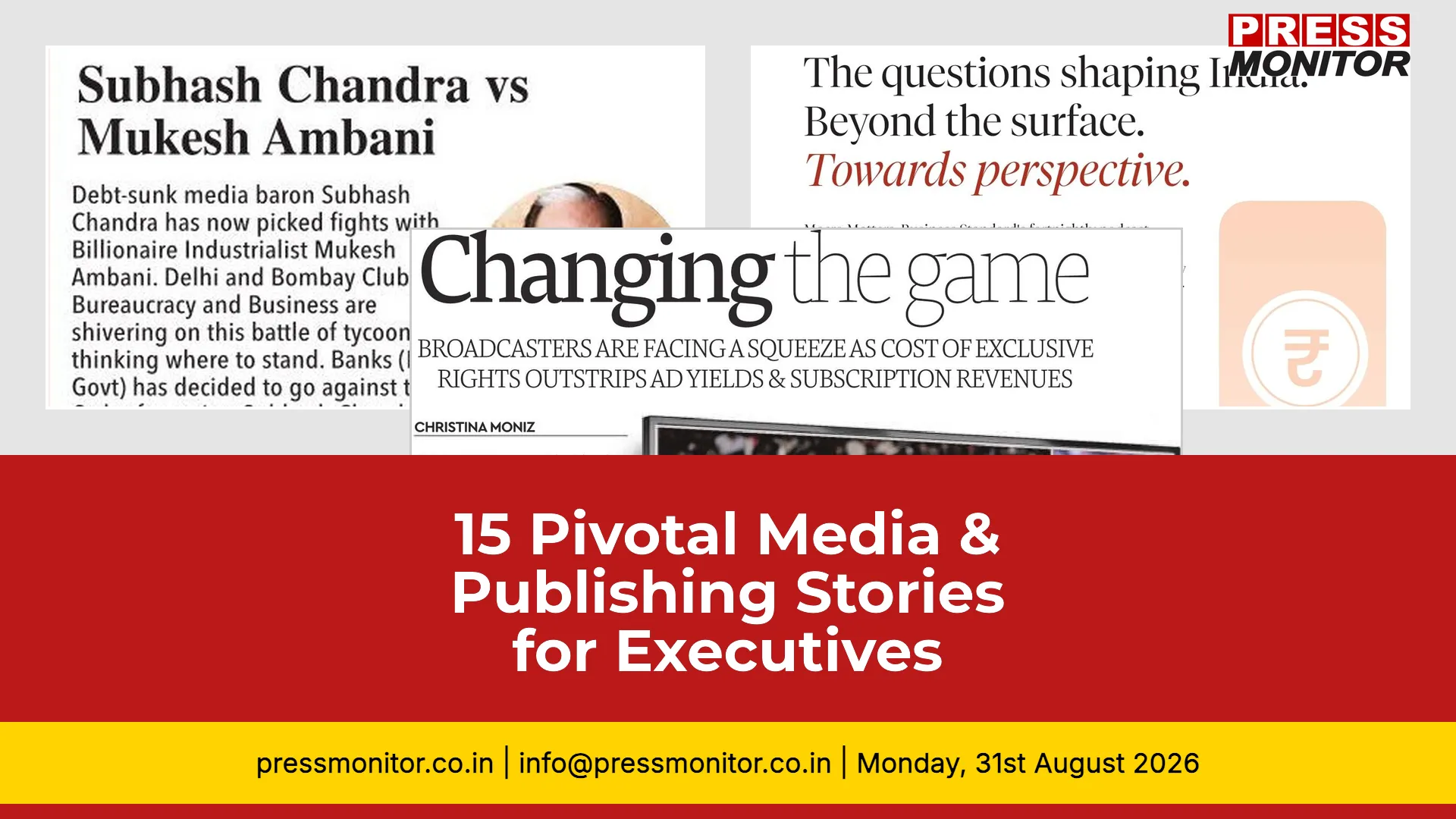
Today's print landscape delivers critical signals for media executives, broadcasters, and publishing leaders. According to Press Monitor's tracking of Indian publications, today's coverage highlights financial restructuring, rights auctions, editorial independence, and market pricing shifts. This press review synthesises the highest-impact developments using verified print data.
1. Debt-Sunk Media Baron Fights Billionaire Industrialist
A front-page report in The Pioneer says, debt-sunk media baron Subhash Chandra has now picked fights with billionaire industrialist Mukesh Ambani. Banks, read: Govt, has decided to go against the NCLT order favouring Subhash Chandra, who has now decided to give direct live in Social Media to answer public questions.
Why it matters: High-profile corporate rivalries directly impact market sentiment and sector consolidation trends.
Key detail: Subhash Chandra has escalated his public dispute with Mukesh Ambani, leveraging live social media engagement after banks challenged the NCLT order favouring him.
Source: The Pioneer
Next step: Monitor regulatory filings and creditor committee updates for early signals on sector consolidation.
2. Business Standard Launches Macro Matters Podcast
A front-page report in Business Standard says the publication has introduced a fortnightly podcast titled Macro Matters. The series features Editorial Director A.K. Bhattacharya and Senior Editor Ankur Bhardwaj decoding geopolitical and economic shifts affecting India.
Why it matters: Traditional publishers are expanding into audio to capture executive audiences and diversify revenue.
Key detail: Editorial Director A.K. Bhattacharya and Senior Editor Ankur Bhardwaj will decode geopolitical and economic shifts affecting India fortnightly.
Source: Business Standard
Next step: Evaluate audio distribution partnerships and sponsor alignment opportunities.
3. JioStar Faces Cricket Rights Squeeze
A front-page report in Financial Express says broadcasters are struggling as the cost of exclusive sports rights, particularly for cricket, outstrips advertising yields and subscription revenues. JioStar and Disney Star are navigating a "winner's curse" where high auction bids exceed standalone revenue potential, prompting a shift toward hybrid monetisation models and alternative sports like kabaddi and football.
Why it matters: Sports broadcasting economics are shifting as auction costs outpace ad yields and subscriptions.
Key detail: JioStar and Disney Star are navigating a winner's curse, prompting hybrid monetisation models and investments in alternative sports like kabaddi and football.
Source: Financial Express
Next step: Track streaming bundle strategies and regional sports league valuations.
4. Subhash Chandra Revises Total Due to Lenders
A front-page report in Business Line says Zee Group founder Subhash Chandra has revised the total outstanding dues owed to lenders to Rs 4,262 crore in his personal insolvency matter. The media baron stated that HDFC Group made claims without a valid personal guarantee and claimed he would settle the amount after reconciliation.
Why it matters: Personal insolvency proceedings for media founders create ripple effects across lender portfolios and asset valuations.
Key detail: Chandra revised outstanding dues to Rs 4,262 crore, contesting HDFC Group claims and citing lack of valid personal guarantee.
Source: Business Line
Next step: Review banking exposure reports for media conglomerates.
5. Indian Express: Not an Industry, But a Mission
A front-page report in the Morning Standard says the Indian Express is not an industry, but a mission. This statement underscores the newspaper's dedication to its principles and purpose. The report highlights the organization's commitment to its core beliefs, suggesting a broader significance beyond simply being a news outlet.
Why it matters: Editorial positioning influences brand loyalty and advertiser trust in polarised markets.
Key detail: Morning Standard highlights the newspaper's commitment to principles over commercial pressures, reinforcing its reputation for independent journalism.
Source: Morning Standard
Next step: Assess brand equity metrics and corporate sponsorship alignment.
6. HDFC Bank Appeals NCLT's Media Conglomerate Plan
A front-page report in Deccan Chronicle says that the National Company Law Tribunal's decision to approve a recovery plan for a media conglomerate has triggered legal action. While the plan secured eighty point eight percent approval from creditors, Union Bank of India and other lenders are challenging the deal due to concerns over transparency and the exceptionally low recovery amount.
Why it matters: Lender pushback against recovery plans signals tightening credit discipline in distressed media assets.
Key detail: Union Bank and other lenders challenge the deal citing transparency concerns and exceptionally low recovery amounts despite 80.8% creditor approval.
Source: Deccan Chronicle
Next step: Follow appellate tribunal schedules for precedent-setting rulings.
7. New Indian Express: A Legacy of Courage and Credibility
The New Indian Express is one of India's most respected English-language newspapers. Over the decades, it has remained committed to credible journalism, editorial independence and reporting in the public interest. Founded by Ramnath Goenka, the newspaper has been guided by the belief that journalism must inform citizens, strengthen democratic values and function without fear or favour. From its early years, The New Indian Express adopted an editorial philosophy that placed journalism above commercial considerations. Ramnath Goenka believed that the credibility of a newspaper was its greatest strength and that editorial decisions should never be influenced by political authority or financial interests.
Why it matters: Historical editorial independence remains a key differentiator for legacy newspapers competing with digital-native outlets.
Key detail: Founded by Ramnath Goenka, the paper maintains a philosophy placing journalism above commercial considerations, resisting political or financial influence.
Source: New Indian Express
Next step: Benchmark against competitor governance frameworks.
8. Chennithala Attacks Penguin Over Sonia Gandhi Memoir Row
A front-page report in Statesman says Kerala Home Minister and senior Congress leader Ramesh Chennithala has strongly criticised Penguin Random House India over the controversy surrounding the proposed Indian publication of Congress Parliamentary Party chairperson Sonia Gandhi's memoir Belonging: A Journey of Love.
Why it matters: Political pressure on publishers tests editorial independence and impacts distribution networks.
Key detail: Kerala Home Minister Ramesh Chennithala criticised Penguin Random House India over the proposed publication of Sonia Gandhi's memoir Belonging.
Source: Statesman
Next step: Monitor legal notices and state-level distribution guidelines.
9. HT Announces New Ad Rates from April 23
A front-page report in Hindustan Times says new advertising rates have been announced effective April 23, 2024, for Hindustan Times and Mint Delhi publications. The new rates vary based on city and page run, offering specific prices ranging from rupees two thousand five hundred to eleven thousand one hundred per square centimetre.
Why it matters: Rate card adjustments reflect inflationary pressures and audience valuation shifts in metro editions.
Key detail: Revised pricing ranges from Rs 2,500 to Rs 11,100 per square centimetre, varying by city and page run including Delhi Metro and Full Run.
Source: Hindustan Times
Next step: Align Q4 marketing budgets with updated inventory pricing.
10. Time Is Right for BCCI to Work on Plan B & C
A front-page report in Times of India says the Board of Control for Cricket in India is reluctant to seek better price discovery for upcoming IPL and domestic bilateral media rights, sparking concerns among cricket stakeholders that JioStar may be the only bidder. BCCI officials need to develop Plan B and Plans to attract non-traditional players like YouTube and Netflix to ensure sustainable value for the game.
Why it matters: Monopoly bidding risks undervalue national sports assets and limit ecosystem growth.
Key detail: BCCI officials are urged to invite non-traditional bidders like YouTube and Netflix to ensure sustainable value discovery for IPL and domestic rights.
Source: Times of India
Next step: Track tender documentation and bidder eligibility criteria.
11. Rate Card Tributes to TOID Capital
A front-page report in The Economic Times says that TOID Capital has introduced a new rate card for tributes and placements, extending benefits to various newspapers including NBT, TOI, and others within Delhi+NCR.
Why it matters: Specialised rate cards expand tribute placements across Delhi+NCR publications, creating new inventory streams.
Key detail: TOID Capital extended benefits to NBT, TOI, and other regional partners, standardising placement fees.
Source: Economic Times
Next step: Evaluate family announcement ROI and local government tie-ups.
12. Subhash Chandra's Controversial Verdict
A front-page report in The Hans India says Subhash Chandra, founder of Zee and Essel Group, received a favourable verdict from the National Company Law Tribunal (NCLT) that approved his repayment plan of Rs 6.25 crore to creditors and Rs 25 lakh towards insolvency-process costs against admitted claims of Rs 22,006.57 crore.
Why it matters: NCLT approvals for minimal repayment plans against massive admitted claims reshape insolvency expectations for media promoters.
Key detail: The tribunal approved a Rs 6.25 crore repayment plan plus Rs 25 lakh costs against admitted claims of Rs 22,006.57 crore.
Source: The Hans India
Next step: Watch for Supreme Court appeals and RBI circular updates.
13. Media Delegation Surveys Jammu's Heritage and Development Projects
A front-page report in State Times says...A media delegation from Ahmedabad arrived in Jammu on Sunday as part of a press tour organised by Press Information Bureau (PIB) to familiarise journalists with the region's cultural heritage, developmental initiatives, and major infrastructure projects. The team visited historic sites including Amar Mahal Palace and Raghunath Temple, and is scheduled to engage with officials overseeing projects such as the Delhi-Amritsar-Katra Expressway, Salal Hydroelectric project, and Biotech Park in Kathua. The 4-day visit aims to provide firsthand exposure to the transformative initiatives of the central government across Jammu Division.
Why it matters: Government press tours shape regional narrative framing and infrastructure reporting standards.
Key detail: Ahmedabad journalists visited Amar Mahal Palace, Salal Hydroelectric project, and Biotech Park Kathua under PIB coordination.
Source: State Times
Next step: Leverage regional coverage for CSR and stakeholder communications.
14. Case of Mistaken Coverage
A front-page report in New Indian Express says: Two journalists reached Chennai airport to cover the return of Nepal flood survivors. Soon enough, they were surrounded by television cameras, microphones and reporters, mistaking the journos for the relatives of those stranded in Nepal.
Why it matters: Operational missteps during high-sensitivity events highlight the need for rigorous field verification protocols.
Key detail: Two journalists were surrounded by TV crews at Chennai airport while covering Nepal flood survivors, mistaking them for stranded relatives.
Source: New Indian Express
Next step: Implement pre-briefing checklists for crisis deployment teams.
15. Started in PR
A front-page report in New Indian Express says student-run media committees in India's higher education institutions are taking on responsibilities beyond organising fests. These teams manage institutional content, digital platforms, and media outreach at colleges like IIM Indore and BITS Pilani Hyderabad to shape campus public images.
Why it matters: Student-run media committees are evolving into professional pipelines for institutional communications.
Key detail: Teams at IIM Indore and BITS Pilani Hyderabad now manage digital platforms, campus content, and media outreach beyond traditional fests.
Source: New Indian Express
Next step: Partner with campuses for talent acquisition and brand ambassador programs.
Closing: These developments underscore how print media intelligence continues to surface actionable signals before digital echo chambers amplify them. How will your organisation adapt to shifting rights valuations and editorial independence benchmarks? Tracked by Press Monitor.
