15 Pivotal Startups & Entrepreneurship Stories for Founders & VCs


Tracking the pulse of India's innovation ecosystem requires precise media monitoring. This press review distills today's most critical developments across venture capital, deep tech, and policy. According to Press Monitor's tracking of Indian publications, here are the fifteen defining moves shaping the quarter.
1. Nvidia Acquires Hugging Face
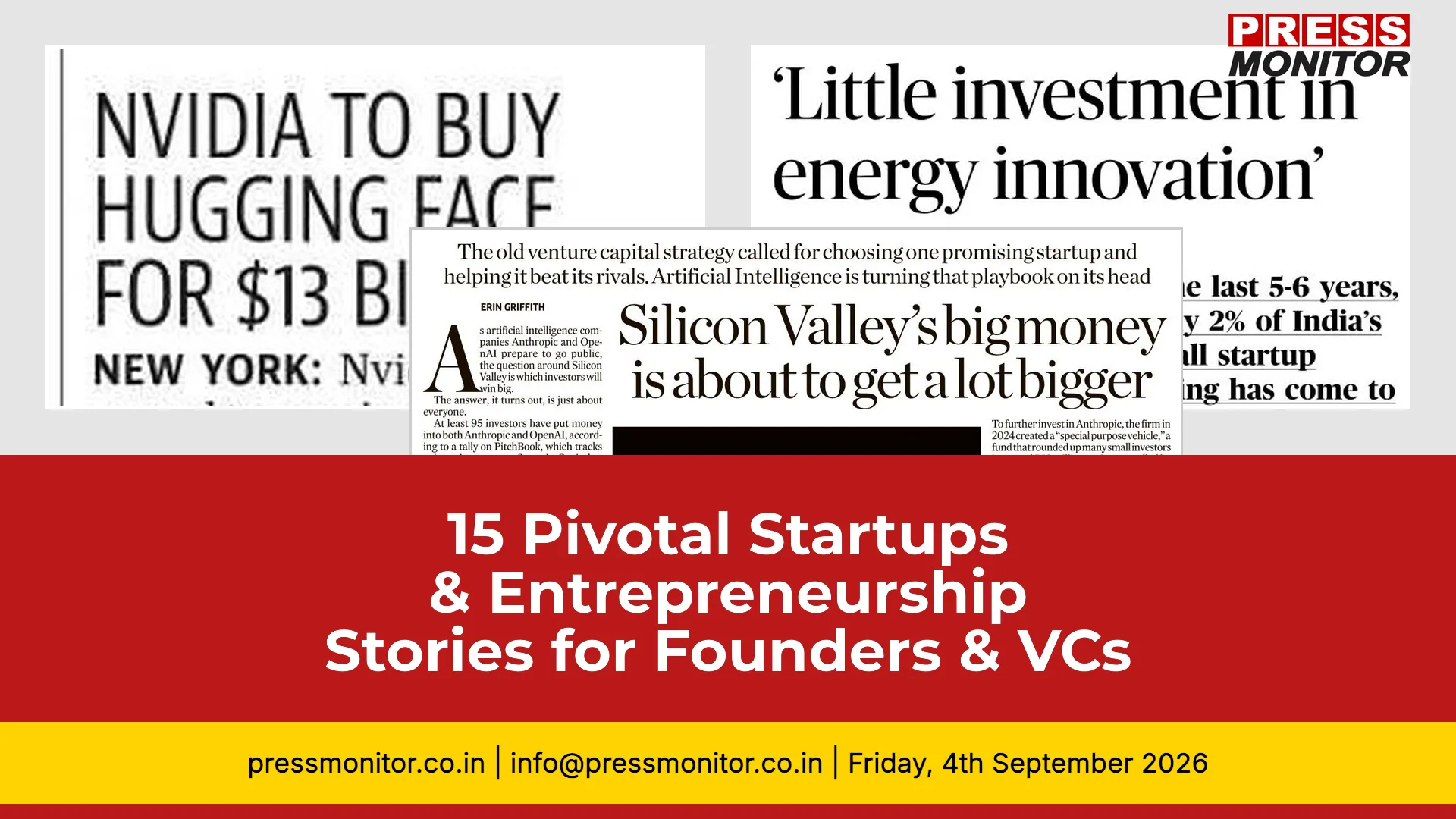
A front-page report in Hindustan Times says Nvidia Corp. has agreed to acquire artificial intelligence startup Hugging Face in a transaction valued at about $13 billion. The price includes an up to $1 billion equity-based retention program for Hugging Face employees that join Nvidia. The chipmaker giant said it will keep Hugging Face's platform open and consistent with the startup's existing practices.
Why it matters: Consolidates open-source AI infrastructure under a single compute giant.
Key detail: Transaction valued at ~$13B includes a $1B equity-based retention program; platform commitment remains open.
Source: Hindustan Times
Next step: Enterprise teams should audit their current model pipelines ahead of integration.
2. Energy Sector Funding Gap
A front-page report in The Hindu says Indian Oil Corporation Ltd chairman A. S. Sahney lamented that energy innovation in India received very little attention and capital. He stated that in the last 5 to 6 years, barely 2 percent of India's overall startup funding went to the energy sector, and only Rs 11,000 crore of the Rs 5.5 lakh crore spent on startups reached the energy sector. He said the situation needs to be corrected quickly as India's energy demand will double in 15 to 20 years.
Why it matters: Highlights a critical capital mismatch in India's clean transition.
Key detail: IOCL Chairman A.S. Sahney notes barely 2% of total startup funding reached energy over five years, totaling just Rs 11,000 crore against surging demand.
Source: The Hindu
Next step: Climate VCs and corporate strategists must reallocate capital toward grid-scale storage and green hydrogen.
3. Dual-Backed AI Giants
A front-page report in Deccan Herald says at least 95 investors have put money into both Anthropic and OpenAI, including Sequoia Capital and Founders Fund. Anthropic has raised more than 130 billion dollars from roughly 300 investors, while OpenAI has raised more than 180 billion from about 230 investors. The AI boom has changed Silicon Valley norms, with top venture firms shifting strategies to avoid missing out on the next trillion-dollar winner.
Why it matters: Proves institutional investors refuse to pick sides in the foundational model race.
Key detail: At least 95 firms, including Sequoia and Founders Fund, hold stakes in both Anthropic and OpenAI, reshaping Silicon Valley risk calculus.
Source: Deccan Herald
Next step: LPs should monitor dual-exposure strategies as regulatory scrutiny intensifies.
4. Sugar Cosmetics & Slice Valuation Reset
A front-page report in Economic Times says Sugar Cosmetics and Slice are raising capital amid significant valuation cuts, with the direct-to-consumer beauty brand seeking funds at a Rs 4,275–4,465 crore valuation and fintech lender Slice targeting comparable reduced metrics. The fundraising comes as both companies navigate mounting losses, shrinking revenues, and intensifying market competition following their previous peak valuations of roughly Rs 11,000 crore each. Existing investors including A1 Partners, 8i Ventures, L Catterton, and Elevation Capital are expected to participate in the new financing rounds to support working capital and growth.
Why it matters: Marks the end of hyper-growth pricing in D2C and fintech.
Key detail: Both brands raise capital at slashed metrics (Sugar targeting Rs 4,275–4,465 crore vs past Rs 11,000 crore peak) amid revenue contraction and burn-rate pressures.
Source: Economic Times
Next step: Operators must pivot to unit economics and sustainable CAC before next fundraising.
5. Cradlewise Secures Series A
A front-page report in Business Standard says AI-first health and wellness startup Cradlewise has raised a $12 million Series A funding round led by 3One4 Capital and Prudent Investment Management. The company focuses on infant and child sleep and plans to use the capital for growth, channel expansion, product research and development, and geographic expansion. To date, Cradlewise has raised a total of $26 million.
Why it matters: Validates AI-first maternal health tech in emerging markets.
Key detail: Raised $12M led by 3One4 Capital and Prudent Investment Management for product R&D and geographic expansion.
Source: Business Standard
Next step: Healthtech founders should benchmark Cradlewise's channel strategy for rural penetration.
6. Leanwatts Seeds Power Conversion Play
A front-page report in Business Standard says Leanwatts raised rupees one point eight five crore in seed funding led by Trivest Partners with angel investors Abraham George and Alok Rungta. The Hyderabad‑based startup plans to use the capital to expand manufacturing capacity, strengthen research and development, and accelerate new power conversion platforms. Founded in October twenty twenty‑three, Leanwatts, led by former BITS Pilani and NIT Surathkal alumni, offers high‑power‑density chargers for electric two‑wheelers, L2 and L5 vehicles and e‑tractors, working with OEMs such as Ultraviolette and Moonrider.
Why it matters: Addresses critical charging infrastructure bottlenecks for EV two-wheelers and agri-machinery.
Key detail: Hyderabad startup secures ₹1.85 crore from Trivest Partners to scale manufacturing with OEM partners like Ultraviolette.
Source: Business Standard
Next step: Supply chain directors should track domestic power electronics localization trends.
7. Exato Technologies Hits BSE SME
A front-page report in Business Standard says Exato Technologies listed its Initial Public Offer on the BSE SME Platform on December 5, 2025, under Scrip Code 544626. The company positions itself as a technical partner for enterprise AI and customer experience, with a strong order book of approximately 660 crore dollars and growing intellectual property investments. Leadership appointments include new Chief AI Officer Muralidharan Menon and other senior executives to support international expansion.
Why it matters: Demonstrates appetite for enterprise AI and CX platforms among retail and institutional traders.
Key detail: Lists under Scrip Code 544626 with an order book near $660 crore and new Chief AI Officer Muralidharan Menon appointed.
Source: Business Standard
Next step: Portfolio managers should evaluate SME-listed AI vendors for mid-cap exposure.
8. Accel’s Subrata Mitra on India AI
A front-page report in Economic Times says that on 18 July 2026, Anirban Chowdhury spoke with Accel’s Subrata Mitra in India about the venture funding slowdown and India’s realistic artificial intelligence opportunity. The conversation examined where India can make practical bets in AI and why deeptech, spacetech and advanced manufacturing could drive the next startup wave.
Why it matters: Provides a realistic VC roadmap beyond generative hype.
Key detail: Mitra highlights deeptech, spacetech, and advanced manufacturing as the next wave, urging practical bets over speculative scaling.
Source: Economic Times
Next step: Founders should align pitch decks with Mitra's sector-specific validation frameworks.
9. Nidhi Pant Takes Social Entrepreneur Award
A front-page report in Indian Express says that Nidhi Pant, co‑founder of S4S Technologies, was honoured with the 17th Social Entrepreneur of the Year Award India 2026. The award recognised Pant’s work in developing biotechnology solutions that convert waste into bio‑based products and sustainable agricultural inputs, and highlighted S4S Technologies’ farm‑factory model that supports small‑holder women farmers. The ceremony brought together representatives from government, business, academia, philanthropy and civil society to celebrate scalable social innovations across agriculture, livelihoods, healthcare, education and climate resilience.
Why it matters: Showcases scalable biotech solutions bridging waste management and agricultural livelihoods.
Key detail: Co-founder of S4S Technologies honored for farm-factory models supporting smallholder women farmers.
Source: Indian Express
Next step: Impact investors should study S4S's circular economy unit economics.
10. Bengaluru Targets $400B Economy
A front-page report in Deccan Herald says that Bengaluru's economic master plan aims to transform the Bengaluru Metropolitan Region into a $400 billion economy by 2037 through five key growth drivers including IT, artificial intelligence, infrastructure, and planned urbanisation. The plan was prepared with the Karnataka government and ISEG Foundation as the knowledge partner, and envisions the creation of 2 to 2.5 million jobs. It proposes dedicated IT and GCC hubs, deep-tech sandboxes, a dedicated AI mission, major public transport expansion, and a second airport alongside affordable housing and a slum rehabilitation programme.
Why it matters: Municipal planning directly impacts startup talent pools and infrastructure costs.
Key detail: Master plan envisions 2–2.5 million jobs, dedicated AI missions, deep-tech sandboxes, and expanded public transit by 2037.
Source: Deccan Herald
Next step: HR leaders and facility planners should factor Bengaluru's zoning shifts into expansion timelines.
11. UPPPC Launches Med-Tech Accelerator
A front-page report in Times of India says the Uttar Pradesh Promote Pharma Council has launched the Med-Tech Launcher Program 2026 to bridge the Valley of Death in India's MedTech ecosystem. The initiative supports high-potential innovations at Technology Readiness Levels 7 to 9, offering strategic assistance with regulatory compliance, clinical trials, and market commercialization. Applications are invited from MedTech startups, academic institutions, and biomedical enterprises seeking validation access across Uttar Pradesh.
Why it matters: Bridges the Valley of Death for clinical-stage hardware innovations.
Key detail: Supports TRL 7–9 devices with regulatory navigation, trial design, and commercialization access across Uttar Pradesh.
Source: Times of India
Next step: Medtech founders should apply before Q1 deadlines to secure state-backed validation pathways.
12. UP Govt Seeks Biomedical Innovators
A front-page report in Times of India says the Uttar Pradesh government has invited applications from medical technology startups, academic institutions, and research laboratories for its new healthcare innovation initiative. The Uttar Pradesh Promote Pharma Council is seeking advanced biomedical devices, in-vitro diagnostics, biosensors, and point-of-care technologies with trial readiness levels seven to nine to accelerate clinical validation and scaling across the state.
Why it matters: Expands state-level procurement and pilot opportunities for diagnostic startups.
Key detail: Inviting applications for biosensors, point-of-care tech, and advanced diagnostics ready for clinical scaling.
Source: Times of India
Next step: Commercial heads should register portfolios with UPPPCC for direct government tender eligibility.
13. BIO-NIVESH Biotech Capital Platform
A front-page report in State Times says Union Minister Dr Jitendra Singh launched BIO-NIVESH, a strategic platform to strengthen engagement between biotechnology innovators and investors. The inaugural event at Ambedkar International Centre brought together 20 high-potential startups and around 50 investors to accelerate private capital into promising technologies for scale-up and commercialisation.
Why it matters: Centralizes investor-innovator matchmaking for high-potential life sciences ventures.
Key detail: Union Minister Dr Jitendra Singh inaugurated the platform, convening 20 startups and 50 investors for rapid capital deployment.
Source: State Times
Next step: Biofounders should prepare data rooms aligned with BIO-NIVESH due diligence checklists.
14. MSME Parks Drive Women Entrepreneurship
A front-page report in Free Press Journal says MSME and Rural Poverty Alleviation Minister Kondapalli Srinivas urged women to become successful entrepreneurs for societal progress at an MSME Growth Workshop in Vijayawada on Wednesday. The minister highlighted that MSMEs contribute around 30 per cent to the country's GDP and generate more than 50 per cent of employment, while the government is establishing MSME parks in every constituency to promote local entrepreneurship. He noted that nineteen parks have already been launched with another 138 under progress, collectively expected to facilitate 2,876 industrial units, attract Rs 8,000 crore in investments and create 1.03 lakh jobs.
Why it matters: Policy infrastructure directly correlates with female founder participation rates.
Key detail: Minister Kondapalli Srinivas highlighted 19 operational parks attracting Rs 8,000 crore investment and creating 1.03 lakh jobs nationwide.
Source: Free Press Journal
Next step: Female-led startups should leverage park subsidies for early-stage capex reduction.
15. IIM Jammu & Mission YUVA Incubation MoU
A front-page report in State Times says IIM Jammu's Faculty of Entrepreneurship and Innovation Studies and Development, along with Mission YUVA, signed a tripartite Memorandum of Understanding in Jammu to promote new innovative enterprises in Jammu and Kashmir. The ceremony was led by Professor Jabir Ali, Dean of Faculty and Research, with signatories including Dr. Mugbil Burhan, Chairperson of the Centre for Entrepreneurship and Innovation Studies and Development, Dr. Vivek Sharma, Chief Innovation Officer, and Paramjeet Raina, Joint Director Employment of Mission YUVA. Separately, Government Degree College Bani organized a UDYAM JAGRITI 5.0 Hackathon under Mission YUVA with Principal Professor Neena Gupta and Doctor J.S. Sodan, and Project Director Mukhtar Malik participating.
Why it matters: Academic-commercial partnerships accelerate regional startup density outside metros.
Key detail: Tripartite agreement focuses on innovative enterprise creation in Jammu and Kashmir, complemented by UDYAM JAGRITI hackathons.
Source: State Times
Next step: University tech-transfer offices should adopt Mission YUVA's mentorship architecture.
According to Press Monitor's tracking of Indian publications, these fifteen developments collectively signal a maturation phase: capital is becoming selective, policy is enabling hardware and climate plays, and valuation discipline is returning. Which shift demands immediate strategic action in your sector? Share your take below.