17 Critical Logistics & Supply Chain Stories for Executives


This week's print landscape reveals a seismic shift in how Indian logistics, freight, and supply chains are adapting to demand spikes, policy incentives, and global trade realignments. According to Press Monitor's tracking of Indian publications, executives who act on these verified developments will secure a decisive operational edge. Below is your essential press review of the week's highest-impact moves.
1. Logistics firms brace for festival runs
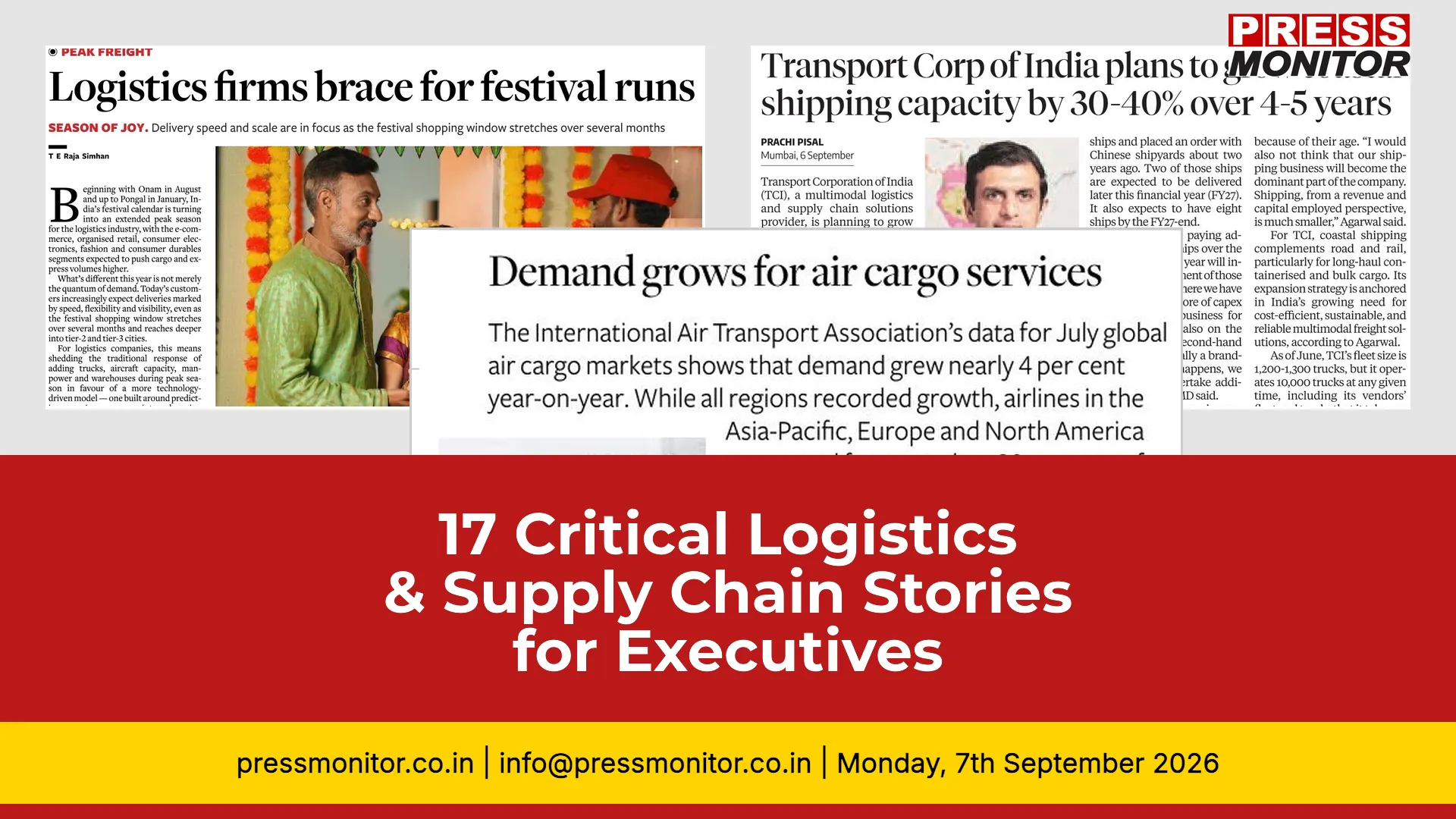
A front-page report in Business Line says India's logistics industry is preparing for an extended festival peak season from August to January, with e-commerce, organised retail, and consumer electronics expected to drive cargo and express volumes higher across tier-2 and tier-3 cities. Companies like Flipkart, Blue Dart, DTDC, and FreightFox are shifting from traditional capacity additions to technology-driven models using predictive analytics, distributed fulfilment, and multimodal networks to manage demand. Officials noted that rising customer expectations for speed, flexibility, and visibility are transforming festival logistics into a test of network intelligence rather than just freight capacity.
Why it matters: Peak season capacity planning directly impacts customer retention and margin protection.
Key detail: Companies like Flipkart, Blue Dart, DTDC, and FreightFox are pivoting to predictive analytics and distributed fulfilment rather than traditional fleet additions.
Source: Business Line
Next step: Audit your tier-2 and tier-3 network visibility tools ahead of August-January volumes.
2. TCI Targets Coastal Shipping Growth
A front-page report in Business Standard says Transport Corporation of India plans to increase its coastal shipping capacity by 30 to 40 per cent, to 94,000 tonnes of deadweight tonnage, over four to five years. The plan was outlined in Mumbai on 6 September by Managing Director Vineet Agarwal, who said the company currently has almost 78,000 tonnes of deadweight tonnage and expects to add 15,000 to 16,000 tonnes with two new ships due this financial year. The expansion strengthens Transport Corporation of India's multimodal logistics capabilities across road, rail and coastal shipping, with Rs 200 crore earmarked for the shipping business this year and Rs 400 to Rs 500 crore planned annually from financial year 27 to financial year 30.
Why it matters: Multimodal diversification reduces road dependency and cuts transit costs.
Key detail: Transport Corporation of India plans to raise coastal shipping capacity by 30-40% to 94,000 DWT, backed by Rs 200 crore this FY and up to Rs 500 crore annually through FY30.
Source: Business Standard
Next step: Evaluate coastal routing options for bulk commodities to offset highway congestion.
3. Air Cargo Demand Grows Nearly 4 Per Cent
A front-page report in Business Line says global air cargo demand grew nearly 4 per cent year-on-year in July. Asia-Pacific, Europe and North America accounted for more than 90 per cent of the increase, with dedicated freighters gaining market share as belly-hold traffic declined. IATA Senior Vice-President Sustainability and Chief Economist Marie Owens Thomsen notes the outlook remains positive but higher fuel prices, geopolitical tensions and tariff uncertainty need careful watching.
Why it matters: Belly-hold decline signals a structural shift toward dedicated freighter networks.
Key detail: Asia-Pacific, Europe, and North America drove over 90% of July gains, with fuel prices and tariff uncertainty requiring active hedging strategies.
Source: Business Line
Next step: Lock in dedicated air cargo contracts for high-value exports before Q4 rate hikes.
4. India InvITs Target Rs 720 Crore Assets
A front-page report in Mint says India's Infrastructure Investment Trusts will target over Rs 720 crore in assets by 2030, expanding beyond roads and telecom into power, shipping, logistics, data centres, ports and railways. N.S. Venkatesh, CEO of the Bharat InvITs Association, said the near-tripling of the current Rs 27.3 crore asset base will be driven by a growing pipeline of operational infrastructure assets and the need to recycle capital into new projects.
Why it matters: Capital recycling is unlocking funding for next-gen logistics infrastructure.
Key detail: Bharat InvITs Association CEO N.S. Venkatesh projects near-tripling of the asset base, expanding into power, shipping, logistics, data centres, ports, and railways.
Source: Mint
Next step: Align capex pipelines with InvIT-backed project financing windows.
5. India InvITs target 220 lakh crore assets by 2030
A front-page report in Hindustan Times says India's infrastructure investment trusts (InvITs) are targeting more than 220 lakh crore in assets by 2030, expanding beyond roads and telecom into power, shipping, logistics, data centres, ports, and railways. N. S. Venkatesh, CEO of the Bharat InvITs Association, said the near-tripling of the current asset base of about 27.3 lakh crore will be driven by a growing pipeline of operational infrastructure assets and the need to recycle capital into new projects.
Why it matters: Macro-scale infrastructure growth will redefine last-mile and intermodal corridors.
Key detail: The pipeline targets over 220 lakh crore in operational assets by 2030, driven by public-private partnerships and regulatory tailwinds.
Source: Hindustan Times
Next step: Map long-term lease opportunities on InvIT-developed logistics parks.
6. 18-tonne Payload Rentals Shift
A front-page report in Business Line says rental charges for an eighteen-tonne payload truck changed across major Indian routes as of August 20 and September 3, according to Subham Freight Carriers India Pvt Ltd. The table shows fares ranging from seventy-two thousand rupees for Mumbai to Pune back to Mumbai to two lakh eighty-eight thousand rupees for Delhi to Thiruvananthapuram back to Delhi, with changes from flat rates to increases of five point four one percent on Mumbai to Nashik back to Mumbai.
Why it matters: Route-specific pricing volatility demands dynamic freight brokerage models.
Key detail: Subham Freight Carriers reports fare adjustments ranging from Rs 72,000 (Mumbai-Pune-Mumbai) to Rs 2.88 lakh (Delhi-Thiruvananthapuram-Delhi), with flat rates giving way to percentage increases.
Source: Business Line
Next step: Implement automated rate-shopping algorithms for heavy payload routes.
7. India EV Truck Financing Push
A front-page report in Mint says manufacturers are concerned about whether electric trucks with battery-swapping capabilities will qualify for incentives under the new EV financing scheme for e-trucks, as the rollout under PM E-Drive has been limited with only 52 electric trucks receiving subsidies as of 6 September. The move comes as Prime Minister Narendra Modi's administration seeks to reduce diesel use in freight transport, with industry stakeholders including Amit Bhatt of the International Council on Clean Transportation calling for parity between fixed-battery and battery-swapping models.
Why it matters: Policy parity between fixed-battery and battery-swapping trucks dictates fleet electrification ROI.
Key detail: Only 52 e-trucks have received PM E-Drive subsidies so far, prompting industry calls for equal incentive treatment to accelerate diesel displacement.
Source: Mint
Next step: Engage policymakers on subsidy standardization while piloting swap-compatible vehicles.
8. ₹9,852 Crore E-Truck Battery Swap Plan
A front-page report in Mint says the ministry of heavy industries is considering a nine thousand eight hundred fifty-two rupees crore programme to provide financial incentives for battery-swappable electric trucks. The move aims to address the shortage of charging infrastructure that is slowing the adoption of electric commercial vehicles in India. Heavy vehicles account for nearly a third of India's diesel usage and over thirty-four percent of transport-related carbon emissions.
Why it matters: Infrastructure investment removes range anxiety for commercial operators.
Key detail: The Heavy Industries Ministry is considering a Rs 9,852 crore incentive programme to address charging shortages, targeting heavy vehicles that account for 34% of transport emissions.
Source: Mint
Next step: Secure early-access slots for depot-level swapping stations in high-density corridors.
9. ORN Integrates European Travel Logistics
A front-page report in Economic Times says European travel operator ORN has integrated its fragmented logistics network into a single operating system to reduce costs and enhance customer experience. The asset heavy firm directly manages transportation, contracted hotels, and route planning across Europe. The venture is backed by prominent Indian business leaders including Shikhar Malhotra, Television Mohandas Pai, Vani Kola, Doctor Ranjan Pai, and Bader Kanoo.
Why it matters: Asset-heavy vertical integration proves viable beyond traditional freight.
Key detail: Backed by Shikhar Malhotra, Television Mohandas Pai, Vani Kola, Dr Ranjan Pai, and Bader Kanoo, ORN consolidated fragmented transport, hotel, and route planning into a single OS to cut vendor margins.
Source: Economic Times
Next step: Study ORN's operating model for potential replication in domestic B2B service layers.
10. Embraer Accelerates India Supply Chain Expansion
A front-page report in Business Line says Embraer is accelerating its India supply chain expansion across commercial and defence aviation segments. The aerospace major has signed an MoU with Hindalco Industries for aerospace-grade aluminium raw material manufacturing and partnered with Adani Defence & Aerospace to establish a final assembly line for the E75 aircraft in India.
Why it matters: Aerospace localization creates high-margin manufacturing and MRO opportunities.
Key detail: Embraer signed an MoU with Hindalco for aerospace-grade aluminium and partnered with Adani Defence & Aerospace for E75 final assembly line setup.
Source: Business Line
Next step: Qualify Tier-2 suppliers for defence and commercial aviation component standards.
11. India Supplies 60 Per Cent Of European Diesel
A front-page report in Financial Express says India supplied roughly 60 per cent of diesel transiting the Bab-el-Mandeb Strait to Europe in August. With Russian exports severely constrained and US shipments weakening, Indian refineries are stepping up to meet eastern European demand. Despite this export surge, crude intake into India fell for a second straight month to approximately 3.8 million barrels daily.
Why it matters: Refining export dynamics are reshaping global energy trade flows.
Key detail: Indian refineries filled the gap left by constrained Russian and weakening US shipments, moving roughly 60% of diesel transiting Bab-el-Mandeb to Europe in August.
Source: Financial Express
Next step: Hedge crude intake costs while capitalizing on product export premiums.
12. Assocham Urges Visa And Magnet Resolution
A front-page report in Business Line says Assocham has written to the Secretary of the Ministry of External Affairs proposing structured inter-ministerial engagement with the Chinese Ambassador on residual visa, technology movement, and supply chain matters. The industry body highlights that visa curbs and restrictions on rare earth permanent magnets have disrupted manufacturing, and urges the government to give permanence to recent visa facilitation measures.
Why it matters: Geopolitical friction directly impacts rare earth supply chains and manufacturing continuity.
Key detail: Assocham requested structured engagement with the Chinese Ambassador to resolve visa curbs and permanent magnet restrictions disrupting domestic production lines.
Source: Business Line
Next step: Diversify critical component sourcing and monitor BRICS trade facilitation outcomes.
13. India Becomes Major Defence Exporter
A front-page report in Financial Express says India has already demonstrated growing momentum in defence exports, supported by international interest generated by several indigenous defence platforms. The ability to manufacture and support complete systems will strengthen India's position in global markets by allowing industry to offer integrated solutions.
Why it matters: Indigenous capability scaling opens integrated solution markets globally.
Key detail: International interest in platforms like Tejas and Pinaka is driving demand for complete system manufacturing and sustainment contracts.
Source: Financial Express
Next step: Position OEM partnerships around export-ready configuration packages.
14. Piyush Goyal Urges Pharma R&D Investments
A front-page report in Economic Times says Commerce and Industry Minister Piyush Goyal called for making the pharmaceutical sector more attractive for investments in clinical trials and research and development. He urged the industry to build resilient supply chains and reduce dependence on single sources for imports, warning that supply chains can be weaponised. Goyal also stated India needs to move beyond generics and promote R&D, patenting, and biotech innovation.
Why it matters: Supply chain resilience requires moving beyond generic dependency.
Key detail: Commerce Minister Piyush Goyal warned that supply chains can be weaponised, urging industry focus on clinical trials, patenting, and biotech innovation.
Source: Economic Times
Next step: Allocate R&D budget to high-barrier therapeutic segments with export potential.
15. India Missile Production Boosts Defence
A front-page report in Financial Express says that Indian industry has the potential to develop a broader domestic supply chain for manufacturing and integrating complete missile systems. This could gradually reduce reliance on imported platforms and foreign suppliers, while improving resilience against supply-chain disruptions and geopolitical restrictions.
Why it matters: Domestic integration reduces foreign supplier lock-in risks.
Key detail: Industry experts highlight the potential to build end-to-end missile supply chains, insulating strategic programs from geopolitical export controls.
Source: Financial Express
Next step: Invest in precision machining and guidance system sub-assemblies.
16. Russia buys back Indian petrol
A front-page report in Financial Express says Russia is now buying back petrol from India even as it supplies two point five to two point six million barrels per day of crude to Indian refiners. Recent Urals purchases have moved to around a one dollar per barrel premium to Brent rather than wider discounts yielding no pricing advantage for Indian refiners. Ukrainian attacks have disrupted Russian refining operations and tightened domestic supply prompting the rare reversal in oil trade with India's direct gasoline exports to Russia averaging about seventeen thousand one hundred forty six barrels per day in June and thirty seven thousand two hundred fifty five barrels per day in July.
Why it matters: Unusual trade reversals signal shifting refinery economics and regional demand.
Key detail: Direct gasoline exports to Russia averaged 17,146 bpd in June and 37,255 bpd in July, even as Russia supplies 2.5-2.6 million bpd of Urals crude to India.
Source: Financial Express
Next step: Optimize blending ratios and track Baltic premium movements.
17. Indian Immunologicals confirms fake rabies vaccine batch not exported
A front-page report in Economic Times says Indian Immunologicals Ltd confirmed that no part of a counterfeit Abhayrab rabies vaccine batch seized in Delhi was exported, reassuring international health authorities. Delhi Police arrested four people and seized fake vials from a residential premises, while the Central Drugs Standard Control Organisation tightened surveillance across the country. The manufacturer stated that batch release certification from the Central Research Institute in Kasauli ensures vaccines reach patients only through authorised supply chains.
Why it matters: Quality control integrity remains non-negotiable for pharma supply chains.
Key detail: Delhi Police seized counterfeit Abhayrab vials; the manufacturer reaffirmed that Central Research Institute Kasauli certification ensures authorised distribution channels only.
Source: Economic Times
Next step: Strengthen anti-counterfeit serialization across cold-chain partners.
Closing: The convergence of festival-driven volume spikes, policy-backed electrification, and global trade realignment makes this a defining week for logistics leaders. Which operational bottleneck will you tackle first: coastal routing, EV financing, or AI-driven peak forecasting? Share your priority below.