17 Essential Consumer Goods and Retail Stories for Retail Leaders


India's consumer goods and retail sector is reshaping the economy at breakneck speed. From a $345 billion e-commerce vision to supply chain disruptions and brand strategy shifts, the news on consumer goods and retail demands constant attention. According to Press Monitor's tracking of Indian publications, this press review highlights the 17 most consequential stories from today's print editions — delivering media intelligence that moves markets.
1. India's E-Commerce Eyes $345 Billion
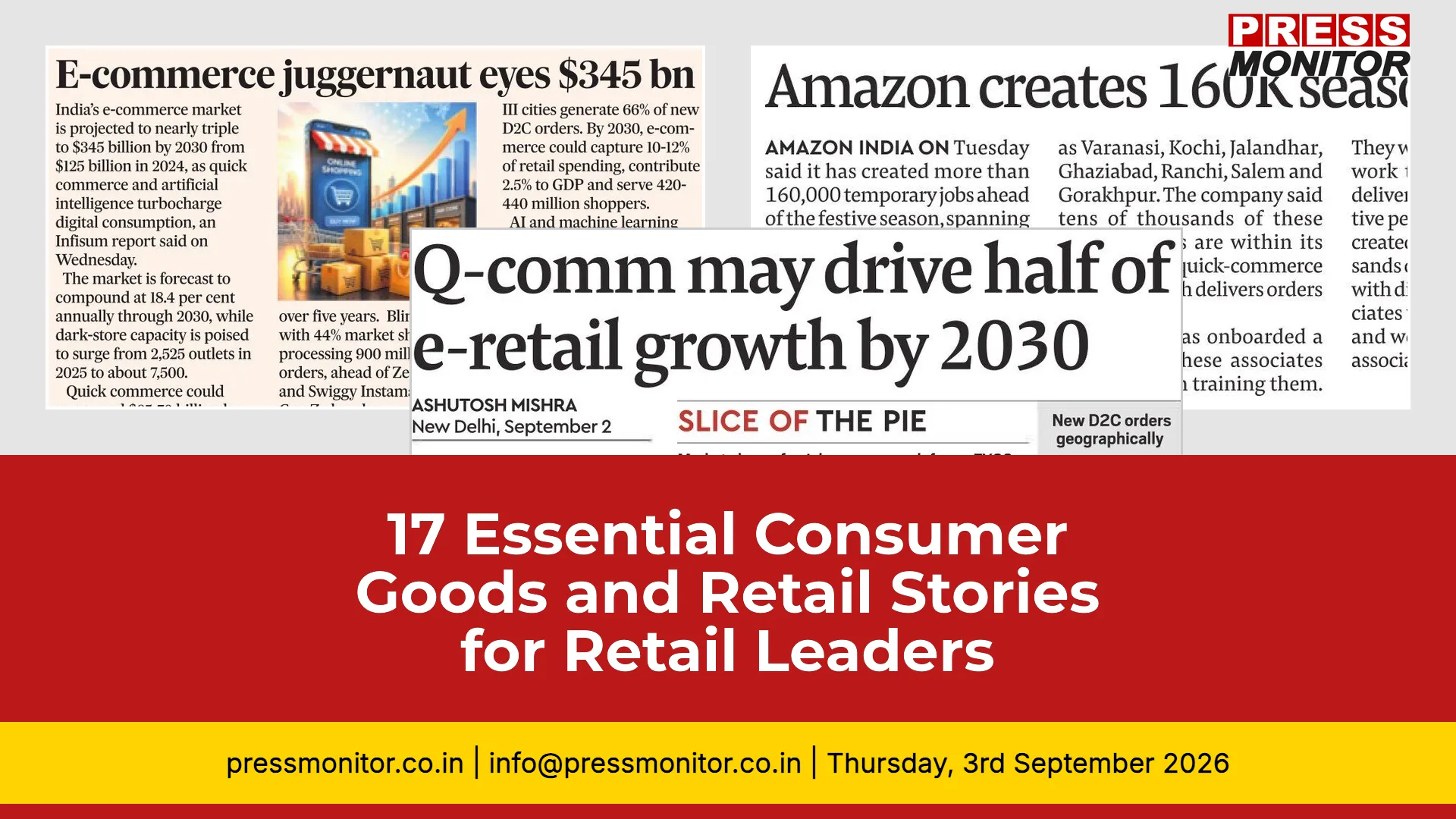
A front-page report in Free Press Journal says India's e-commerce market is projected to nearly triple to $345 billion by 2030 from $125 billion in 2024, as quick commerce and artificial intelligence turbocharge digital consumption. The Infisum report forecasts 18.4 per cent annual growth through 2030, with Blinkit leading quick commerce at 44% market share, ahead of Zepto at 25% and Swiggy Instamart at 20%. By 2030, e-commerce could capture 10-12% of retail spending, contribute 2.5% to GDP and serve 420-440 million shoppers.
Why it matters: India's e-commerce market is projected to nearly triple to $345 billion by 2030, driven by quick commerce and AI. This is the defining growth story for every consumer goods and retail executive.
Key detail: 18.4% annual growth; Blinkit leads quick commerce at 44% market share; 420-440 million shoppers expected.
Source: Free Press Journal, Mumbai.
Next step: Track which players capture the 2.5% GDP contribution and 10-12% of retail spending.
2. Amazon India Creates 1.6 Lakh Jobs
A front-page report in Financial Express says Amazon India has created more than 1.6 lakh temporary jobs ahead of the festive season, spanning both its e-commerce and quick-commerce businesses. The roles, a mix of direct and indirect opportunities, are spread across 400 cities including tier-2 and tier-3 centres such as Varanasi, Kochi, Jalandhar, Ghaziabad, Ranchi, Salem and Gorakhpur. Tens of thousands of the positions are within the Amazon Now quick-commerce network, with opportunities created for women and associates with disabilities, who will receive the same safety and welfare benefits as other associates.
Why it matters: Amazon's festive-season hiring blitz across 400 cities signals aggressive expansion into tier-2 and tier-3 markets.
Key detail: 1.6 lakh temporary jobs; tens of thousands in Amazon Now quick-commerce; women and associates with disabilities included.
Source: Financial Express, Delhi.
Next step: Monitor how seasonal hiring translates to year-round workforce retention.
3. Quick Commerce to Drive 45-50% of E-Retail Growth
A front-page report in Financial Express says quick commerce is set to become a major engine of India’s e-commerce growth, contributing 45-50% of incremental e-retail growth over the next five years as the segment value expands to an estimated $65-70 billion by 2030, according to a report by research consultancy Infisum.
Why it matters: Quick commerce is emerging as the primary engine of India's e-retail expansion, with a projected segment value of $65-70 billion by 2030.
Key detail: 45-50% of incremental e-retail growth over the next five years; Infisum research.
Source: Financial Express, Delhi.
Next step: Assess quick-commerce infrastructure readiness for your supply chain.
4. GCPL Struggles with Execution
A front-page report in Economic Times says, Godrej Consumer Products (GCPL) has struggled to execute several of its growth bets. CEO Aasif Malbari flags weak core-category growth, falling margins; promises big innovation push.
Why it matters: Godrej Consumer Products' CEO flags weak core-category growth and falling margins — a cautionary signal for legacy FMCG players.
Key detail: CEO Aasif Malbari promises a big innovation push to counter execution gaps.
Source: Economic Times, Delhi.
Next step: Watch whether the innovation pipeline translates into margin recovery.
5. Bengaluru Leads Earnings, Delhi is Biggest Market
A front-page report in Times of India says that prosperity in urban India is not solely about income. The study by People Research on India Consumer Economy (PRICE) and Tata’s ‘The Many Urban Indias’ highlights how India’s Big Six cities earn, spend, save, and borrow differently. Bengaluru leads in earnings and savings, while Delhi is the biggest consumption market. The study also reveals spending patterns and debt levels across these cities.
Why it matters: Urban prosperity in India is not uniform — Bengaluru leads in earnings and savings while Delhi dominates consumption.
Key detail: PRICE and Tata's 'The Many Urban Indias' study across Big Six cities.
Source: Times of India, New Delhi.
Next step: Tailor regional strategies based on city-specific earning and spending patterns.
6. Household Spending Across India's Big Six Cities
A front-page report in Times of India says households across India’s major cities spend about 75% of their income, compared with 58% in the Big Six. Bengaluru households spend the most in absolute terms, followed by Delhi-NCR and Mumbai. Spending patterns vary by geography: northern households devote more to housing, clothing and education, while southern households spend more on health.
Why it matters: Spending patterns vary sharply by geography — northern households spend more on housing and education, southern on health.
Key detail: Big Six households spend ~75% of income vs. 58% nationally; Bengaluru spends most in absolute terms.
Source: Times of India, New Delhi.
Next step: Use geographic spending data to optimize product assortment and marketing.
7. India's Diversity Challenges Business Expansion
A front-page report in Economic Times says India’s diversity presents a challenge to building a business across different states, spanning various cultures, climates, consumer behaviors, and skin tones.
Why it matters: Building a business across India's states means navigating vastly different cultures, climates, and consumer behaviors.
Key detail: Diversity spans cultures, climates, consumer behaviors, and skin tones — a unique barrier for national brands.
Source: Economic Times, Delhi.
Next step: Invest in hyper-localisation strategies rather than one-size-fits-all approaches.
8. JioMart and Ajio Lose Active Users
A front-page report in Financial Express says Reliance Retail's digital platforms JioMart and Ajio have lost weekly active users this year while rivals Blinkit, Zepto and Myntra expanded their bases. JioMart lost 17 lakh weekly active users and Ajio 15 lakh, whereas Blinkit added 1.34 crore and Myntra 68 lakh, according to a CLSA report citing Sensor Tower data. Only about 7% of JioMart's 13.24 crore downloads convert into weekly users, against 24% for Blinkit and Zepto, highlighting Reliance's struggle to turn reach into regular habits.
Why it matters: Reliance Retail's digital platforms are losing ground to Blinkit, Zepto, and Myntra in weekly active users — a critical retention gap.
Key detail: JioMart lost 17 lakh WAU; Ajio lost 15 lakh; Blinkit added 1.34 crore. Only 7% of JioMart downloads convert to weekly users vs. 24% for Blinkit and Zepto.
Source: Financial Express, Bengaluru.
Next step: Evaluate Reliance's digital strategy and its implications for retail competition.
9. Sugar Prices Retreat as Ex-Mill Rates Crash 30%
A front-page report in Free Press Journal says, Sugar prices are retreating from record highs across India, with ex-mill rates tumbling nearly 30% while retail prices have declined only 5%, creating scope for further consumer-level correction within seven to ten days, industry bodies said.
Why it matters: A 30% crash in ex-mill sugar rates from peaks creates consumer-level price relief and margin opportunities for FMCG players.
Key detail: Retail prices down only 5%; further correction expected within 7-10 days.
Source: Free Press Journal, Mumbai.
Next step: Monitor whether the correction reaches retail shelves and impacts input costs.
10. India's Rich Diversity Makes Localisation Necessary for Brands
A front-page report in Economic Times says that Shiseido’s Asia Pacific president, Nicole Tan, believes that India’s beauty market has moved beyond the singular aspiration of lighter skin, embracing a broader definition of beauty. The challenge for brands like Shiseido is to cater to the diversity and individuality of Indian consumers.
Why it matters: Shiseido's Asia Pacific president says India's beauty market has moved beyond singular aspirations — brands must embrace individuality.
Key detail: Nicole Tan highlights the shift toward broader definitions of beauty in India.
Source: Economic Times, Mumbai.
Next step: Review brand positioning to ensure it reflects India's diverse consumer identity.
11. Retail Evolution in India
A front-page report in Business Standard says how economic liberalisation transformed the retail landscape in India from traditional kirana stores to quick commerce, highlighting the rise of global retailers and the influence of ecommerce.
Why it matters: From kirana stores to quick commerce, India's retail transformation offers a blueprint for understanding consumer behaviour shifts.
Key detail: Economic liberalisation reshaped the retail landscape; global retailers and e-commerce are now dominant forces.
Source: Business Standard, Mumbai.
Next step: Study the kirana-to-quick-commerce pipeline for partnership and investment opportunities.
12. Brands Step Up Kitchen Vigilance Amid Crackdown
A front-page report in Times of India says that amid government crackdown on food safety violations, brands are stepping up checks in restaurant kitchens and strengthening compliance.
Why it matters: Government food safety crackdowns are forcing brands to strengthen compliance — a regulatory trend with direct cost implications.
Key detail: Brands are stepping up checks in restaurant kitchens and strengthening compliance protocols.
Source: Times of India, Mumbai.
Next step: Audit your brand's food safety compliance posture ahead of potential regulatory tightening.
13. Onion Prices Surge
A front-page report in The Hindu says the price of onion, an essential commodity, has nearly doubled from last year’s. The all-India average price was Rs 49.59 a kg, registering an over 74% increase from Rs 28.48 on the corresponding day in 2025. The government is searching for reasons behind this surge, as the Opposition says the government has failed to curb the price rise of essentials.
Why it matters: Onion prices nearly doubling year-on-year signals food inflation pressure that ripples across the consumer goods sector.
Key detail: All-India average price Rs 49.59/kg, up 74% from Rs 28.48 in 2025; government searching for causes.
Source: The Hindu, Delhi.
Next step: Assess supply chain exposure to essential commodity price volatility.
14. Festival Demand Boosts Hiring in Ecom and Logistics
A front-page report in Business Standard says that with the festival season around the corner, ecommerce, quick-commerce, and logistics firms are ramping up hiring to meet a longer demand period.
Why it matters: Festival season is driving a hiring surge across e-commerce, quick-commerce, and logistics — a seasonal employment signal.
Key detail: Firms ramping up hiring to meet longer demand periods ahead of festivals.
Source: Business Standard, New Delhi.
Next step: Plan workforce and logistics capacity for the festive quarter.
15. Adulteration Ban in Rajasthan
A front-page report in First India says that an adulteration campaign, being conducted under the direction of CM Bhajan Lal Sharma and Health Minister Gajendra Singh Khinvsar, has led to the statewide ban of five unsafe packaged food products for two months. The affected products include Nandi cow ghee, Ratwadi Tea (Golden Thar), G.S. Gold red chilli powder, KDP Dairy-Krishna ghee, and KDP Dairy-Saras ghee. Additionally, licenses of nine food establishments in Barmer, Churu, Bikaner, Ajmer, and Tonk were suspended after unsafe samples were detected. Registrations of three Jaipur establishments—Balaji Jaika, Ganpati Dryfruits, and The Kambu Cafe—were cancelled for operating without valid licenses.
Why it matters: Rajasthan's statewide ban on five unsafe packaged food products signals tightening food safety enforcement nationwide.
Key detail: Five products banned for two months; nine food establishment licenses suspended; three Jaipur establishments cancelled.
Source: First India, Jaipur.
Next step: Review your product portfolio for compliance with evolving food safety standards.
16. Supreme Court Flags Consumer Commission Vacancies
A front-page report in Free Press Journal says the Supreme Court has directed states and Union Territories to respond within three weeks on a status report highlighting vacancies in district and state consumer commissions. A bench led by Chief Justice Surya Kant, also comprising Justices Joymalya Bagchi and V Mohana, observed that no tribunal should become non-functional merely because of the transition, and sought compliance on pay and allowances for commission members. Attorney General R Venkataramani informed the court that the president of the National Consumer Disputes Redressal Commission has submitted a detailed report on vacancies and pendency.
Why it matters: Vacancies in district and state consumer commissions could delay dispute resolution — a risk for consumer goods companies.
Key detail: Supreme Court directed states and UTs to respond within three weeks; Chief Justice Surya Kant leading the bench.
Source: Free Press Journal, Mumbai.
Next step: Prepare for potential delays in consumer grievance redressal and its brand reputation implications.
17. Purple Style Labs IPO Subscribed 1.29x
A front-page report in Mint says Purple Style Labs Ltd, the parent company of fashion platform Pernia's Pop-Up Shop, received 1.29 times subscription for its initial public offering on the final day on Wednesday. The IPO drew bids for 8.86 million shares against 6.84 million shares on offer, as per National Stock Exchange data, with the retail portion subscribed 1.58 times. The Rs 680 crore fresh issue, priced at Rs 546-575 per share, values the company at over Rs 7,600 crore at the upper end of the price band.
Why it matters: Fashion platform Pernia's Pop-Up Shop's IPO performance reflects investor appetite for consumer retail ventures.
Key detail: 1.29x subscription; Rs 680 crore fresh issue at Rs 546-575/share; valuation over Rs 7,600 crore at upper end.
Source: Mint, Delhi.
Next step: Track whether retail IPO momentum translates into sustained market confidence.
Closing: Which of these stories will reshape your strategy tomorrow? Stay ahead with Press Monitor's print media monitoring, turning today's headlines into tomorrow's competitive advantage. What story in today's edition surprised you most?