17 Essential Green Energy Stories for Decision-Makers


India's print media continues to drive the national conversation on green energy. According to Press Monitor's tracking of Indian publications, this press review captures the day's most important developments—from cabinet approvals to grassroots struggles. Our media intelligence draws from 15 sources across the country, providing an authoritative snapshot of the sector. This print media monitoring roundup covers policy shifts, corporate strategies, and emerging challenges. Stay informed on news on green energy with Press Monitor's daily insights.
1. Chhattisgarh Auctions 65 Mineral Blocks
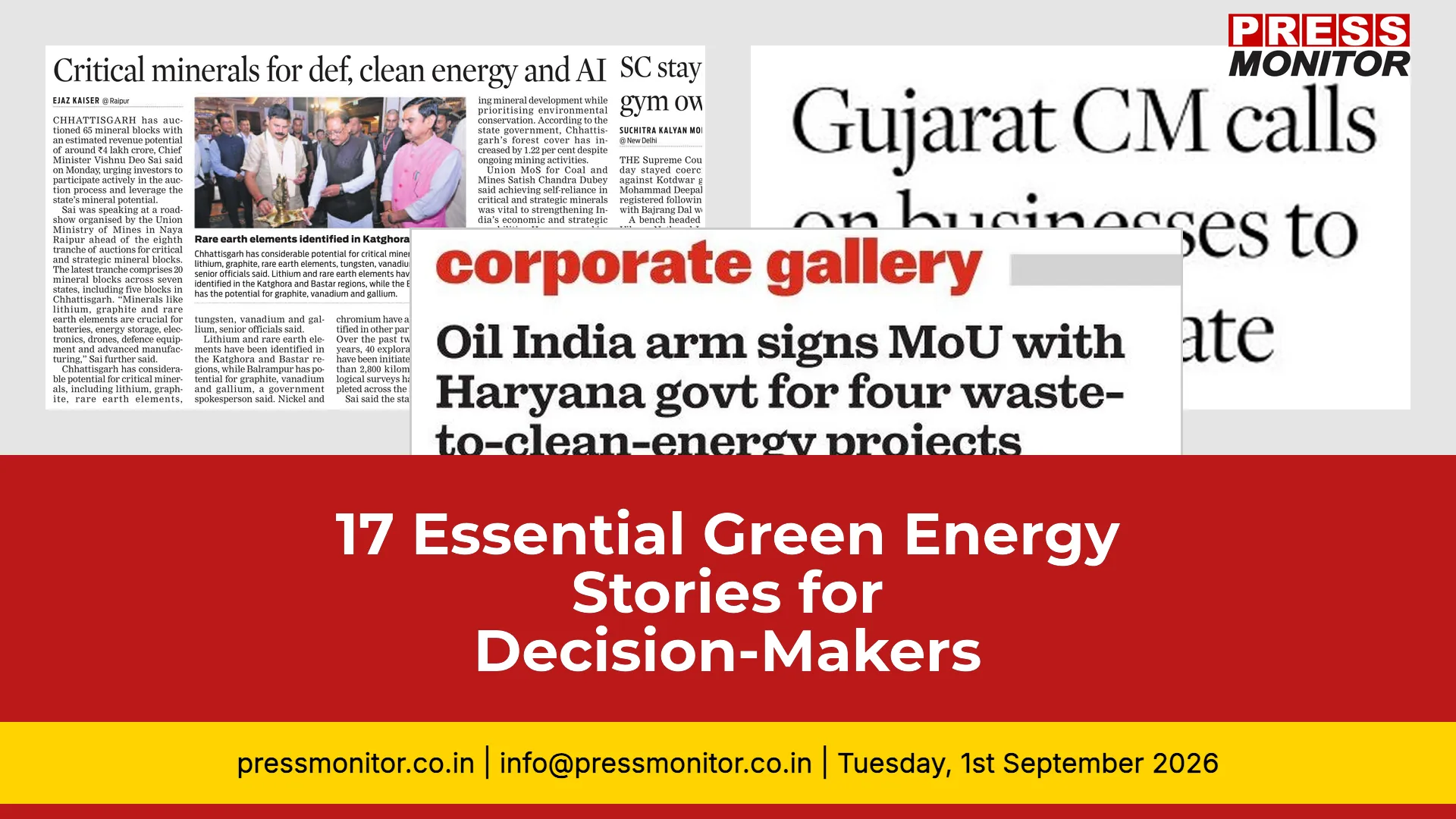
“A front-page report in New Indian Express says Chhattisgarh has auctioned 65 mineral blocks with an estimated revenue potential of around ₹4 lakh crore, Chief Minister Vishnu Deo Sai said on Monday, urging investors to participate actively in the auction process and leverage the state’s mineral potential. Sai was speaking at a road-show organised by the Union Ministry of Mines in Naya Raipur ahead of the eighth tranche of auctions for critical and strategic mineral blocks. The latest tranche comprises 20 mineral blocks across seven states, including five blocks in Chhattisgarh. ‘Minerals like lithium, graphite and rare earth elements are crucial for batteries, energy storage, electronics, drones, defence equipment and advanced manufacturing,’ Sai further said. Chhattisgarh has considerable potential for critical minerals, including lithium, graphite, rare earth elements, tungsten, vanadium and gallium, senior officials said. Lithium and rare earth elements have been identified in the Katghora and Bastar regions, while Balrampur has potential for graphite, vanadium and gallium. Nickel and chromium have also been identified in other parts of the state. Over the past two and a half years, 40 exploration projects have been initiated, while more than 2,800 kilometres of geological surveys have been completed across the state. Sai said the state was pursuing mineral development while prioritizing environmental conservation. According to the state government, Chhattisgarh’s forest cover has increased by 1.22 per cent despite ongoing mining activities. Union MoS for Coal and Mines Satish Chandra Dubey said achieving self-reliance in critical and strategic minerals was vital to strengthening India’s economic and strategic capabilities. He encouraged investors, young entrepreneurs and startups to tap the opportunities emerging in the sector. During the roadshow, Sai launched the ‘e-Ret Sangwari’ and ‘Tin’ portals. The former aims to provide a simple and transparent mechanism for supplying sand at concessional rates to beneficiaries of the Pradhan Mantri Awas Yojana. The ‘Tin’ portal, launched in Dantewada, ensures fair prices for produce from tribals engaged in tin-related activities while bringing transparency to the trading process. SUCHITRA KALYAN MOHANTY New Delhi THE Supreme Court on Monday stayed coercive action against Kotdwar gym owner Mohammad Deepak in an FIR registered following a dispute with Bajrang Dal workers. A bench headed by Justice Vikram Nath and Justice Sandeep Mehta also stayed the operation of the Uttarakhand High Court order restraining Deepak from posting any content about the incident on social media. Deepak had approached the Supreme Court seeking quashing of the FIR. The court issued notice on his petition and granted the Uttarakhand government four weeks to file its counter. Senior advocate Abhishek Manu Singhvi, appearing for Deepak, submitted that his client had intervened to pacify the situation after Bajrang Dal workers objected to a Muslim shopkeeper using the word ‘Baba’ in his shop’s name. Singhvi pointed out that Section 191 of the BNS, which deals with rioting, had initially been invoked against Deepak despite its essential ingredients not being made out. The charge was later dropped. Singhvi argued that the offences alleged against Deepak are punishable with less than seven years of jail and attract the principles laid down by the Supreme Court in Arnesh Kumar. Raj gets new CJ after SC judge letter, lawyer stir EXPRESS NEWS SERVICE New Delhi AMID a row over acting Chief Justice Sanjeev Prakash Shar ma of the Rajasthan Higl Court, the Supreme Court collegium on Monday recommended the appointment of Chattisgarh HC judge Justice Sanjay K Agrawal as Chief Justice of the Rajasthan High Court. Currently a judge of the Chattisgarh High Court, Justice Agrawal was appointed as an additional judge in September 2013 and made permanent in March 2016. He had earlier also served as Advocate General of Chhattisgarh.
Why it matters: Critical minerals are the backbone of clean energy supply chains. Chhattisgarh's auction of 65 mineral blocks—including lithium and rare earth elements—positions the state as a key player in India's energy transition. Key detail: The blocks have an estimated revenue potential of ₹4 lakh crore, and the state has initiated 40 exploration projects.
Source: New Indian Express, Morning Standard, The Pioneer. Next step: Investors should evaluate the upcoming eighth tranche of auctions for strategic mineral blocks.
2. Gujarat Invites Global Investors for Vibrant Summit
A front-page report in Business Line says Gujarat Chief Minister Bhupendra Patel has invited global and domestic investors to explore opportunities in manufacturing, green energy, and new technologies. The 11th Vibrant Gujarat summit, which serves as a platform for knowledge sharing, is scheduled to begin on January 10, 2027.
Why it matters: Gujarat is positioning itself as a hub for green energy and new technologies ahead of the 11th Vibrant Gujarat Global Summit. Key detail: Chief Minister Bhupendra Patel highlighted opportunities in manufacturing, green energy, and new technologies, with the summit scheduled for January 10, 2027.
Source: Business Standard, Asian Age, Business Line. Next step: Companies with clean energy portfolios should explore investment opportunities in the state.
3. Haryana Signs Four Waste-to-Clean-Energy MoUs
A front-page report in Free Press Journal says Oil India Limited's arm, OIL Green Energy Limited (OGEL), signed Memoranda of Understanding (MoUs) with four Municipalities of Haryana for development of Integrated CBG and Wasteto-Energy Projects across the respective clusters. The four projects are proposed across the Hisar (56OO TPD), Ambala (9OO TPD), Faridabad (l,6OO TPD) and Gurugram (2,OOO TPD) clusters. Together, the facilities will have the capacity to scientifically process 5,OOO tonnes of municipal solid waste per day and are expected to produce 7O-75 TPD of Compressed Biogas (CBG) along with 5O MW of green power.
Why it matters: Municipal solid waste is a growing problem; converting it to clean energy addresses both waste management and power generation. Key detail: OIL Green Energy Limited signed MoUs with four Haryana municipalities to process 5,000 tonnes of waste daily, producing 70-75 TPD of Compressed Biogas and 50 MW of green power.
Source: Statesman, Free Press Journal. Next step: Similar waste-to-energy models could be replicated in other states.
4. Floating Solar Gets Cabinet Nod
A front-page report in Business Standard says the Union Cabinet has approved a national scheme for floating solar power projects, setting in motion a larger debate around the technology, including its potential in the Indian energy context, commercial viability and benefits.
Why it matters: Floating solar offers land-use efficiency and higher generation due to cooling effects. Key detail: The Union Cabinet approved a national scheme for floating solar projects, sparking debate on commercial viability and environmental benefits.
Source: Business Standard. Next step: Project developers should prepare for scheme guidelines and bidding timelines.
5. India Crosses 300 GW Non-Fossil Capacity
A front-page report in Deccan Chronicle says the Centre has called for faster action on clean energy as India's installed non-fossil fuel capacity crossed the 300 gigawatt (GW) mark and the government pushes towards its 2030 target of 500 GW.
Why it matters: This milestone demonstrates India's commitment to its 500 GW target by 2030. Key detail: The Centre called for faster action on clean energy as installed non-fossil capacity crossed 300 GW.
Source: Deccan Chronicle. Next step: Policymakers need to accelerate grid integration and storage infrastructure.
6. State Accelerates Rooftop Solarisation of Government Buildings
A front-page report in Free Press Journal says the state government will accelerate rooftop solar installations on government buildings under the PM Surya Ghar Muft Bijli Yojana. Additional Chief Secretary, Energy Department, Gaurav Gupta reviewed the progress of solarising government buildings and the scheme’s payment mechanism.
Why it matters: Rooftop solar reduces electricity costs and promotes distributed generation. Key detail: The state government will accelerate installations under PM Surya Ghar Muft Bijli Yojana, with Additional Chief Secretary Gaurav Gupta reviewing progress.
Source: Free Press Journal. Next step: Other states should adopt similar accelerated timelines.
7. MNRE Hosts Bharat Summit and Eran 2026 Roadshow
A front-page report in Deccan Chronicle says the Ministry of New and Renewable Energy (MNRE) and the Indian Space Association (ISA) are hosting the Bharat Summit and Eran 2O26 roadshow in Hyderabad ahead of the November event.
Why it matters: This event brings together renewable energy and space industry stakeholders. Key detail: The Ministry of New and Renewable Energy and Indian Space Association are hosting the event in Hyderabad ahead of the November summit.
Source: Deccan Chronicle. Next step: Industry participants should prepare for collaboration opportunities.
8. India's Climate-Tech Bankability Gap
A front-page report in Mint says India’s green investment story is a success. In 2024, 83% of all investment in its power sector went into clean energy, according to the International Energy Agency. However, the country is much less adept at financing technologies it will need for the next stage of its transition to a low-carbon economy.
Why it matters: While 83% of power sector investment went to clean energy in 2024, financing next-gen clean technologies remains a challenge. Key detail: India needs better financing mechanisms for emerging climate technologies beyond solar and wind.
Source: Mint. Next step: Financial institutions must develop tailored products for climate-tech startups.
9. Surat's Green Energy Struggle
A front-page report in Free Press Journal says MSME industrialists in Surat are protesting frequent curtailment of power generated by their captive solar plants, alleging it is turning crores of investment into losses.
Why it matters: Curtailment of captive solar power is hurting MSME investments. Key detail: Industrialists in Surat are protesting frequent power cuts from their captive solar plants, alleging losses.
Source: Free Press Journal. Next step: Regulators need to address grid integration issues to protect distributed solar investments.
10. Workshop Highlights Solar Energy Awareness Among Youth
A front-page report in First India says a workshop organized by Iconix Broadcasting and Ra-atluj Jal Vidyut Nigam (SJVN) in Jaipur aimed to raise awareness among youth about solar energy and conservation. Key speakers highlighted the potential of solar energy for employment and Rajasthan’s achievements in renewable energy.
Why it matters: Building a skilled workforce is critical for India's renewable energy expansion. Key detail: Iconix Broadcasting and SJVN organized a workshop in Jaipur highlighting solar energy employment potential and Rajasthan's renewable achievements.
Source: First India. Next step: More such workshops can boost grassroots awareness and job creation.
11. NTPC Profit Growth Outpaces Revenue
A front-page report in Indian Express says, NTPC’S PROFIT GROWTH HAS OUTPACED ITS REVENUE GROWTH IN THE PAST THREE YEARS, COINCIDING WITH A PERIOD WHEN INDIA SIGNIFICANTLY RAMPED UP RENEWABLE ENERGY CAPACITY ADDITION.
Why it matters: NTPC's financial performance correlates with India's renewable capacity addition. Key detail: Profit growth exceeded revenue growth over the past three years, coinciding with significant renewable energy addition.
Source: Indian Express. Next step: Investors should watch for similar trends in other power utilities.
12. India's Self-Reliant Push on Critical Minerals
A front-page report in Free Press Journal says India is making continuous efforts to become self-reliant in critical minerals to secure domestic industrial and clean energy supply chains. Minister of State for Coal and Mines Satish Chandra Dubey stated on Monday at an industry roadshow that the initiative connects state authorities with industry leaders to address operational and technical aspects.
Why it matters: Domestic critical mineral supply chains are essential for clean energy and defense. Key detail: Minister of State Satish Chandra Dubey stated at an industry roadshow that the initiative connects state authorities with industry to address operational aspects.
Source: Free Press Journal. Next step: Companies in battery and renewable sectors should secure mineral supply agreements.
13. Maruti Suzuki's Investment Plans in India
A front-page report in Business Line says that Maruti Suzuki's MD and CEO, Hisashi Takeuchi, announced plans to invest 70,000 crore over the next five to six years in India. The company aims to achieve carbon neutrality by increasing its in-house solar capacity and sourcing green electricity from solar and wind power.
Why it matters: Automakers are aligning with India's net-zero goals through green electricity. Key detail: Maruti Suzuki plans to invest ₹70,000 crore over 5-6 years, increasing in-house solar capacity and sourcing green electricity from solar and wind.
Source: Business Line. Next step: Other automakers will likely follow with similar renewable procurement strategies.
14. Adani Urges Broader Frameworks for Infrastructure Ratings
“Selon Millennium Post, billionaire Gautam Adani has urged Indian credit-rating agencies to adopt broader frameworks for assessing infrastructure projects, saying conventional models can under-state their wider economic and strategic value. Speaking at the CareEdge Group Annual Summit in Mumbai, Adani said India needs "wider lenses", not lower credit standards, to evaluate infrastructure that creates new markets and industrial ecosystems. He proposed a framework for ‘integrated platform infrastructure’ that considers ecosystem effects, strategic resilience & adjacency value alongside leverage, cash flows, execution risks. Adani cited Mundra, Vizhinjam and Khavda ‘as examples of infrastructure creating wider capabilities and adjacency value along-side leverage, cash flows and execution risks. Adani cited Mundra port, Vizhinjam port and the Khavda renewableenergy project as examples of infrastructure creating capabilities beyond their standalone assets. He said Khavda’s clean power could support data centres, Aland advanced manufacturing, while Vizhinjam could strengthen India’s position in global shipping. Adani stressed that his proposal was not for weaker scrutiny, but for dynamic models that capture the ‘compound-ing power of national platforms’. He called on CareEdge to develop a comprehensive credit framework that could be adopted by other emerging economies. "The India of 2O47 will not be built by ambition alone," Adani said that trust and c: translate ambition into national capability.
Why it matters: Traditional credit models may undervalue infrastructure projects like renewable energy parks. Key detail: Gautam Adani called for integrated platform infrastructure frameworks that account for ecosystem effects, citing Khavda, Mundra, and Vizhinjam as examples.
Source: Millennium Post. Next step: Rating agencies should develop dynamic models for emerging economies.
15. Coal India Diversifies into Critical Minerals
A front-page report in Financial Express says Coal India Limited is expanding beyond conventional coal into critical minerals, including rare earth elements in Maharashtra and iron ore in Odisha. The company has also established CIL Global Pte. Ltd. in Singapore to facilitate overseas asset acquisition and significantly increased its solar project expenditure to Rs 1,651 crore.
Why it matters: Coal India's pivot signals the broader energy transition within traditional energy companies. Key detail: The company is expanding into rare earth elements in Maharashtra and iron ore in Odisha, and has increased solar project expenditure to ₹1,651 crore.
Source: Financial Express. Next step: Diversification strategies of other coal-based firms should be monitored.
16. Coal India Targets 1 Billion Tonnes Production
A front-page report in Mint says Coal India Limited is targeting a production of approximately one billion tonnes by FY 2029-30. The company is diversifying into renewable energy and critical minerals while maintaining strong financial resilience and a AAA credit rating.
Why it matters: Amid the energy transition, Coal India aims for peak production by FY 2029-30 while diversifying into renewables. Key detail: The company targets approximately one billion tonnes with a AAA credit rating, maintaining financial resilience.
Source: Mint. Next step: Balance between coal production and renewable investments will define India's energy mix.
17. PFC and REC Propose Strategic Merger
A front-page report in Economic Times says Power Finance Corporation and REC Limited have proposed a strategic merger to strengthen India's infrastructure financing. The combined entity will create one of the nation's largest specialised financing institutions with an aggregate loan book of around Rs 212 lakh crore.
Why it matters: A merged entity would become one of India's largest infrastructure financing institutions, critical for green energy projects. Key detail: Power Finance Corporation and REC propose an aggregate loan book of around ₹212 lakh crore.
Source: Economic Times. Next step: The merger will likely accelerate financing for renewable energy and grid infrastructure.
Closing thought: These 17 stories, tracked by Press Monitor's ongoing print media monitoring, highlight the multifaceted nature of India's green energy transition. Which development will have the most impact on your strategy?