17 Essential Legal and Regulatory Stories for Legal Professionals


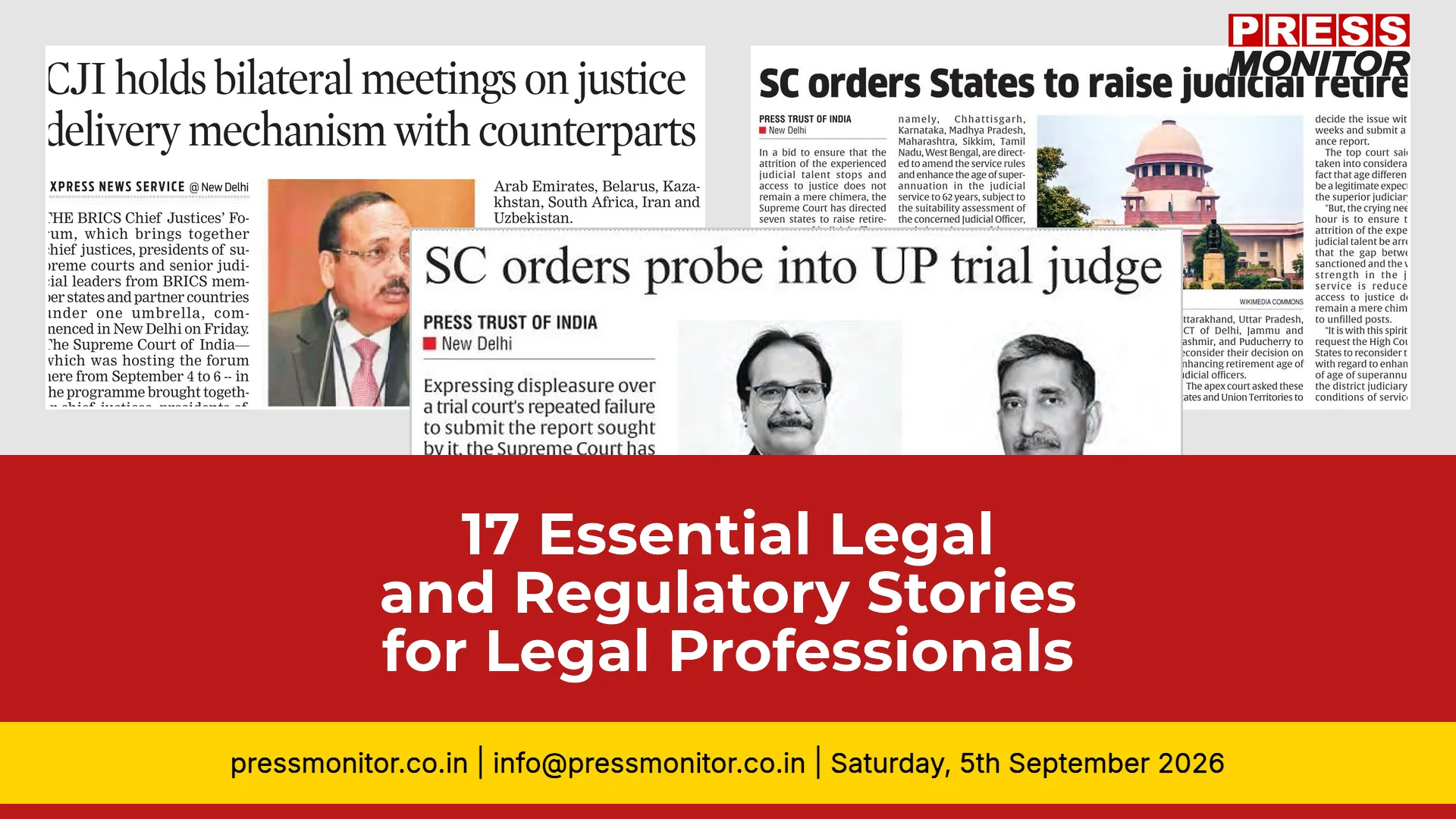
According to Press Monitor's tracking of Indian publications, this media monitoring report covers 17 news on legal and regulatory developments from today's Indian print landscape. This media intelligence review draws from print media monitoring across national dailies and regional newspapers to bring you the stories shaping India's judiciary and regulatory framework.
1. BRICS Chief Justices Forum Concludes in New Delhi
A front-page report in New Indian Express says the BRICS Chief Justices' Forum commenced in New Delhi on Friday, bringing together chief justices and senior judicial leaders from BRICS member states and partner countries. CJI Surya Kant held bilateral meetings with counterparts from Russia, China, Egypt, Indonesia, the United Arab Emirates, Belarus, Kazakhstan, South Africa, Iran, and Uzbekistan. Discussions centered on justice delivery mechanisms, mutual recognition of judicial awards, mediation and arbitration for commercial disputes, and strengthening judicial cooperation through MoUs. Chief Justice of India Surya Kant hosted the BRICS Chief Justices' Forum, bringing together judicial leaders from Russia, China, Egypt, Indonesia, UAE, Belarus, Kazakhstan, South Africa, Iran, and Uzbekistan. The forum proposed a common platform for arbitration and mediation to tackle commercial disputes. Why it matters: This signals India's ambition to lead in international judicial cooperation and cross-border dispute resolution. Key detail: Bilateral meetings covered justice delivery mechanisms and mutual recognition of judicial awards. Source: New Indian Express. Next step: Watch for MoUs signed during the forum. What does this mean for Indian arbitration law?
2. Supreme Court Directs 7 States to Raise Judicial Retirement Age to 62
A front-page report in The Pioneer says the Supreme Court has directed seven states to raise the retirement age of judicial officers from 60 to 62 years to stop attrition of experienced talent and ensure access to justice. The bench comprising Chief Justice Surya Kant and Justices Joymalya Bagchi and V Mohana said superannuated officers in Chhattisgarh, Karnataka, Madhya Pradesh, Maharashtra, Sikkim, Tamil Nadu, and West Bengal may rejoin if they have not obtained subsequent employment. The court directed other states and union territories to reconsider their decisions within two weeks and submit a compliance report. The Supreme Court, in the All India Judges Association versus Union of India case, ordered Chhattisgarh, Karnataka, Madhya Pradesh, Maharashtra, Sikkim, Tamil Nadu, and West Bengal to amend service rules within two months. Why it matters: This addresses attrition of experienced judicial talent and could reshape district judiciary capacity across India. Key detail: Officers who superannuated on or after March 31 this year may rejoin if not employed. Source: The Pioneer. Next step: States must submit compliance reports within two weeks. How will this impact case backlog reduction?
3. Supreme Court Orders Probe Into UP Trial Judge
A front-page report in The Pioneer says the Supreme Court has directed the registrar general of the Allahabad High Court to initiate a preliminary inquiry against a trial judge in Uttar Pradesh for repeatedly failing to submit reports. The apex court bench of Justices Prashant Kumar Mishra and Shree Chandrashekhar expressed displeasure that the trial court failed to submit the report on three occasions despite orders dating back to February 2020. The court has set a 15-day deadline for the inquiry report and will consider a departmental inquiry based on the findings. The Supreme Court directed the registrar general of the Allahabad High Court to initiate a preliminary inquiry against a trial judge in Uttar Pradesh for repeatedly failing to submit reports. Justices Prashant Kumar Mishra and Shree Chandrashekhar set a 15-day deadline. Why it matters: This reinforces judicial accountability and sends a strong signal against procedural negligence. Key detail: The trial court failed to submit the report on three occasions despite orders dating back to February 2020. Source: The Pioneer. Next step: The inquiry report will determine if a departmental inquiry is warranted. Should chronic non-compliance lead to automatic removal?
4. Supreme Court Reprimands Bar Council of India
A front-page report in Free Press Journal says the Supreme Court has reprimanded the Bar Council of India twice for attempting punitive disciplinary action against law students at NALSAR Hyderabad who protested against a speech by Chief Justice Surya Kant. The court clarified that the council disciplinary authority only begins once individuals enrol as advocates, criticising attempts to silence legitimate student dissent. Officials warned that political interference risks undermining the legal profession commitment to defending constitutional freedoms and client independence. The Supreme Court reprimanded the Bar Council of India twice for attempting punitive disciplinary action against law students at NALSAR Hyderabad who protested against a speech by Chief Justice Surya Kant. Why it matters: This ruling protects student dissent and reaffirms the distinction between student expression and professional conduct. Key detail: The court clarified that BCI disciplinary authority only begins once individuals enrol as advocates. Source: Free Press Journal. Next step: Law schools may see more student activism emboldened by this ruling. Will this change how bar councils handle student protests?
5. Supreme Court Bars BCI From Regulating Students
A front-page report in Deccan Chronicle says the Supreme Court has firmly drawn the Lakshman Rekha around the powers of the Bar Council of India, ruling that it cannot regulate students. The article, published on page 6 on 18 July 2026, notes that Hyderabad-based writer T. Kailash Ditya questions how such a learned institution could exceed its statutory mandate. He argues that such hyperactivism risks undermining institutional autonomy and that regulatory bodies must respect law and jurisdiction. The Supreme Court has firmly drawn the Lakshman Rekha around the powers of the Bar Council of India, ruling that it cannot regulate students. Writer T. Kailash Ditya questioned how such a learned institution could exceed its statutory mandate. Why it matters: This reinforces institutional autonomy and limits regulatory overreach by bar councils. Key detail: The ruling was published on page 6 of Deccan Chronicle on 18 July 2026. Source: Deccan Chronicle. Next step: BCI must revise its student-facing policies. How will this affect legal education governance?
6. Minnesota AI Nude Ban Stands
A front-page report in Tribune says a federal judge declined to block Minnesota's ban on AI-generated fake nude images, allowing the constitutional challenge by Elon Musk's xAI to proceed. The law targets nonconsensual sexual imagery created with artificial intelligence. xAI argues the measure restricts free speech protected by the US Constitution. A federal judge declined to block Minnesota's ban on AI-generated fake nude images, allowing the constitutional challenge by Elon Musk's xAI to proceed. Why it matters: This sets a precedent for AI regulation and free speech boundaries in the digital age. Key detail: xAI argues the measure restricts free speech protected by the US Constitution. Source: Tribune / Reuters. Next step: The case will proceed to trial. How will this ruling influence AI regulation debates in India?
7. Jharkhand DGP Appointment Challenged in Supreme Court
A front-page report in The Pioneer says the Supreme Court has been told that the JMM government's appointment of Tadasha Mishra as Jharkhand DGP on December 30, 2025, one day before her retirement, violates the apex court's direction requiring at least six months of residual service. Senior advocate and amicus curiae Raju Ramchandran submitted the note before a bench headed by Chief Justice of India Surya Kant, stating that the appointment completely violates the principles laid down in the Prakash Singh judgments. The Supreme Court was told that the JMM government's appointment of Tadasha Mishra as Jharkhand DGP on December 30, 2025, one day before her retirement, violates the apex court's direction requiring at least six months of residual service. Senior advocate Raju Ramchandran submitted the note before a bench headed by CJI Surya Kant. Why it matters: This tests the Prakash Singh judgments on police appointments and political accountability. Key detail: The appointment completely violates the principles laid down in the Prakash Singh judgments. Source: The Pioneer. Next step: The court will decide on the violation. Will this set a precedent for future police appointments?
8. Supreme Court Stays Winding-Up Of Industrial Firm
A front-page report in Free Press Journal says the Supreme Court directed re-examination of dues settlement on Jan 31, 2025, following a High Court order on Sept 5, 2005 for formal winding-up due to sickness. A Division Bench permanently stays winding-up on Sept 2, 2026, benefiting around 2,834 former workers expected to receive about Rs 223 crore in dues. Grand View and Forbes together hold a 53.25% stake, with Grand View depositing Rs 240 crore with the official liquidator. The Supreme Court directed re-examination of dues settlement and permanently stayed the winding-up of an industrial firm, benefiting around 2,834 former workers expected to receive about Rs 223 crore in dues. Why it matters: This protects worker rights and shows the court's willingness to intervene in corporate restructuring. Key detail: Grand View and Forbes together hold a 53.25% stake, with Grand View depositing Rs 240 crore with the official liquidator. Source: Free Press Journal. Next step: The revival scheme will be implemented. What does this mean for other sick industrial companies?
9. Supreme Court Rejects Allahabad HC 2 Pages
A front-page report in Hindustan Times says the Supreme Court held that the Allahabad High Court failed to adequately explain why six people should face a criminal trial, with only two pages, eight paragraphs, and fifteen sentences in its order. The court reminded judges that a judicial order cannot be reduced to a conclusion without the reasoning that leads to it and that heavy caseload cannot be an excuse for dispensing with reasons. The Supreme Court held that the Allahabad High Court failed to adequately explain why six people should face a criminal trial, with only two pages, eight paragraphs, and fifteen sentences in its order. Why it matters: This reinforces the requirement for reasoned judicial orders and cannot be excused by heavy caseload. Key detail: The court reminded judges that a judicial order cannot be reduced to a conclusion without the reasoning that leads to it. Source: Hindustan Times. Next step: The Allahabad HC must provide fuller reasoning. Should insufficient reasoning be grounds for appellate review?
10. BNSS Section 356 Enables Trials of Absconding Accused Abroad
A front-page report in Free Press Journal says that Section 356 of the Bharatiya Nagarik Suraksha Sanhita allows courts to try absconding accused who are proclaimed offenders, even if they are abroad without extradition treaties. The provision is intended to pressure countries like Pakistan to act on wanted terrorists such as Dawood Ibrahim, but some officials warn it may be a futile exercise. Section 356 of the Bharatiya Nagarik Suraksha Sanhita allows courts to try absconding accused who are proclaimed offenders, even if they are abroad without extradition treaties. Why it matters: This is a powerful tool to pressure countries like Pakistan to act on wanted terrorists such as Dawood Ibrahim. Key detail: Some officials warn it may be a futile exercise without cooperation from other nations. Source: Free Press Journal. Next step: The government must assess diplomatic feasibility. Will this provision actually lead to arrests?
11. Rs 100 Fine Set Aside For Four Advocates
A front-page report in New Indian Express says the Additional District and Sessions Court of Madurai set aside the conviction and fine of Rs 100 each imposed on four advocates in contempt proceedings. The contempt proceedings were initiated by JM V of Madurai for disrupting court proceedings and insulting her on January 19. The judge expunged certain remarks made by the magistrate and noted the proceedings became illegal as they were not completed on the same day. The Additional District and Sessions Court of Madurai set aside the conviction and fine of Rs 100 each imposed on four advocates in contempt proceedings. Why it matters: This highlights the importance of procedural legality in contempt proceedings and protects advocate rights. Key detail: The contempt proceedings were initiated by JM V of Madurai for disrupting court proceedings and insulting her on January 19. Source: New Indian Express. Next step: The court expunged certain remarks made by the magistrate. Should contempt proceedings require stricter procedural compliance?
12. NSE IPO Gets Sebi Nod After Decade
A front-page report in Business Standard says the Securities and Exchange Board of India has approved the long-awaited initial public offering of the National Stock Exchange in Mumbai on 4 September. The exchange may file the updated draft red herring prospectus next week with the offer opening on 15 September and listing on the Bombay Stock Exchange by 25 September. The IPO size is pegged at nearly 30,000 crore rupees, based on the market capitalisation of the exchange in the unlisted market, making it India's largest public offering ever. The Securities and Exchange Board of India has approved the long-awaited initial public offering of the National Stock Exchange in Mumbai. Why it matters: This is India's largest public offering ever, with the IPO size pegged at nearly 30,000 crore rupees. Key detail: The exchange may file the updated draft red herring prospectus next week with the offer opening on 15 September and listing on the Bombay Stock Exchange by 25 September. Source: Business Standard. Next step: Investors should prepare for the subscription period. What does this mean for India's capital markets?
13. Rajasthan High Court Grants Diesel School Bus Relief
A front-page report in First India says the Rajasthan High Court has granted interim relief to diesel-powered school buses in the National Capital Region, staying a transport department order restricting the operation of diesel school buses less than ten years old. A single bench of Justice Manish Sharma issued notices to the Transport Department, the Commission for Air Quality Management, the Bharatpur Regional Transport Authority and other officials. The order came on a petition filed by Children's Academy Convent School in Alwar, challenging the refusal to renew permits for its six-year-old BS-IV diesel buses. The Rajasthan High Court granted interim relief to diesel-powered school buses in the National Capital Region, staying a transport department order restricting the operation of diesel school buses less than ten years old. Why it matters: This balances environmental concerns with the practical needs of school transport. Key detail: A single bench of Justice Manish Sharma issued notices to the Transport Department, the Commission for Air Quality Management, and other officials. Source: First India. Next step: The petition by Children's Academy Convent School in Alwar will be heard. How will this ruling affect NCR air quality policy?
14. Sebi Probes Kingdon Capital Short Positions
A front-page report in Financial Express says Sebi is pursuing offshore entities including US-based Kingdon Capital over short positions in Adani stocks built before the Hindenburg report. Six entities gained 22.25 million US dollars from shortselling trades, and Sebi is seeking asset recovery through a rare stay in a Mauritius insolvency proceeding. The regulator argues trades were based on non-public information, setting a precedent for enforcing penal action overseas where all parties are based abroad but trades occurred in India. Sebi is pursuing offshore entities including US-based Kingdon Capital over short positions in Adani stocks built before the Hindenburg report. Why it matters: This sets a precedent for enforcing penal action overseas where all parties are based abroad but trades occurred in India. Key detail: Six entities gained 22.25 million US dollars from shortselling trades, and Sebi is seeking asset recovery through a rare stay in a Mauritius insolvency proceeding. Source: Financial Express. Next step: The Mauritius insolvency stay will be tested. Can regulators enforce actions across borders effectively?
15. Bombay High Court Orders Rs 30 Lakh Compensation for Manual Scavenging Deaths
A front-page report in Free Press Journal says the Bombay High Court criticised Maharashtra’s policy on compensation for sanitation workers, holding that workers performing the same hazardous work cannot be treated differently based on employer type. The court directed the government to identify within six months all persons who died while engaged in hazardous manual scavenging and pay Rs 30 lakh to each family. The Bombay High Court criticised Maharashtra's policy on compensation for sanitation workers, holding that workers performing the same hazardous work cannot be treated differently based on employer type. Why it matters: This is a landmark ruling for human rights and labour policy, ensuring equal compensation for all manual scavenging deaths. Key detail: The court directed the government to identify within six months all persons who died while engaged in hazardous manual scavenging and pay Rs 30 lakh to each family. Source: Free Press Journal. Next step: The government must identify eligible families within six months. Will other states follow Maharashtra's example?
16. Swadeshi Mills Revival Cleared by Bombay High Court
A front-page report in Free Press Journal says the Bombay High Court has cleared the way for the revival of Swadeshi Mills Company Ltd, setting aside a single-judge order that had refused to halt its winding-up and rejecting objections from minority shareholders. A division bench of Justices Ajey Gadkari and Kamal Khata on September 2 permanently stayed the 2005 winding-up order, paving the way for a revival scheme backed by majority shareholders Grand View Estates Pvt Ltd and Forbes and Co Ltd, along with the Rashtriya Mill Mazdoor Sangh. The plan involves redevelopment of the company's 48-acre Chunabhatti land, and about 2,834 former workers are expected to receive about Rs 223 crore in dues, substantially higher than the estimated Rs 74 crore they could have received through liquidation. The Bombay High Court has cleared the way for the revival of Swadeshi Mills Company Ltd, setting aside a single-judge order that had refused to halt its winding-up. Why it matters: This protects labour rights and enables industrial revival, with about 2,834 former workers expected to receive about Rs 223 crore in dues. Key detail: The division bench of Justices Ajey Gadkari and Kamal Khata permanently stayed the 2005 winding-up order, paving the way for a revival scheme backed by majority shareholders Grand View Estates Pvt Ltd and Forbes and Co Ltd. Source: Free Press Journal. Next step: The redevelopment of the 48-acre Chunabhatti land will begin. What does this mean for other sick textile mills?
17. Missouri Supreme Court Blocks Trump Districts
A front-page report in Free Press Journal says the Missouri Supreme Court has unanimously blocked new congressional districts backed by President Trump from being used in the November election and ordered a statewide vote on the map. The court ruled that a petition backed by over three hundred thousand signatures seeking a referendum on the map was legal and timely. Missouri Attorney General Catherine Hanaway said she would appeal to the United States Supreme Court, calling the ruling a constitutional crisis. The Missouri Supreme Court unanimously blocked new congressional districts backed by President Trump from being used in the November election and ordered a statewide vote on the map. Why it matters: This is a major check on executive power and redistricting authority, with Missouri Attorney General Catherine Hanaway saying she would appeal to the United States Supreme Court. Key detail: The court ruled that a petition backed by over three hundred thousand signatures seeking a referendum on the map was legal and timely. Source: Free Press Journal / AP. Next step: The appeal to the US Supreme Court will be watched closely. What does this mean for the separation of powers in redistricting?
Which of these developments will have the most lasting impact on India's legal landscape? Stay tuned for tomorrow's print media monitoring update from Press Monitor.