19 Pivotal Supply Chain & Procurement Stories for Business Leaders


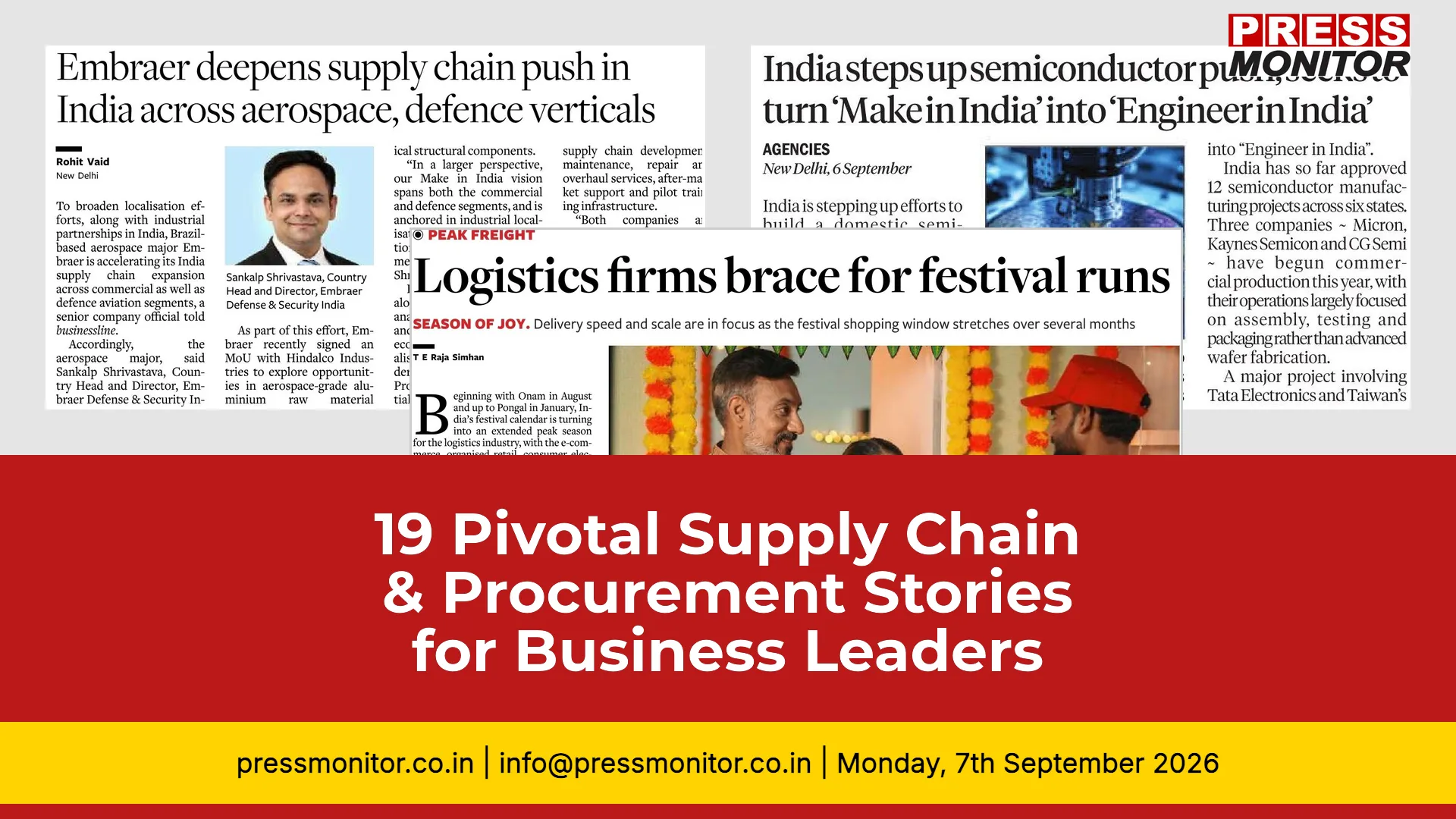
Tracking real-time shifts in global trade and domestic operations requires precise print media monitoring. This press review distills today’s most critical developments across aerospace, logistics, pharma, and digital retail. According to Press Monitor's tracking of Indian publications, here are the 19 pivotal stories shaping supply chain & procurement strategy right now.
1. Embraer Accelerates India Supply Chain Expansion
A front-page report in Business Line says Embraer is accelerating its India supply chain expansion across commercial and defence aviation segments. The aerospace major has signed an MoU with Hindalco Industries for aerospace-grade aluminium raw material manufacturing and partnered with Adani Defence & Aerospace to establish a final assembly line for the E75 aircraft in India.
Why it matters: Aerospace localization directly impacts defence and commercial aviation procurement cycles, reducing import dependency and shortening lead times.
Key detail/stat: Embraer signed an MoU with Hindalco Industries for aerospace-grade aluminium and partnered with Adani Defence & Aerospace for an E75 final assembly line in India.
Source: Business Line
Next step: Evaluate local supplier qualification timelines and align procurement contracts with the new assembly line milestones.
2. $13 Billion Semiconductor Mission
A front-page report in Statesman says India has launched the second phase of its semiconductor mission with a budget of around $13 billion to build a domestic semiconductor industry. The programme expands focus beyond basic infrastructure to cover the wider supply chain and developing a skilled workforce. India has approved 12 semiconductor manufacturing projects across six states, with three companies beginning commercial production this year.
Why it matters: Domestic chip manufacturing reshapes electronics and automotive procurement, creating immediate demand for packaging, testing, and raw material suppliers.
Key detail/stat: Phase II launches with a $13 billion budget, expanding beyond infrastructure to workforce development. Twelve projects approved across six states, with three entering commercial production.
Source: Statesman
Next step: Audit current semiconductor sourcing exposure and map alternative domestic vendors ahead of capacity ramp-up.
3. Logistics Firms Brace for Festival Runs
A front-page report in Business Line says India's logistics industry is preparing for an extended festival peak season from August to January, with e-commerce, organised retail, and consumer electronics expected to drive cargo and express volumes higher across tier-2 and tier-3 cities. Companies like Flipkart, Blue Dart, DTDC, and FreightFox are shifting from traditional capacity additions to technology-driven models using predictive analytics, distributed fulfilment, and multimodal networks to manage demand. Officials noted that rising customer expectations for speed, flexibility, and visibility are transforming festival logistics into a test of network intelligence rather than just freight capacity.
Why it matters: Extended peak seasons require dynamic capacity planning, shifting procurement from static freight contracts to technology-driven network models.
Key detail/stat: Companies like Flipkart, Blue Dart, DTDC, and FreightFox are deploying predictive analytics and distributed fulfilment to manage tier-2 and tier-3 city demand.
Source: Business Line
Next step: Negotiate flexible SLAs with 3PL partners that trigger automated capacity scaling during high-volume windows.
4. Flipkart Minutes Pulls Ahead Of Amazon
A front-page report in Financial Express says Flipkart Minutes is gaining an edge over Amazon Now in quick commerce, operating more than 1,000 dark stores across 120 to 130 cities. Amazon Now has slowed expansion to 500 to 600 stores across 11 cities due to operational issues. Flipkart converts a larger share of existing customers and generates more orders per store, giving it an advantage ahead of the festive season.
Why it matters: Quick commerce dark store density dictates last-mile procurement efficiency and inventory turnover rates for FMCG brands.
Key detail/stat: Flipkart operates over 1,000 dark stores across 120-130 cities, converting higher customer shares and generating more orders per store than Amazon Now.
Source: Financial Express
Next step: Prioritize distribution agreements with high-density quick commerce networks to optimize stock rotation.
5. Assocham Urges Visa And Magnet Resolution
A front-page report in Business Line says Assocham has written to the Secretary of the Ministry of External Affairs proposing structured inter-ministerial engagement with the Chinese Ambassador on residual visa, technology movement, and supply chain matters. The industry body highlights that visa curbs and restrictions on rare earth permanent magnets have disrupted manufacturing, and urges the government to give permanence to recent visa facilitation measures.
Why it matters: Cross-border visa restrictions and rare earth magnet export controls directly disrupt engineering and manufacturing supply chains.
Key detail/stat: Assocham requested structured inter-ministerial engagement with the Chinese Ambassador to formalize visa facilitation and resolve permanent magnet trade barriers.
Source: Business Line
Next step: Diversify magnet sourcing across ASEAN and monitor government diplomatic resolutions for procurement risk mitigation.
6. Houthi Conflict Hits Pakistan Trade
A front-page report in Statesman says the escalating Houthi conflict in the Red Sea zone has hit Pakistan's shipping and trade. Pakistan's foreign exchange earnings depend on overseas remittances from Pakistani nationals working on merchant ships and trade flows through Karachi and Gwadar ports. The shifting threat from piracy to missile and drone attacks since late 2023 creates a dangerous zone that Pakistan cannot independently secure.
Why it matters: Red Sea maritime disruptions validate the need for route diversification and contingency procurement frameworks in South Asian trade corridors.
Key detail/stat: Escalating missile and drone threats have paralyzed Karachi and Gwadar port flows, impacting remittance-dependent shipping lanes.
Source: Statesman
Next step: Stress-test freight routing alternatives and secure cargo insurance coverage for high-risk maritime zones.
7. Piyush Goyal Urges Pharma R&D Investments
A front-page report in Economic Times says Commerce and Industry Minister Piyush Goyal called for making the pharmaceutical sector more attractive for investments in clinical trials and research and development. He urged the industry to build resilient supply chains and reduce dependence on single sources for imports, warning that supply chains can be weaponised. Goyal also stated India needs to move beyond generics and promote R&D, patenting, and biotech innovation.
Why it matters: Policy shifts toward clinical trials and biotech innovation will transform API procurement strategies away from single-source dependencies.
Key detail/stat: Commerce Minister warned that supply chains can be weaponised, urging domestic regulators to adopt global best practices and promote patenting.
Source: Economic Times
Next step: Align vendor selection criteria with emerging R&D hubs and prioritize multi-geography API suppliers.
8. Quick Commerce Infrastructure Attracts $150 Million
A front-page report in Financial Express says verticalised quick-commerce startups attracted about $150 million in 2025, nearly 20 times the $8 million raised in 2024, with more than 20 companies raising capital. The report highlights the emergence of shared dark stores, warehousing, fulfilment technology, and last-mile networks that serve multiple businesses, allowing specialised players to scale without building capabilities from scratch. It also notes that quick-commerce enablement startup Inamo raised $8 million in a Series A in March, and Fairdeal.Market raised $15 million in May to expand its B2B network.
Why it matters: Shared dark store networks and fulfilment tech platforms are lowering entry barriers for specialized logistics providers.
Key detail/stat: Vertical quick-commerce startups raised ~$150 million in 2025. Enablement players like Inamo and Fairdeal.Market secured Series A funding to expand B2B networks.
Source: Financial Express
Next step: Partner with shared infrastructure operators to reduce capex while maintaining rapid delivery SLAs.
9. India Missile Production Boosts Defence
A front-page report in Financial Express says that Indian industry has the potential to develop a broader domestic supply chain for manufacturing and integrating complete missile systems. This could gradually reduce reliance on imported platforms and foreign suppliers, while improving resilience against supply-chain disruptions and geopolitical restrictions.
Why it matters: Indigenous missile system integration creates massive opportunities for domestic component suppliers and reduces foreign exchange exposure.
Key detail/stat: Industry potential exists to develop broader domestic supply chains for complete missile systems, improving resilience against geopolitical restrictions.
Source: Financial Express
Next step: Register with defence procurement portals and qualify for Make in India tier-1 supplier status.
10. Startups to Get ₹25 Crore Procurement Push
A front-page report in Deccan Herald says the Karnataka government will earmark ₹25 crore to support 100 startups under the 'Government First' initiative, positioning the state as the first customer of startups working on governance and public service delivery. The IT-BT department has drawn out the specifics and the proposal will soon be placed before the Cabinet. The initiative aims to relax traditional procurement barriers such as prior experience and earnest money deposits, enabling startups to test solutions in real-world government environments.
Why it matters: Government-first procurement policies are opening public sector contracts to agile tech startups, bypassing traditional experience barriers.
Key detail/stat: Karnataka earmarks ₹25 crore for 100 startups, relaxing earnest money deposits and prior experience requirements for governance solutions.
Source: Deccan Herald
Next step: Submit capability statements to state IT-BT departments and leverage relaxed tender conditions.
11. MachTech Expo Opens Today
A front-page report in Times of India says the MachTech Expo and Pharma & Laboratory Quality Assurance Procurement Expos open today at Bharat Mandapam Hall 6 in New Delhi. The events feature over 200 exhibitors, live industry leader demonstrations, and experts including Rakesh Suraj and Shafiqakhtar, targeting manufacturers, distributors, and business owners in the biopharma, R&D, and regulatory sectors.
Why it matters: Direct manufacturer-to-distributor engagements at major expos accelerate equipment procurement and streamline regulatory compliance discussions.
Key detail/stat: Over 200 exhibitors showcase live demonstrations targeting biopharma, R&D, and quality assurance sectors at Bharat Mandapam.
Source: Times of India
Next step: Schedule vendor meetings on-site and collect technical specifications for Q4 capital expenditure planning.
12. Glass, PET Fill Drinks Gap
A front-page report in Economic Times says cola and beer companies in India are increasingly using glass and PET bottles as aluminium can prices rise at least 20 percent due to West Asia conflict. Suppliers report stronger demand for glass bottles and some brands moving certain SKUs to alternative packaging. Import of can shells from the UAE and Saudi Arabia remains necessary to bridge supply gaps during the festive season.
Why it matters: Packaging material substitution driven by West Asia aluminium price surges forces beverage manufacturers to renegotiate container procurement contracts.
Key detail/stat: Can prices rose 20%+, prompting brands to shift SKUs to glass and PET while importing can shells from UAE and Saudi Arabia.
Source: Economic Times
Next step: Lock in multi-quarter glass and PET pricing before festive season demand spikes.
13. RPG Life Sciences Spends Rs 725 Crore On API Acquisitions
A front-page report in Mint says PG Life Sciences has spent 725 crore rupees buying two active pharmaceutical ingredient makers in five weeks, with another 700 crore rupees earmarked for inorganic growth. Managing director Ashok Nair says the company is betting on the China-plus-one strategy, as customers seek sourcing diversification and reduced concentration, positioning India to benefit from this trend with government incentives.
Why it matters: M&A activity in active pharmaceutical ingredients signals consolidation trends and validates China-plus-one sourcing strategies.
Key detail/stat: PG Life Sciences acquired two API makers in five weeks, allocating another ₹700 crore for inorganic growth to capture diversification demand.
Source: Mint
Next step: Monitor competitor acquisition pipelines and identify undervalued API manufacturing assets for strategic partnerships.
14. Strait of Hormuz Ships Carry Alien Species
A front-page report in Times of India says researchers Chad Hewitt, Gregory Ruiz, Ian Davidson and Mario Tamburri warn that more than 1,500 commercial vessels laid up in the Persian or Arabian Gulf since February because of the Strait of Hormuz closure could carry invasive marine biofouling species to world ports when shipping resumes, with Mumbai and Colombo among likely destinations. Stationary vessels can accumulate algae, bacteria, parasites and other non-native species on submerged hulls, increasing ship weight and threatening ecosystems, coastal industries and ports such as Mumbai, Kochi and Colombo.
Why it matters: Environmental biosecurity risks from laid-up vessels highlight the hidden costs of maritime delays and port contamination protocols.
Key detail/stat: Over 1,500 commercial vessels stranded in the Gulf may transport invasive marine species to Mumbai, Kochi, and Colombo upon resumption.
Source: Times of India
Next step: Update port clearance SOPs and coordinate with environmental agencies for hull inspection mandates.
15. 49% Vizhinjam Stake: MSC Terminal Deal
A front-page report in Business Line says India permits vertical integration between shipping lines and terminals, as seen with MSC's Terminal Investment agreement to acquire a 49 per cent stake in the Vizhinjam terminal operated by Adani Ports. The article examines how carrier-owned terminals can bring capital and operational expertise but may also favour own vessels, and asks why such structures are accepted in maritime transport while being debated in aviation.
Why it matters: Carrier-owned terminal vertical integration alters port access dynamics and influences liner shipping procurement negotiations.
Key detail/stat: India permits vertical integration as MSC acquires 49% stake in Adani Ports’ Vizhinjam terminal, raising questions about vessel preference policies.
Source: Business Line
Next step: Review terminal access agreements and benchmark carrier-owned port models against independent hub reliability.
16. India Navigates Rising Economic Nationalism
A front-page report in First India says the world's economy is moving toward economic nationalism as globalization faces pressure from tariffs, sanctions, and protectionism. The trade rivalry between the United States and China is reshaping global supply chains, prompting India to seek a stronger position as an alternative to China while deepening ties with multiple partners. The article warns that rising tariffs could trigger retaliation, leading to costlier trade and weaker global growth, and argues that India must balance domestic industry strength with global competitiveness.
Why it matters: Global tariff wars and protectionism force Indian exporters to restructure supply chains and negotiate bilateral trade safeguards.
Key detail/stat: US-China rivalry reshapes global trade flows, prompting India to position itself as an alternative manufacturing base while balancing competitiveness.
Source: First India
Next step: Conduct tariff impact analysis on cross-border components and explore FTAA benefits for regional sourcing.
17. APTRANSCO Invites Tender
A front-page report in The Hindu says that the Transmission Corporation of Andhra Pradesh Limited (APTRANSCO) has invited bids online for the supply of 30 22OV, 10AH VRLA battery banks and 28 22OV, 20AH VRLA battery banks. The tender will be available from 9 September 2026 at 6:00 PM on the official website. The notice is issued by APTRANSCO’s CE/Transmission office.
Why it matters: State utility procurement cycles create predictable demand windows for battery banks and power infrastructure suppliers.
Key detail/stat: APTRANSCO issued online bids for 30 units of 220V 10AH and 28 units of 220V 20AH VRLA battery banks, closing September 9.
Source: The Hindu
Next step: Prepare technical compliance documents and submit bids through the official e-procurement portal before deadline.
18. Capital Surge in Quickcommerce
A front‑page report in Financial Express says that vertical quickcommerce startups are raising significant capital to build shared dark store networks in India, with Fairdeal.Market raising fifteen crore rupees in May and DocPharma raising two crore rupees in August, and a BCG report outlines the order density needed for profitability.
Why it matters: Venture funding flowing into shared fulfilment networks indicates maturation of quick commerce logistics, enabling scalable procurement models.
Key detail/stat: Fairdeal.Market raised ₹15 crore and DocPharma ₹2 crore recently, while BCG outlines order density thresholds for profitability.
Source: Financial Express
Next step: Integrate with funded enablement platforms to access standardized warehousing and last-mile routing tools.
19. India Defence Manufacturing Boost
A front-page report in Financial Express says investment requirements may rise in the near term as manufacturers establish specialised production facilities, testing infrastructure and quality assurance systems. Domestic production is expected to generate longer-term economic benefits by reducing dependence on imported equipment, overseas support services and foreign currency-linked procurement costs. Increased competition, larger production runs and improved local availability of spare parts could also contribute to more efficient lifecycle costs while circulating a greater share of defence expenditure within the domestic economy through employment generation, industrial investment, research and development and supply chain expansion.
Why it matters: Domestic production expansion reduces lifecycle costs and circulates defence expenditure within the local economy through employment and R&D.
Key detail/stat: Specialized facilities and quality assurance systems will lower reliance on imported equipment and overseas support services over the long term.
Source: Financial Express
Next step: Align product roadmaps with indigenous defence standards and participate in upcoming capability development programmes.
These stories represent the pulse of today's news on supply chain & procurement. How will your organization adapt its sourcing strategy to these shifts? Share your tactical approach below.