3 Essential Commercial Shipping Stories for Maritime Leaders


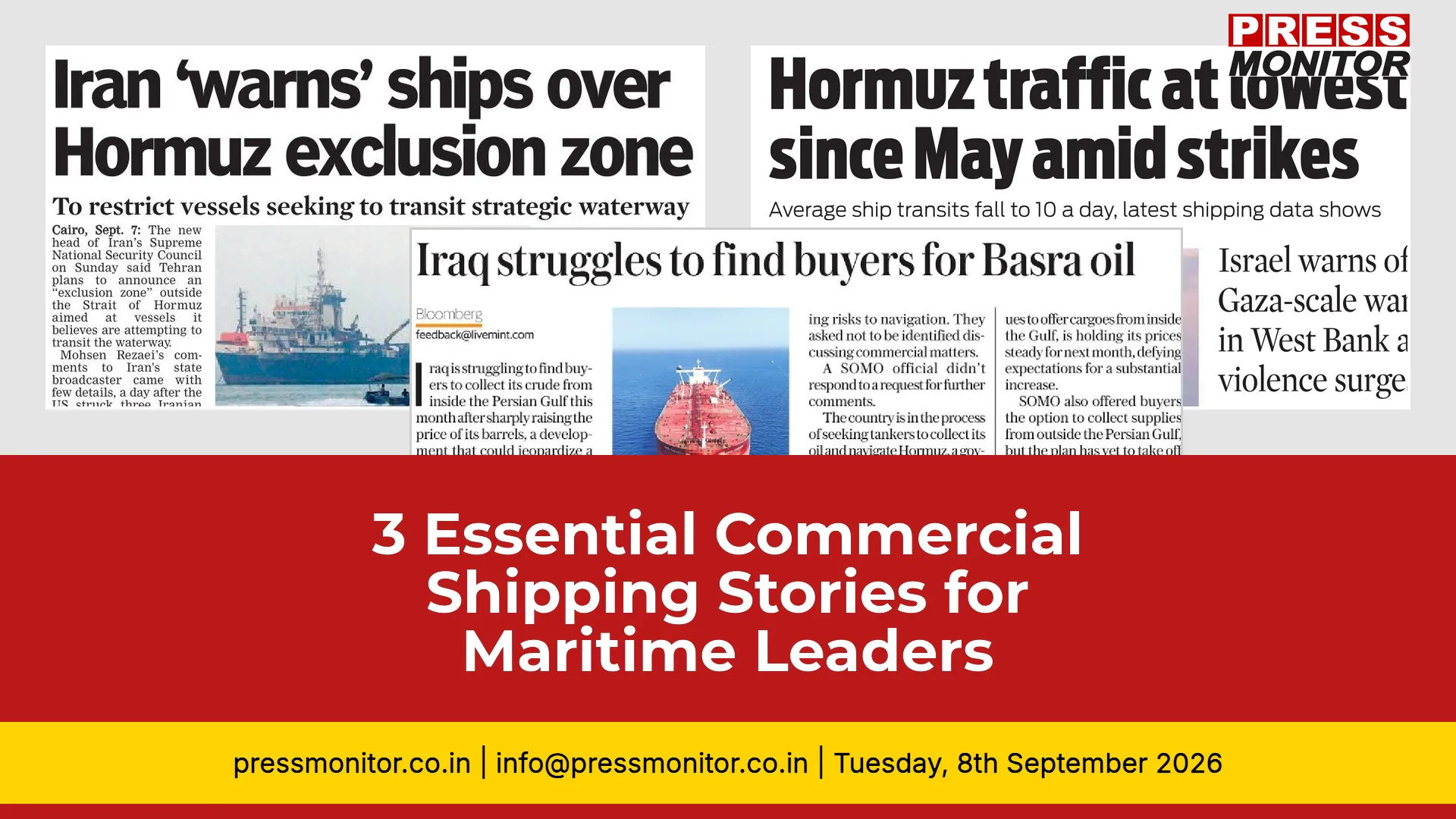
According to Press Monitor's tracking of Indian publications, this media monitoring report delivers print media monitoring intelligence on the Strait of Hormuz crisis — news on commercial shipping that demands immediate attention from maritime leaders. This press review distills the most consequential developments from today's Indian print coverage, providing media intelligence that supply chain and shipping leaders need to act on now.
1. Iran's Hormuz Exclusion Zone
A front-page report in Asian Age says Tehran plans to announce an exclusion zone outside the Strait of Hormuz aimed at vessels attempting to transit the waterway. Mohsen Rezaei, head of Iran's Supreme National Security Council, stated the zone would extend from the US naval blockade line into the Persian Gulf, with ships entering facing sanctions. The announcement follows US strikes on Iranian oil tankers after Tehran launched ballistic missiles at US warships, and comes as gas prices hit Labour Day records in the US due to disruptions in crude oil traffic through the strait. Iran's Supreme National Security Council head Mohsen Rezaei announced plans for a strategic exclusion zone outside the Strait of Hormuz, targeting vessels attempting to transit the waterway. Ships entering the zone would face sanctions, according to the Asian Age report. The move follows US strikes on Iranian oil tankers and Tehran's ballistic missile attacks on US warships, and comes as gas prices hit Labour Day records in the US due to disruptions in crude oil traffic through the strait.
Why it matters: For maritime operators, this means immediate rerouting decisions and revised risk assessments for any vessel transiting the Persian Gulf. The exclusion zone extends from the US naval blockade line into the Gulf itself, widening the zone of operational uncertainty for shipping companies worldwide.
Key stat: Gas prices hit Labour Day records in the US as crude oil traffic disruptions through the strait mount.
Source: Asian Age, Delhi, Sept. 7
Next step: Shipping managers should review current Hormuz transit schedules and prepare contingency routing through alternative corridors.
2. Hormuz Traffic Falls to May Low
A front-page report in Morning Standard says shipping traffic through the Strait of Hormuz fell to an average of ten vessels daily over the past ten days, marking the lowest level since May amid escalating United States-Iran tensions and proposed exclusion zones. Simultaneously, Israeli Defence Minister Israel Katz warned that full-scale war could erupt in the West Bank if the Palestinian Authority initiates attacks resembling those launched from Gaza on October seventh, two thousand twenty-three. Shipping data from Kpler, reported by Morning Standard, shows an average of just ten merchant vessels transited the Strait of Hormuz per day over the past ten days — the lowest level since May. The sharp decline reflects the combined impact of US-Iran tensions and proposed exclusion zones.
Why it matters: Reduced transit volume directly impacts freight rates, delivery timelines, and chartering costs across global container and bulk shipping. Every day of reduced throughput compounds delays across international supply chains.
Key stat: Ten vessels per day — the lowest since May.
Source: Morning Standard, New Delhi
Next step: Freight forwarders should alert clients to potential delays and explore alternative routing options through the Suez Canal or overland corridors where feasible.
3. Iraq Struggles to Find Basra Oil Buyers
A front-page report in Mint says Iraq is struggling to find buyers for Basra oil as its state marketing company SOMO sharply raised prices by cutting discounts last week. The Iran war has hit Iraq hard, squeezing oil exports and exposing dependence on the Strait of Hormuz. Traders say smaller discounts make Iraq's barrels too unattractive given high shipping costs and navigation risks. Iraq's state marketing company SOMO sharply raised Basra oil prices by cutting discounts, but traders report the country is struggling to find buyers. The Iran war has hit Iraq hard, squeezing oil exports and exposing dependence on the Strait of Hormuz. Smaller discounts make Iraqi barrels too unattractive given high shipping costs and navigation risks through the contested waterway.
Why it matters: The Hormuz disruption is not just a regional issue — it is reshaping global crude oil pricing and buyer behavior across the Middle East, with downstream effects on tanker demand and freight indices.
Key detail: The Iran war has hit Iraq hard, squeezing oil exports and exposing dependence on the Strait of Hormuz.
Source: Mint, Delhi (Bloomberg)
Next step: Oil traders and tanker operators should reassess Basra cargo commitments and factor in elevated routing risk premiums.
Closing: As Hormuz tensions escalate and Iraq's oil export challenges mount, the commercial shipping sector faces a defining moment. How will your organisation adapt transit routes and risk models when the world's most critical oil chokepoint is effectively contested? Share your perspective in the comments.
