3 Key Shipping Stories for Maritime Professionals


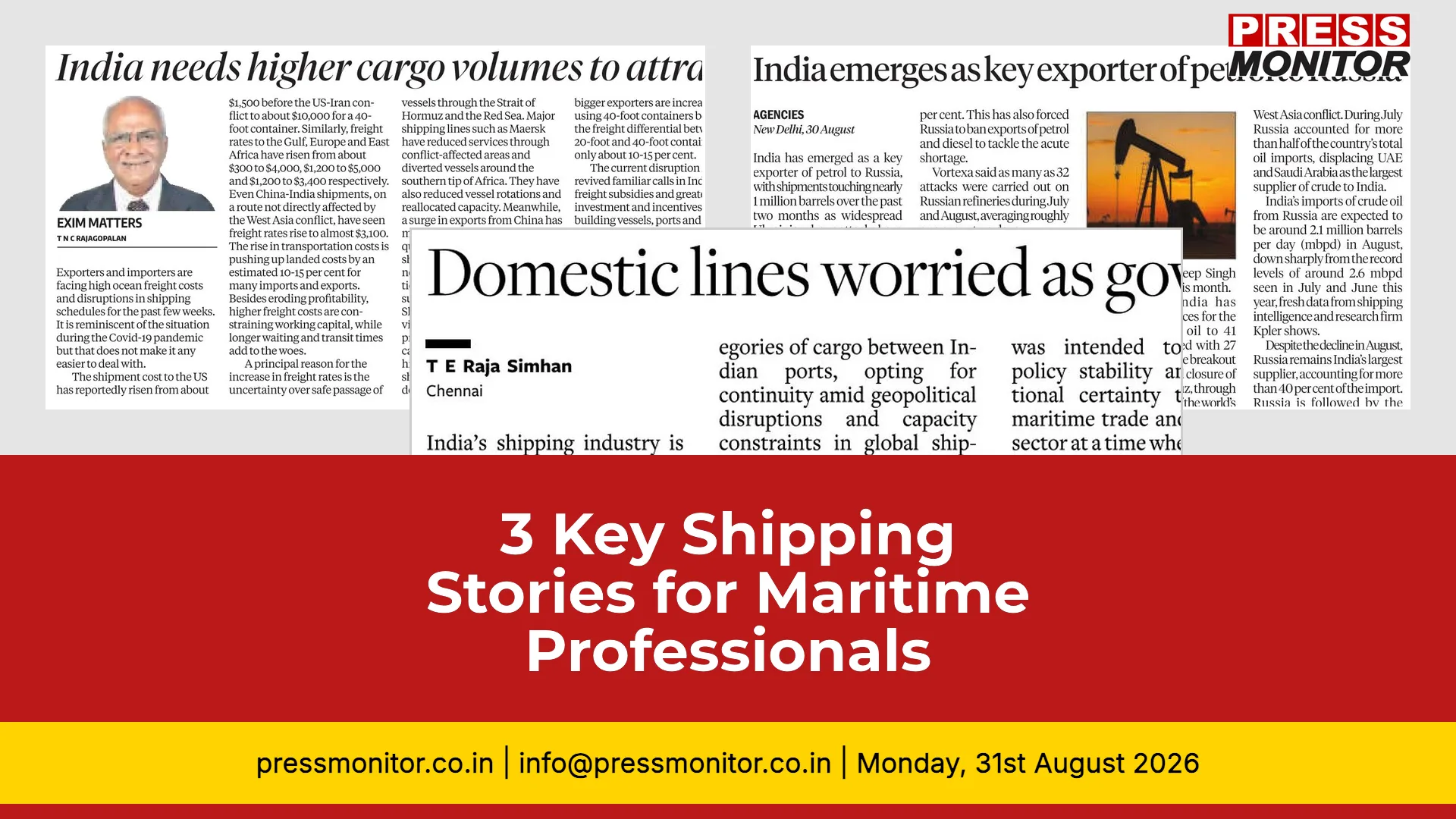
India's maritime sector is facing a trifecta of challenges: rising freight costs, geopolitical shifts, and regulatory changes. According to Press Monitor's tracking of Indian publications, these three stories from today's print media offer critical insights for shipping professionals. Here's your daily press review powered by print media monitoring.
1. India's Cargo Volume Challenge
Exporters and importers are facing high ocean freight costs and disruptions in shipping schedules. Shipment costs to the US have risen from $1,500 to $10,000, and to the Gulf, Europe, and East Africa from $300 to $4,000, $1,200 to $5,000, and $1,200 to $3,400 respectively. The rise in transportation costs is pushing up landed costs. India needs sufficient export and import cargo volumes to attract sailings from global shipping lines, which necessitates increased competitiveness and market share. Subsidies or investments in vessels and ports are being considered, but must be weighed against a broader technological transition in the maritime industry.
Why it matters: High freight rates are squeezing exporters and importers.
Key detail: Shipment costs to the US have risen from $1,500 to $10,000; to the Gulf from $300 to $4,000; to Europe from $1,200 to $5,000; and to East Africa from $1,200 to $3,400.
Source: Business Standard, New Delhi
Next step: India needs to boost export and import cargo volumes to attract global shipping lines.
Closing: How can India compete with larger trade hubs?
2. India's Petrol Exports to Russia
"Selon The Statesman, India has emerged as a key exporter of petrol to Russia, with shipments touching nearly 1 million barrels over the past two months as widespread Ukrainian drone attacks have crippled the country’s refineries, forcing Moscow to take recourse to imports to meet domestic demand. Russia's seaborne gasoline imports surged to a record 470,000 tonnes in August, with long queues of cars at local filling stations reflecting the shortage. Russia’s domestic fuel production has dropped by as much as 70 per cent, forcing Russia to ban exports of petrol and diesel to tackle the acute shortage."
Why it matters: India emerges as a key fuel supplier to Russia amid refinery disruptions from Ukrainian drone attacks.
Key detail: Shipments of nearly 1 million barrels over two months; Russia's seaborne gasoline imports hit a record 470,000 tonnes in August.
Source: The Statesman, Delhi
Next step: This could reshape energy trade routes between India and Russia.
Closing: What does this mean for global energy security?
3. Foreign Vessels in Coastal Trade
A front-page report in Business Line says India’s shipping industry is set for continued competition from foreign-flagged vessels in coastal trade, with the Centre restoring the 2018 relaxations to ensure capacity for exporters and importers amid geopolitical disruptions.
Why it matters: Domestic shipping lines face increased competition from foreign-flagged vessels in coastal trade.
Key detail: The Centre restored 2018 relaxations to ensure capacity for exporters and importers amid geopolitical disruptions.
Source: Business Line, Delhi
Next step: Balancing domestic industry concerns with trade needs.
Closing: Will foreign vessels crowd out Indian shipping?
Stay ahead with Press Monitor's media intelligence on Indian print media. Which of these developments impacts your operations most? Share your thoughts.