5 Essential Delivery Services Stories for Logistics Leaders


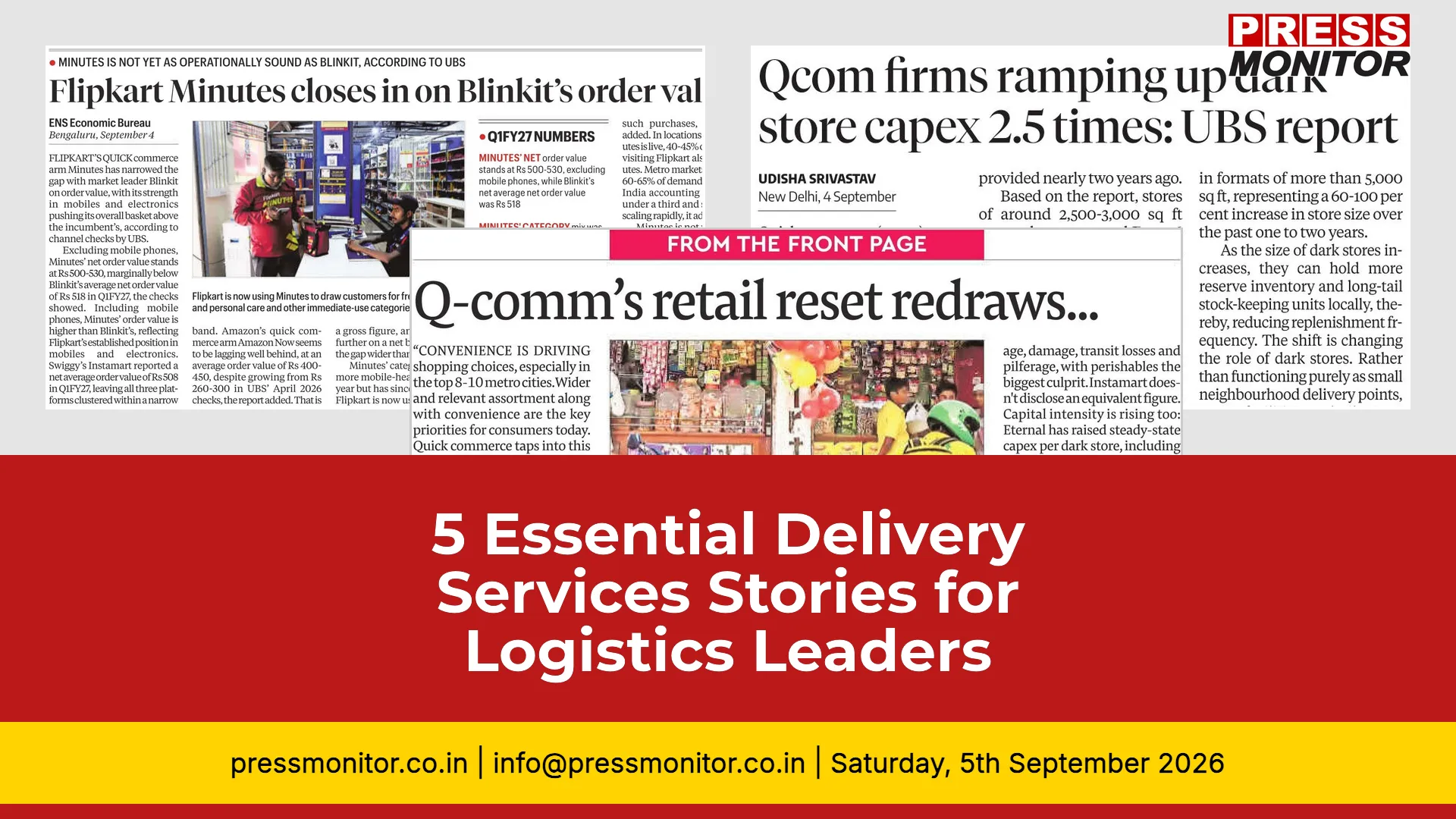
According to Press Monitor's tracking of Indian publications, this media monitoring press review draws on print media monitoring and media intelligence to examine five essential stories shaping the delivery services and logistics sector. From quick commerce capex surges to new rail freight corridors, these stories capture the news on delivery services that every supply chain leader must track.
1. Flipkart Minutes Narrows Blinkit Gap
A front-page report in Indian Express says Flipkart Minutes has narrowed its gap with Blinkit on order value, based on UBS channel checks for Q1FY27 data reported from Bengaluru on September 4. The comparison involved Flipkart Minutes, Blinkit, Swiggy Instamart, Zepto and Amazon Now, with UBS finding Flipkart Minutes at rupees five hundred to rupees five hundred thirty excluding mobile phones, below Blinkit's rupees five hundred eighteen, but higher when mobile phones are included. UBS also said Minutes is not yet as operationally sound as Blinkit, with gross margins trailing and discounts higher despite cost per order moving closer to Blinkit and Instamart levels.
Flipkart's quick commerce arm is closing in on market leader Blinkit, signaling intensifying competition in India's online grocery and quick commerce space.
Why it matters: The order value gap is narrowing fast, and Flipkart's ecosystem advantage in mobiles could reshape the competitive hierarchy.
Key detail: Flipkart Minutes' net order value stands at Rs 500-530 excluding mobile phones, below Blinkit's Rs 518 — but surpasses Blinkit when mobile phones are included, reflecting Flipkart's established electronics strength. Minutes trails Blinkit on gross margins and discounts, though cost per order is converging.
Source: Indian Express, 4 September, Bengaluru
Next step: Watch for operational parity — if Minutes closes the margin gap, it becomes a genuine challenger to Blinkit's market leadership. Tag the teams at Blinkit and Flipkart in your comments on this development.
2. 22.5 Crore Capex Surge for Dark Stores
A front-page report in Business Standard says that Quick Commerce firms like Eternal’s Blinkit and Swiggy’s Instamart are raising capex for dark stores to about 22.5 crore, up 2.5 times from earlier guidance, with larger store sizes now costing 23 crore for 7,000 sq ft, as of 4 September in New Delhi.
Quick commerce firms are dramatically increasing capital expenditure for dark stores, signaling confidence in sustained demand for instant delivery.
Why it matters: This capex wave reflects the sector's bet on permanent infrastructure rather than temporary growth, with major implications for real estate and financing in the logistics space.
Key detail: Per UBS data, capex guidance has risen 2.5 times to 22.5 crore per store, with larger 7,000 sq ft formats now costing 23 crore.
Source: Business Standard, 4 September, New Delhi
Next step: Monitor whether this investment translates to market share gains or margin pressure across Blinkit, Instamart, and Zepto. Tag Blinkit and Swiggy to join the conversation.
3. Swiggy's Inventory Model Shift
A front-page report in Financial Express says Swiggy has shifted its Instamart service to an inventory‑led model after shareholders approved a forty‑nine point five percent cap on foreign ownership. The change means the platform will now record the full value of goods sold rather than just commission, boosting reported revenue and making it more like a conventional retailer. FMCG companies are expected to benefit from a new profitable route to consumers and higher margins for quick‑commerce operators.
Swiggy has shifted Instamart to an inventory-led model after shareholders approved a 49.5 percent foreign ownership cap, transforming it from a marketplace to a conventional retailer.
Why it matters: FMCG companies gain a new profitable route to consumers, and quick-commerce operators see potential for higher margins under the inventory model.
Key detail: The platform will now record the full value of goods sold rather than just commission, boosting reported revenue and creating a more sustainable business model.
Source: Financial Express, 4 September, Bengaluru/Mumbai
Next step: FMCG companies should evaluate Instamart as a distribution channel with potentially better unit economics than the marketplace model. Tag Swiggy to share your perspective.
4. Quick Commerce Firms Hire Quality Checkers
A front-page report in Mint says quick commerce firms are actively hiring quality checkers following recent regulatory enforcement. Regulators have inspected dark stores across Maharashtra and Karnataka, leading to license suspensions for Blinkit, Zepto, and Swiggy Instamart over hygiene and labelling violations. These companies operate thousands of dark stores and are responding to scrutiny by adding dedicated store-level compliance roles.
Regulatory enforcement is forcing quick commerce operators to build dedicated compliance teams, raising operational costs but strengthening food safety standards across dark stores.
Why it matters: Compliance infrastructure is becoming a competitive differentiator — firms that invest early gain regulatory goodwill and consumer trust advantages.
Key detail: Regulators in Maharashtra and Karnataka have inspected dark stores and suspended licenses for Blinkit, Zepto, and Swiggy Instamart over hygiene and labelling violations.
Source: Mint, 5 September, Bengaluru
Next step: Companies should treat quality assurance as a strategic investment, not just a cost center, as regulatory scrutiny intensifies. Tag Blinkit, Zepto, and Swiggy on this regulatory shift.
5. 166-Hour Cargo Train to Delhi
A front-page report in Deccan Herald says Indian Railways has launched a container train service between Whitefield in Bengaluru and Tughlakabad, with delivery to Delhi. The service, announced on 5 September 2026 by Union Minister of State for Railways and Jal Shakti V. Somanna, will deliver cargo to Delhi in 166 hours from dispatch, down from an earlier average of 216 hours, while offering first-mile and last-mile road connectivity and secure transfer.
Indian Railways has launched a container train service between Bengaluru and Delhi, cutting cargo transit time from 216 hours to 166 hours.
Why it matters: This corridor could transform bulk cargo economics for e-commerce and freight operators moving goods between South and North India.
Key detail: Announced by Union Minister of State for Railways and Jal Shakti V. Somanna, the service offers first-mile and last-mile road connectivity with secure transfer.
Source: Deccan Herald, 5 September, Bengaluru
Next step: Logistics firms should evaluate this route for cost-effective cargo movement and consider integrating it into their supply chain planning. Tag Indian Railways to amplify this infrastructure story.
These five stories, tracked through Press Monitor's print media monitoring, illustrate a sector in transition — from regulatory compliance and capital investment to new infrastructure and business model innovation. Which of these developments will have the biggest impact on your supply chain strategy in the next quarter?