5 Essential Legal and Regulatory Stories for Legal Counsel


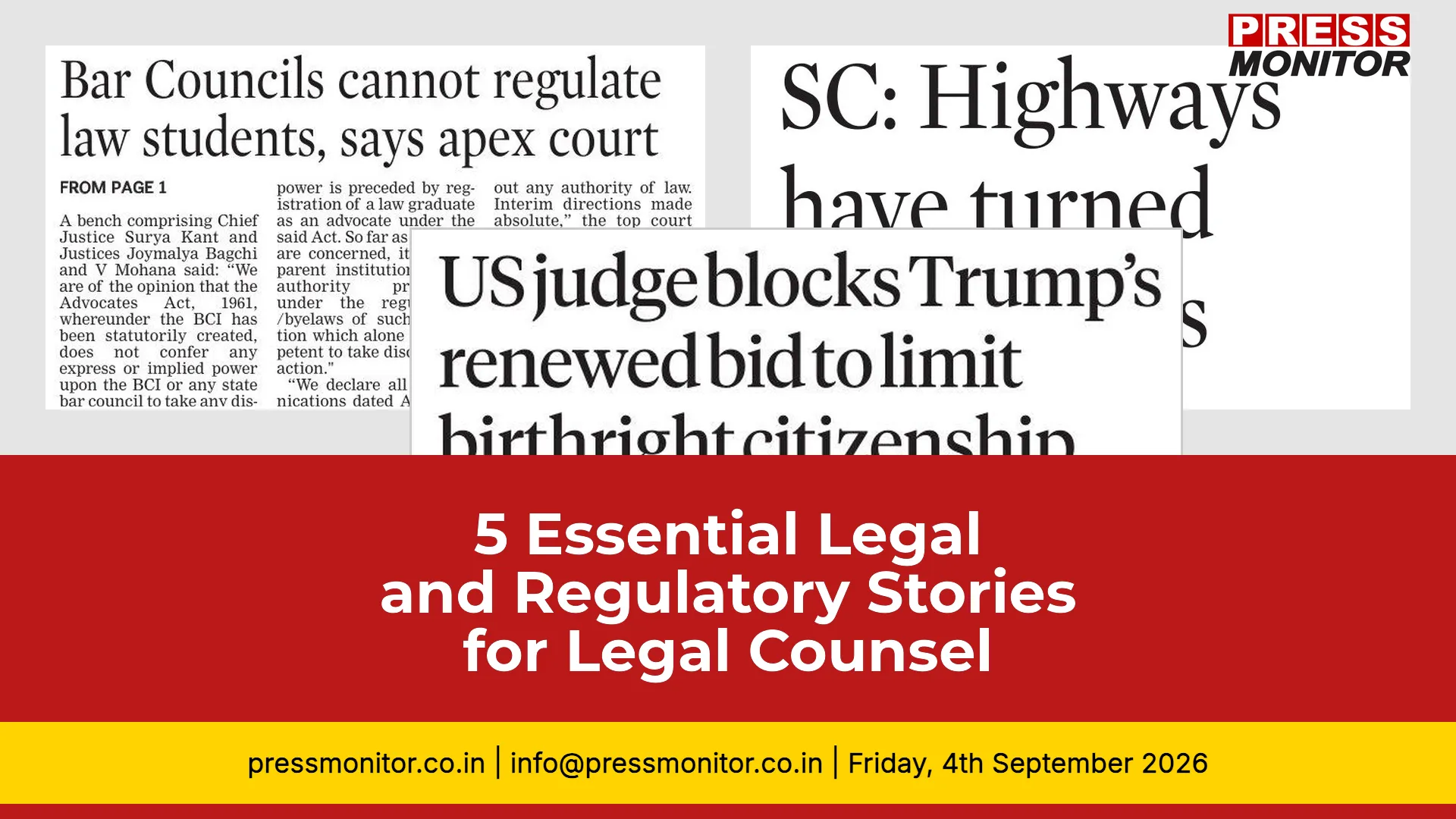
Media monitoring of India's legal and regulatory landscape reveals dramatic shifts today, according to Press Monitor's tracking of Indian publications. From a landmark Supreme Court ruling on bar council authority to highway safety mandates, these stories define the day's most consequential developments. This press review delivers media intelligence on the cases and policies that matter, bringing you news on legal and regulatory developments as they unfold.
1. SC Rules Bar Councils Cannot Regulate Law Students
A front-page report in Deccan Chronicle says the Supreme Court of India ruled that Bar Councils and the Bar Council of India have no power to take disciplinary action against law students. The bench led by Chief Justice Surya Kant declared all communications issued by the Bar Council of India chairman Manan Kumar Mishra on August thirteen to be without legal authority. The interim directions were made absolute while disposing of a plea by two Nalsar University alumni, Mihira Sood and Abhishek Tiwari.
Why it matters: The Supreme Court's ruling redefines the boundary between regulatory bodies and educational institutions, with significant implications for student rights and academic freedom across India.
Key detail/stat: The bench, led by Chief Justice Surya Kant, set aside all communications issued by BCI chairman Manan Kumar Mishra on August 13 as without legal authority. The interim directions were made absolute while disposing of a plea by NALSAR University alumni Mihira Sood and Abhishek Tiwari.
Source: Deccan Chronicle, front page, September 4, 2026. Cross-referenced across 13 Indian publications.
Next step: Law firms and legal education policymakers should reassess compliance frameworks in light of this ruling.
2. SC Orders NHAI to Install Surveillance at All Toll Plazas
A front-page report in New Indian Express says the Supreme Court on Thursday flagged encroachment and stationary vehicles on national highways, asking the NHAI why it cannot install camera surveillance and monitoring rooms across toll plazas. A bench of Justices Vikram Nath and Sandeep Mehta, while hearing a suo motu case of an accident in Rajasthan's Phalodi area that claimed fifteen lives, noted that illegally parked vehicles, breakdowns and encroachments have made highways unsafe. The Court directed NHAI to file a comprehensive affidavit in four weeks detailing existing surveillance, toll plazas with monitoring rooms, and feasibility of CCTV every two to five kilometres.
Why it matters: This order could transform road safety infrastructure across India's national highway network, potentially preventing future accidents caused by illegal parking and vehicle breakdowns.
Key detail/stat: The suo motu case was triggered by a devastating accident in Rajasthan's Phalodi area that claimed 15 lives. The court asked NHAI to file a comprehensive affidavit in four weeks detailing existing surveillance and the feasibility of CCTV cameras every 2 to 5 kilometres.
Source: New Indian Express, front page, September 4, 2026. Cross-referenced across 3 Indian publications.
Next step: NHAI and state transport departments must begin planning surveillance deployment immediately.
3. Trump Administration Loses Birthright Citizenship Battle
A front-page report in Statesman says a US federal judge on Wednesday blocked the Trump administration from enforcing a renewed executive order seeking to restrict birthright citizenship. US District Judge Deborah Boardman ruled that the policy likely violates the 14th Amendment and follows a recent Supreme Court decision striking down a similar directive. The preliminary injunction prohibits enforcement against any child born after February 2025 to parents who were not lawfully in the country at the time.
Why it matters: This ruling reinforces constitutional protections and signals judicial scrutiny of executive immigration actions, with implications for citizenship law globally.
Key detail/stat: US District Judge Deborah Boardman ruled the policy likely violates the 14th Amendment, following a recent Supreme Court decision striking down a similar directive. The preliminary injunction prohibits enforcement against any child born after February 2025 to parents who were not lawfully in the country.
Source: Statesman, front page, September 4, 2026. Cross-referenced across 2 Indian publications.
Next step: International legal observers and immigration lawyers should monitor further proceedings in the class-action lawsuit.
4. Centre Tells SC It Is Implementing CBSE Three-Language Policy
A front-page report in Morning Standard says the Centre informed the Supreme Court on Thursday that it was working on the court's suggestions regarding the implementation of the CBSE policy mandating the study of three languages, including two Indian languages, for Class 9 students. Additional Solicitor General Aishwarya Bhati told the bench of Chief Justice Surya Kant and Justices Joymalya Bagchi and V Mohana that the government was assessing teacher availability, textbooks, and language choices. The bench directed the Centre to file a detailed affidavit within four weeks outlining an effective roadmap, noting that promoting Indian languages should not come at the cost of students.
Why it matters: Education policy implementation now has direct judicial oversight, affecting millions of students across India's school system.
Key detail/stat: Additional Solicitor General Aishwarya Bhati told the bench of Chief Justice Surya Kant and Justices Joymalya Bagchi and V Mohana that the government is assessing teacher availability, textbooks, and language choices. The bench directed the Centre to file a detailed affidavit within four weeks.
Source: Morning Standard, front page, September 4, 2026. Cross-referenced across 2 Indian publications.
Next step: State education departments should prepare compliance reports addressing the court's concerns about teacher availability and textbook distribution.
5. SC Rules Nuvama Clearing Cannot Be Forced to Restore 900 Crore in Client Securities
A front-page report in Mint says the Supreme Court ruled that Professional Clearing Member Nuvama Clearing Services Ltd cannot be forced to pay back or restore client securities worth over 900 crore. The ruling overturned lower tribunal orders and held that PCMs operated without direct client-level visibility under earlier regulatory rules. The case involved stockbroker Anugrah Stock & Broking and was decided on 2 September 2026.
Why it matters: This verdict reshapes the regulatory framework governing securities clearing and investor protection in India's capital markets.
Key detail/stat: The Supreme Court overturned lower tribunal orders and held that Professional Clearing Members operated without direct client-level visibility under earlier regulatory rules. The case involved stockbroker Anugrah Stock & Broking and was decided on 2 September 2026.
Source: Mint, front page, September 4, 2026. Cross-referenced across 1 Indian publication.
Next step: Market regulators and brokerages must review client visibility requirements in light of this ruling.
According to Press Monitor's tracking of Indian publications, these five stories represent the most significant legal and regulatory developments of the day. For print media monitoring professionals, this review underscores the power of curated Indian print intelligence in tracking judicial and policy shifts in real time. What story will shape your work tomorrow?