7 Essential Employment Stories for HR Leaders


According to Press Monitor's tracking of Indian publications, this media monitoring roundup delivers seven essential stories on jobs, employment, and workforce transformation that every HR leader needs to know. These print media monitoring insights, drawn from today's news on jobs across Indian newspapers, highlight how media intelligence is reshaping workforce strategy. From massive corporate restructuring to emerging skill gaps, these developments are reshaping India's labor market.
1. Jaguar Land Rover Cuts 4,000 Jobs Globally
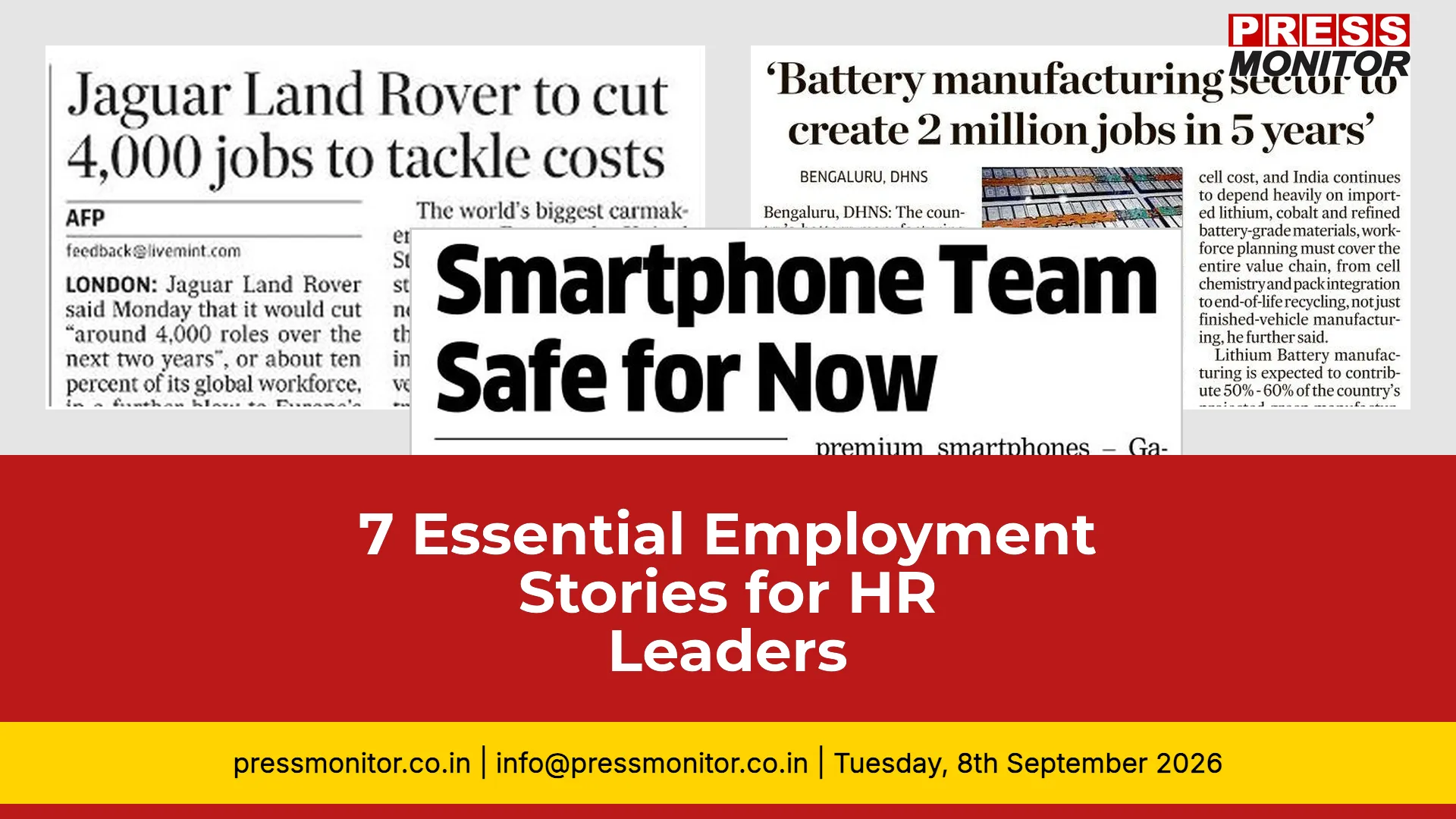
A front-page report in Hindustan Times says Jaguar Land Rover announced Monday that it would cut around 4,000 roles over the next two years, representing about ten percent of its global workforce, as a further blow to Europe’s automobile industry. The voluntary redundancy scheme was revealed just days after German car giant Volkswagen announced 50,000 new job cuts, and follows months of turmoil caused by a cyberattack on the British luxury carmaker and US President Donald Trump’s sector-wide tariffs. JLR’s chief executive PB Balaji stated the company targets cost savings of 17 billion rupees, while the automotive industry faces significant challenges from technological change, intense competition from Chinese manufacturers, and the shift toward electric vehicles. JLR's voluntary redundancy programme targets salaried and management roles across its global workforce, aiming to save £1.7 billion and lower its break-even point to 300,000 vehicles. The move comes amid US tariffs, a cyberattack, and fierce competition from Chinese manufacturers like BYD. Most affected employees are based in the United Kingdom.
Why it matters: This restructuring signals a broader automotive industry pivot toward cost efficiency and electrification, with ripple effects across supply chains and workforce planning globally.
Key detail: JLR employs about 30,000 people in the UK out of a global workforce of roughly 40,000, making the UK the primary impact zone.
Source: Hindustan Times, Delhi
Next step: HR teams at automotive suppliers should assess downstream workforce exposure and prepare contingency plans.
2. Battery Sector to Create 2 Million Jobs by 2030
A front-page report in Deccan Herald says India's battery manufacturing sector is projected to generate 1.5 to 2 million jobs by 2030, with hiring growing 25 to 30 percent year-on-year. Under the PLI Scheme for Advanced Chemistry Cells, the Government of India has committed Rs 18,100 crore to develop 50 GWh of domestic manufacturing capacity. The sector is also building a full industrial ecosystem across Gujarat, Karnataka, Haryana, and Telangana. India's battery manufacturing sector is projected to generate 1.5 to 2 million jobs by 2030, with hiring growing 25 to 30 percent year-on-year. Under the PLI Scheme for Advanced Chemistry Cells, the Government has committed Rs 18,100 crore to develop 50 GWh of domestic manufacturing capacity across Gujarat, Karnataka, Haryana, and Telangana.
Why it matters: This represents one of the largest planned job creation initiatives in India's manufacturing sector, offering massive opportunities for reskilling programmes and vocational training partnerships.
Key detail: The sector is evolving from assembly and import-dependent operations into a fully integrated cell-to-recycling industrial ecosystem.
Source: Deccan Herald, Bengaluru
Next step: Workforce development agencies should align training curricula with battery manufacturing skill requirements now.
3. Samsung India Axes Staff as Sales Dip
A front-page report in Economic Times says Samsung India has been issuing termination letters daily to employees in the home appliance and television businesses without notice periods, offering three months' salary plus one month's pay per year of service as severance. Smartphone staff remain unaffected for now, with the company expecting a sales rebound during Diwali to improve overall financial performance. The challenges include a nearly ten percent rupee decline through fiscal 26, a slip to third place in the domestic smartphone market, and difficulties expanding in the high-value air-conditioner business. Samsung India Electronics has been issuing termination letters daily to employees in the home appliance and television businesses, offering three months' salary plus one month's pay per year of service as severance. Up to 25 percent of the sales and marketing workforce is at risk, while smartphone staff remain unaffected for now.
Why it matters: The cuts reflect broader consumer electronics sector pressures and signal that even market leaders face restructuring during demand cycles.
Key detail: Samsung faces a nearly ten percent rupee decline through fiscal 26 and a slip to third place in the domestic smartphone market.
Source: Economic Times, Delhi
Next step: Affected employees should explore reskilling opportunities in India's growing battery and EV sectors.
4. India Tops Global Hiring League
A front-page report in Economic Times says India's hiring sentiment rose six percentage points quarter-on-quarter and eleven percentage points year-on-year in July 2026, putting the country at the top of the global hiring league table with an outlook 25 percentage points above the global average. Sandeep Gulati, managing director of ManpowerGroup India and Middle East, said employers across India are reshaping workforces with greater intent, placing a stronger emphasis on capability building than on headcount growth alone, while 69% of employers planning to add staff cite changing roles and skills driven by advancing technology. India's hiring sentiment rose six percentage points quarter-on-quarter and eleven percentage points year-on-year in July 2026, putting the country at the top of the global hiring league table with an outlook 25 percentage points above the global average. Sixty-nine percent of employers planning to add staff cite changing roles and skills driven by advancing technology.
Why it matters: This positions India as the most optimistic labour market globally, a critical signal for talent acquisition strategies and workforce investment decisions.
Key detail: Sandeep Gulati, managing director of ManpowerGroup India and Middle East, noted employers are reshaping workforces with greater intent, placing stronger emphasis on capability building than headcount growth alone.
Source: Economic Times, Delhi
Next step: Companies should leverage India's hiring momentum to attract global talent while investing in upskilling existing teams.
5. BJP Creates 1.89 Lakh Government Jobs
A front-page report in First India says Chief Minister Bhajan Lal Sharma highlighted the state’s delivery of 1.89 lakh government jobs and its transition from a power buyer to a supplier during a Bharatpur roadshow on Monday. He emphasised the Yamuna Water Agreement and Ramjal Setu Link Project as vital for meeting long-term water demands while also pushing the “One State, One Election” initiative. Sharma further addressed party workers ahead of upcoming civic polls, urging stronger booth-level management and unity to secure victory. Chief Minister Bhajan Lal Sharma highlighted Rajasthan's delivery of 1.89 lakh government jobs during a Bharatpur roadshow, emphasising the state's transition from a power buyer to a supplier. The announcement also touched on the Yamuna Water Agreement and Ramjal Setu Link Project.
Why it matters: Large-scale government job creation directly impacts public sector workforce planning and signals state-level economic confidence.
Key detail: The jobs are part of a broader governance strategy ahead of upcoming civic polls in Rajasthan.
Source: First India, Jaipur
Next step: Private sector employers in Rajasthan should monitor how government hiring affects local labour market dynamics and talent competition.
6. $9.75 Billion AI FDE Hiring Gap
A front-page report in Economic Times says global tech companies have committed about Rupees Nine point Seven five billion to teams that deploy Artificial Intelligence systems within client organisations. The plans indicate demand for more than Twenty thousand forward-deployed engineers by Twenty twenty-seven, against an estimated global supply of about Seven thousand. Forward-deployed engineers are being paid more than conventional software engineers because the role combines production engineering, Artificial Intelligence skills, system integration and customer-facing work. Global tech companies have committed about Rupees Nine point Seven five billion to teams deploying AI systems within client organisations, with demand for more than 20,000 forward-deployed engineers by 2027 against an estimated global supply of only about 7,000.
Why it matters: The massive gap between demand and supply for forward-deployed engineers highlights a critical reskilling opportunity for the Indian workforce.
Key detail: FDEs are being paid more than conventional software engineers because the role combines production engineering, AI skills, system integration, and customer-facing work.
Source: Economic Times, Delhi
Next step: Engineering colleges and training institutes should design specialised FDE programmes to bridge this gap.
7. Indian IT Firms Hunt FDE Talent
A front-page report in Economic Times says Indian IT services companies are aggressively hiring Forward Deployment Engineers, with TCS targeting 8,900 and Infosys aiming for up to 6,000 this year. Demand has surged nearly nineteen-fold between June 2025 and June 2026, but only 1,300 to 1,500 narrowly defined FDEs are available for hire. Companies are turning to reskilling and adjacent talent pools from banking and retail sectors to fill the gap. Indian IT services companies are aggressively hiring Forward Deployment Engineers, with TCS targeting 8,900 and Infosys aiming for up to 6,000 this year. Demand has surged nearly nineteen-fold between June 2025 and June 2026, but only 1,300 to 1,500 narrowly defined FDEs are available for hire.
Why it matters: The extreme demand-supply mismatch in FDE roles underscores the urgency of reskilling and adjacent talent pool development for Indian IT firms.
Key detail: Companies are turning to reskilling and adjacent talent pools from banking and retail sectors to fill the gap.
Source: Economic Times, Delhi
Next step: Corporate L&D teams should prioritise FDE reskilling pathways and cross-sector talent mobility programmes.
Closing: With AI creating new roles faster than traditional education can fill them, how will your organisation bridge the skills gap in the next hiring cycle?