7 Essential Foreign Exchange Stories for Treasury Teams


India's foreign exchange and currency markets delivered a packed session on September 8, 2026, with the Reserve Bank of India absorbing over six lakh crore rupees in excess liquidity while the rupee navigated conflicting pressures from crude oil prices and foreign portfolio inflows. This press review distills the seven most consequential developments from Indian print media, offering media intelligence on the moves that matter for treasury and finance teams. According to Press Monitor's tracking of Indian publications, this is essential news on foreign exchange for anyone managing cross-border exposure. Print media monitoring ensures you stay ahead of the curve on currency markets.
1. RBI Drains 6 Lakh Crore Liquidity
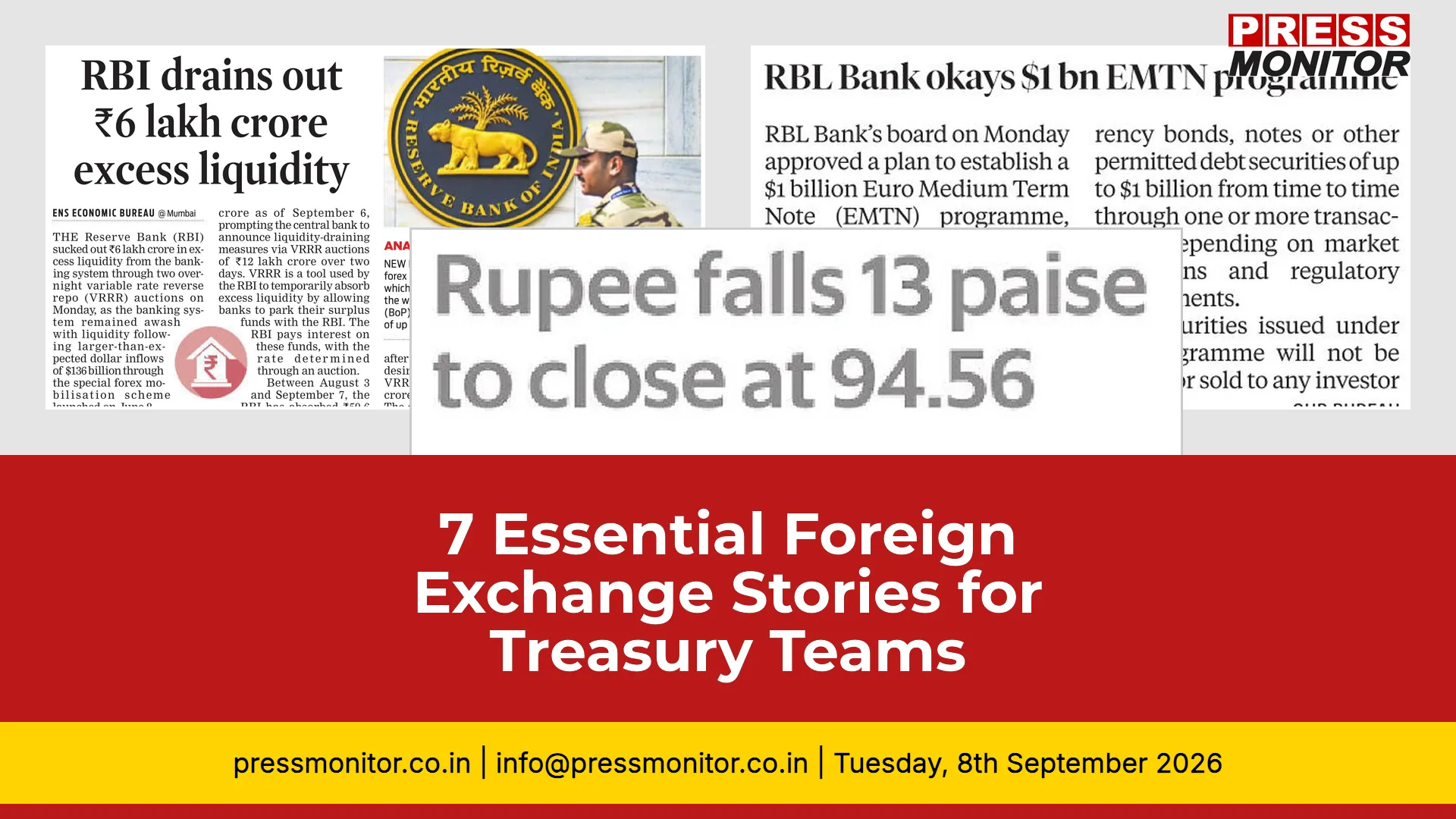
A front-page report in Morning Standard says the Reserve Bank of India sucked out over 6 lakh crore rupees in excess liquidity from the banking system through two overnight variable rate reverse repo auctions on Monday, following larger-than-expected dollar inflows of 136 billion dollars through a special forex mobilisation scheme. System liquidity stood at 11.16 lakh crore rupees as of September 6, prompting the central bank to announce liquidity-draining measures via variable rate reverse repo auctions of 12 lakh crore rupees over two days, with the largest single-day absorption coming on September 7 when 26 lakh crore rupees were removed via two overnight auctions. Economists predict the country's balance of payments could turn into a surplus of up to 100 billion dollars this fiscal, following NRI forex deposits of over 127.23 billion dollars under the concessional forex swap window, which pushed forex reserves to an all-time high of 740.8 billion dollars.
Why it matters: The RBI's aggressive liquidity absorption signals its commitment to managing surplus conditions without disrupting market stability, a move that directly affects short-term interest rates and corporate borrowing costs.
Key detail/stat: Over 6 lakh crore rupees removed through two overnight variable rate reverse repo auctions, with the largest single-day absorption of 26 lakh crore rupees on September 7. Forex reserves reached an all-time high of 740.8 billion dollars.
Source: Morning Standard, Mumbai
Next step: Monitor whether the RBI continues daily auctions or shifts to longer-tenure operations as the liquidity surplus evolves.
2. RBL Bank Approves $1 Billion EMTN Programme
A front-page report in Business Standard says RBL Bank's board approved a plan to establish a $1 billion Euro Medium Term Note programme, giving the private lender a framework to raise funds through foreign-currency bonds and other debt securities in overseas markets. Under the programme, the bank may issue up to $1 billion of securities depending on market conditions and regulatory requirements, with the securities not being offered or sold to any investor in India.
Why it matters: RBL Bank's $1 billion Euro Medium Term Note programme reflects the growing appetite of Indian private banks for offshore funding, with implications for foreign currency debt markets and capital flows.
Key detail/stat: Up to $1 billion in foreign-currency bonds and debt securities can be issued depending on market conditions and regulatory requirements, with securities not offered to any investor in India.
Source: Business Standard, New Delhi
Next step: Watch for the first issuance under this programme and compare pricing with other Indian private bank offshore deals.
3. Rupee Falls 13 Paise Against Dollar
A front-page report in Mint says the Indian rupee settled at 94.56 against the US dollar on Monday, down 13 paise from its previous close, as surging crude oil prices and global headwinds offset support from strong foreign currency deposit inflows. Forex traders noted that while the rupee saw modest gains in initial trade on foreign inflows, a negative trend in domestic equities and rising crude oil prices weighed on investor sentiment. The dollar index, which gauges the greenback's strength against a basket of six currencies, was trading at 98.90, lower by 0.27%.
Why it matters: The rupee's depreciation to 94.56 against the dollar highlights the tension between foreign inflows and commodity-driven headwinds, directly impacting import costs and corporate FX hedging strategies.
Key detail/stat: Rupee settled at 94.56, down 13 paise; dollar index at 98.90, lower by 0.27%; surging crude oil prices weighed on investor sentiment despite strong FCNR deposit inflows.
Source: Mint, Delhi
Next step: Assess whether the depreciation trend will persist given the RBI's liquidity absorption and rising global oil prices.
4. 2026 Market Report Signals Rupee Appreciation
A front-page report in Pioneer says the Indian rupee strengthened in early twenty twenty six driven by robust foreign portfolio inflows and managed inflation targets. The Reserve Bank of India maintained its benchmark interest rates to support steady economic expansion across domestic industries. Market analysts highlight improved corporate profitability and sustained investor confidence as key drivers for ongoing financial stability.
Why it matters: A counter-narrative to the day's depreciation, this report highlights the broader constructive trend for the rupee driven by foreign portfolio inflows and managed inflation, giving treasury teams a balanced view.
Key detail/stat: Rupee strengthened in early 2026 driven by robust foreign portfolio inflows; RBI maintained benchmark interest rates; improved corporate profitability and sustained investor confidence cited as key drivers.
Source: Pioneer, Delhi
Next step: Use this longer-term perspective to calibrate short-term FX risk assessments and hedging decisions.
5. Bank of America Pilots Zelle-UPI Cross-Border Payments
A front-page report in Business Standard says Bank of America is piloting a Zelle and Unified Payments Interface bridge with Early Warning Services to enable alias-based cross-border payments between the US and India. Daniel Stanton, global head of transactional foreign exchange and cross-border real-time payment and clearing at global payments solutions, views India as a strategic growth market due to its robust digital infrastructure and expanding trade role. The bank is also expanding its cross-border real-time payment solution into ten countries, including India, while exploring regulated stablecoins to accelerate settlement and improve treasury operations.
Why it matters: The convergence of traditional forex infrastructure with India's digital payments ecosystem through a Zelle-UPI bridge could reshape cross-border transaction costs and settlement times for businesses.
Key detail/stat: Bank of America is piloting alias-based cross-border payments between the US and India with Early Warning Services; expanding into ten countries; exploring regulated stablecoins for settlement.
Source: Business Standard, New Delhi
Next step: Track regulatory approvals and pilot outcomes, as this could become a model for other corridor pairs.
6. Crypto Gift Cards Bypass RBI Rules
A front-page report in Economic Times says overseas platforms turn Indian users' crypto into gift cards and vouchers that can be used in India to buy groceries, fuel, mobile recharge, food delivery, and even gold without local banks or tax authorities detecting the transactions. Users send stablecoins like USDT from private e-wallets to foreign entities in Sweden, Germany, and Singapore, which then procure gift vouchers from Indian aggregator partners, creating a round-tripping mechanism that operates outside RBI regulation since these closed-loop prepaid cards cannot be used for third-party payments or cash withdrawals. Blockchain research organisation Digital South Trust recently brought this mechanism to the notice of finance and home ministries, warning that the cross-border nature of these pathways merits further examination for regulatory oversight implications.
Why it matters: The use of crypto to buy gift cards and vouchers for everyday purchases in India creates a round-tripping mechanism that operates outside RBI regulation, raising concerns about forex, AML, and tax controls.
Key detail/stat: Users send stablecoins like USDT from private e-wallets to entities in Sweden, Germany, and Singapore, which procure gift vouchers from Indian aggregator partners; Digital South Trust flagged this to finance and home ministries.
Source: Economic Times, Delhi
Next step: Monitor whether regulators move to close this loophole and what compliance requirements may be introduced for crypto-to-gift-card pathways.
7. July Bank Margins Up 22bps
A front-page report in Economic Times says Private banks in India improved profit margins in July by widening fresh lending spreads to 3.13%, reducing deposit rates amid increased foreign currency non‑resident inflows. The rise, driven by a 22 basis‑point spread increase, highlights the banks’ reduced dependence on expensive wholesale funding.
Why it matters: The 22 basis-point spread increase in private bank lending reflects reduced dependence on wholesale funding and has direct implications for corporate borrowing costs and FX hedging pricing.
Key detail/stat: Fresh lending spreads widened to 3.13%; deposit rates reduced amid increased FCNR inflows; banks absorbed the benefit of lower wholesale funding costs.
Source: Economic Times, Delhi
Next step: Evaluate whether this margin trend will continue and how it affects corporate treasury decisions on loan tenures and currency hedging.
As these stories show, the intersection of currency markets, monetary policy, and cross-border payments is evolving rapidly. Which of these developments will have the most lasting impact on your treasury operations? Follow Press Monitor for daily print media intelligence on India's financial landscape.
