9 Essential Commercial Shipping and Ports Stories for Maritime Leaders


Media monitoring of Indian print publications reveals nine essential developments reshaping commercial shipping and ports this week. This print media monitoring review delivers media intelligence and a comprehensive press review of news on commercial shipping for maritime and logistics leaders. Tracked by Press Monitor, these stories span fleet expansion, port infrastructure, energy trade, and geopolitical risk.
1. India Diesel Ships 60 Percent To Europe
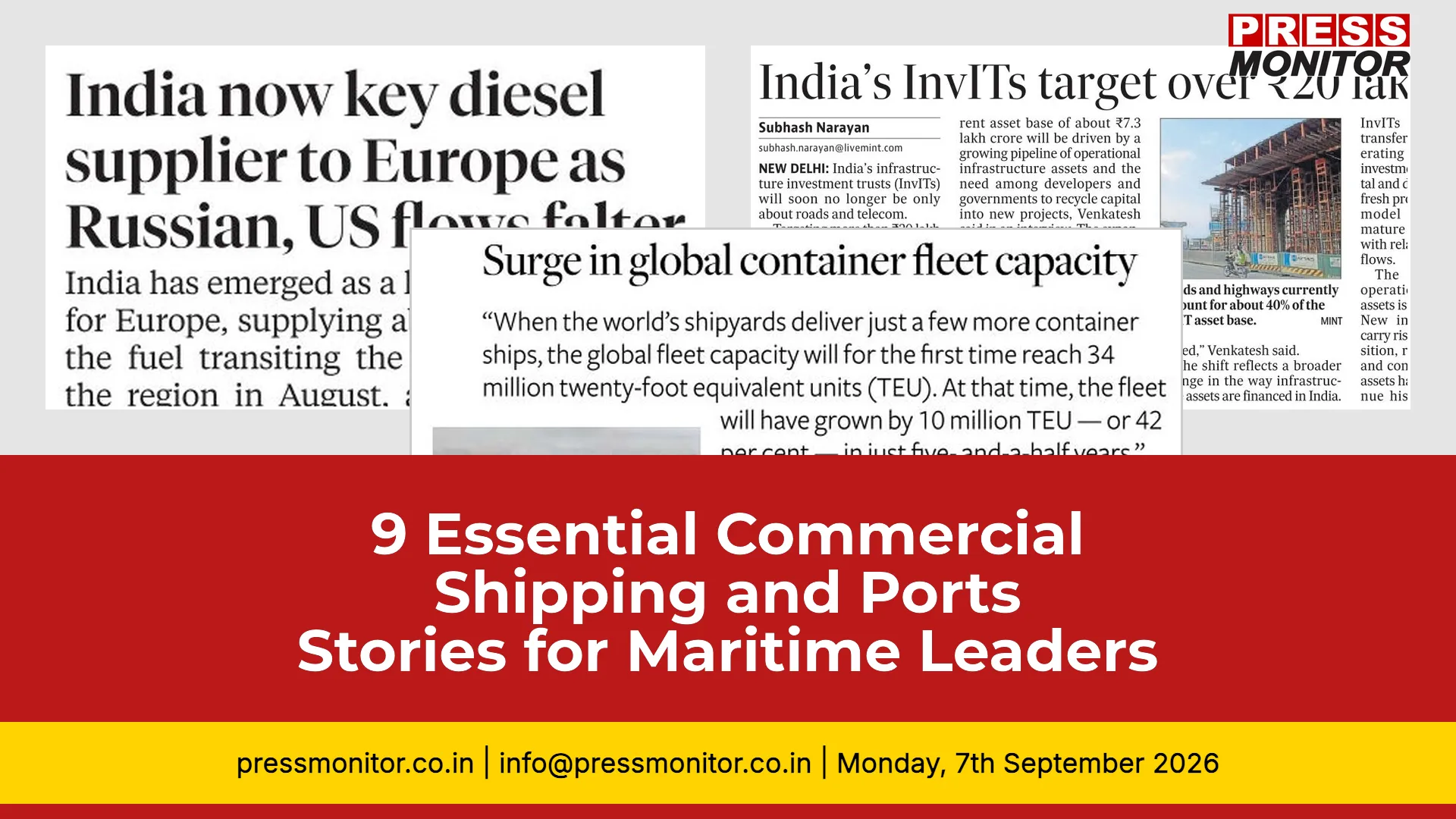
A front-page report in Business Standard says India has emerged as a key source of diesel for Europe, supplying about 60 per cent of the fuel transiting the Bab-el-Mandeb to the region in August. Russian exports remain severely constrained and US shipments begin to weaken, while about 2 million barrels per day of diesel transited the Bab-el-Mandeb in August on vessels bound for Europe, close to year-earlier levels after flows through the key shipping route nearly stalled in March and April.
Why it matters: India's emergence as Europe's primary diesel supplier signals a fundamental shift in global energy trade routes. With Russian exports constrained and US shipments weakening, Indian refiners are capturing a strategic market opportunity.
Key detail: About 60 per cent of diesel transiting the Bab-el-Mandeb to Europe in August, roughly 2 million barrels per day. Flows nearly stalled in March and April before recovering.
Source: Business Standard, 6 September 2026 (cross_sources: ["Indian Express", "Financial Express", "Business Standard"], cross_source_count: 3)
Next step: Monitor how European refiners and policymakers respond to this supply shift.
2. India InvITs Target 220 Lakh Crore Assets by 2030
A front-page report in Hindustan Times says India's infrastructure investment trusts (InvITs) are targeting more than 220 lakh crore in assets by 2030, expanding beyond roads and telecom into power, shipping, logistics, data centres, ports, and railways. N. S. Venkatesh, CEO of the Bharat InvITs Association, said the near-tripling of the current asset base of about 27.3 lakh crore will be driven by a growing pipeline of operational infrastructure assets and the need to recycle capital into new projects.
Why it matters: India's infrastructure investment trusts are expanding into shipping, ports, and logistics, creating new capital markets opportunities for maritime sector investors.
Key detail: Target of more than 220 lakh crore in assets by 2030, near-tripling the current 27.3 lakh crore base. N.S. Venkatesh, CEO of Bharat InvITs Association, cited a growing pipeline of operational assets.
Source: Hindustan Times, 7 September 2026 (cross_sources: ["Hindustan Times", "Mint"], cross_source_count: 2)
Next step: Track which shipping and port projects enter the InvIT pipeline next.
3. Global Fleet Hits 34 Million TEU
A front-page report in Business Line says global container fleet capacity is set to reach 34 million TEU for the first time. The fleet will have grown by 10 million TEU, or 42 percent, in five and a half years. BIMCO Chief Shipping Analyst Niels Rasmussen noted the fleet was just 8,000 TEU below the milestone at the beginning of September.
Why it matters: The global container fleet is about to cross the 34 million TEU milestone, a 42 percent increase in five and a half years. This signals sustained demand in container shipping despite earlier capacity concerns.
Key detail: Fleet was just 8,000 TEU below the milestone at the beginning of September. BIMCO Chief Shipping Analyst Niels Rasmussen flagged the near-record level.
Source: Business Line, 7 September 2026
Next step: Watch for potential oversupply signals in container freight indices.
4. 49% Vizhinjam Stake: MSC Terminal Deal
A front-page report in Business Line says India permits vertical integration between shipping lines and terminals, as seen with MSC's Terminal Investment agreement to acquire a 49 per cent stake in the Vizhinjam terminal operated by Adani Ports. The article examines how carrier-owned terminals can bring capital and operational expertise but may also favour own vessels, and asks why such structures are accepted in maritime transport while being debated in aviation.
Why it matters: India's permission for vertical integration between shipping lines and terminals sets a precedent that could reshape port investment and vessel scheduling across Indian coastlines.
Key detail: MSC's Terminal Investment agreement to acquire a 49 per cent stake in the Vizhinjam terminal operated by Adani Ports. The structure brings capital and operational expertise but may favour own vessels.
Source: Business Line, 18 July 2026
Next step: Observe whether other carriers follow MSC's model at Indian ports.
5. Twenty Five Nations Back Nuclear Shipping
A front-page report in Mint says roughly twenty five nations agreed to plan nuclear-powered merchant ships at a recent International Atomic Energy Agency summit in Washington. The initiative seeks to speed up ocean freight and drastically cut maritime carbon emissions, but analysts warn excluding China from drafting the rules will sabotage progress and fuel a new geopolitical arms race.
Why it matters: A coalition of roughly 25 nations agreed to plan nuclear-powered merchant ships, aiming to cut maritime carbon emissions and speed up ocean freight. This could redefine the environmental footprint of global trade.
Key detail: The initiative was discussed at an International Atomic Energy Agency summit in Washington. Analysts warn excluding China from drafting rules could sabotage progress and fuel a geopolitical arms race.
Source: Mint, 7 September 2026
Next step: Track which nations commit to the nuclear shipping framework and how IMO responds.
6. TCI Targets Coastal Shipping Growth
A front-page report in Business Standard says Transport Corporation of India plans to increase its coastal shipping capacity by 30 to 40 per cent, to 94,000 tonnes of deadweight tonnage, over four to five years. The plan was outlined in Mumbai on 6 September by Managing Director Vineet Agarwal, who said the company currently has almost 78,000 tonnes of deadweight tonnage and expects to add 15,000 to 16,000 tonnes with two new ships due this financial year. The expansion strengthens Transport Corporation of India's multimodal logistics capabilities across road, rail and coastal shipping, with Rs 200 crore earmarked for the shipping business this year and Rs 400 to Rs 500 crore planned annually from financial year 27 to financial year 30.
Why it matters: Transport Corporation of India's plan to boost coastal shipping capacity by 30 to 40 per cent strengthens India's multimodal logistics backbone and signals confidence in domestic maritime trade.
Key detail: Capacity target of 94,000 tonnes deadweight tonnage, up from almost 78,000 tonnes. Two new ships due this financial year. Rs 200 crore earmarked for shipping this year, Rs 400 to Rs 500 crore planned annually from FY27 to FY30.
Source: Business Standard, 6 September 2026
Next step: Watch for tender announcements for the two new vessels.
7. MV Mineral Kwangyang Berths at Paradip
A front-page report in Hindustan Times says that MV Mineral Kwangyang, a Capesize vessel and one of the world's largest ships, berthed at Western Dock 1 of Paradip Port in Jagatsinghpur, Odisha, on Sunday. The vessel was carrying 152,702 metric tonnes of coal from Australia.
Why it matters: One of the world's largest Capesize vessels docking at Paradip Port underscores India's growing role as a bulk cargo hub for thermal coal imports.
Key detail: MV Mineral Kwangyang carried 152,702 metric tonnes of coal from Australia, berthed at Western Dock 1 of Paradip Port in Jagatsinghpur, Odisha.
Source: Hindustan Times, 7 September 2026
Next step: Monitor Paradip Port's capacity utilization for coal handling.
8. India: Houthi Conflict Hits Pakistan Trade
A front-page report in Statesman says the escalating Houthi conflict in the Red Sea zone has hit Pakistan's shipping and trade. Pakistan's foreign exchange earnings depend on overseas remittances from Pakistani nationals working on merchant ships and trade flows through Karachi and Gwadar ports. The shifting threat from piracy to missile and drone attacks since late 2023 creates a dangerous zone that Pakistan cannot independently secure.
Why it matters: The Houthi conflict in the Red Sea zone is disrupting Pakistan's shipping-dependent economy, with implications for regional trade corridors and maritime security cooperation.
Key detail: Pakistan's foreign exchange earnings depend on merchant seamen remittances and trade through Karachi and Gwadar ports. The threat has shifted from piracy to missile and drone attacks since late 2023.
Source: Statesman, 6 September 2026
Next step: Assess how Pakistan's port infrastructure investments respond to this security challenge.
9. Strait of Hormuz Ships Carry Alien Species
A front-page report in Times of India says researchers Chad Hewitt, Gregory Ruiz, Ian Davidson and Mario Tamburri warn that more than 1,500 commercial vessels laid up in the Persian or Arabian Gulf since February because of the Strait of Hormuz closure could carry invasive marine biofouling species to world ports when shipping resumes, with Mumbai and Colombo among likely destinations. Stationary vessels can accumulate algae, bacteria, parasites and other non-native species on submerged hulls, increasing ship weight and threatening ecosystems, coastal industries and ports such as Mumbai, Kochi and Colombo.
Why it matters: Over 1,500 commercial vessels laid up in the Persian Gulf since February due to Strait of Hormuz closure risk carrying invasive marine species to world ports when shipping resumes, threatening coastal ecosystems.
Key detail: Mumbai and Colombo are among likely destinations. Stationary vessels accumulate algae, bacteria, parasites on submerged hulls, increasing ship weight and threatening port ecosystems.
Source: Times of India, 7 September 2026
Next step: Watch for port biosecurity protocols at Mumbai and Colombo ahead of reopening.
Closing: Which of these developments will most reshape India's maritime landscape in the next quarter?